On record – Rupert Marshall-Luck: Soul (TUTL)

Rupert Marshall-Luck (violin)

Baek Afturundirgero
Blak Alvarann; Bohmerlands Dronning
Debess Variations
Rasmussen Echoes of the Past

TUTL FHR90 [52’25”]

Producer Rupert Marshall-Luck
Engineer Theodor Kapnas

Recorded 2-3 April 2019

Written by Richard Whitehouse

What’s the story?

The violinist Rupert Marshall-Luck takes time out from his extensive commitment to British music (and no less extensive schedule for the EM Records label) for this revealing collection of unaccompanied pieces by composers who were born or are resident in the Faroe Islands.

What’s the music like?

Although a self-governing region of Denmark across more than seven decades, classical or art music was slow in taking root in the Faroes, its music-making almost entirely vocal until the 1960s. As with its northerly neighbour Iceland, the creative scene has subsequently been transformed to the extent that these islands currently enjoy a profile out of all proportion to their population in terms of its range and diversity. Soul may only scratch the surface of this musical wealth, but it also underlines the potential of what might appear a restricted medium.

This disc sets off unequivocally with Echoes of the Past by Sunleif Rasmussen (b1961), an eventful sequence of episodes such as makes full use of the violin’s potential for heightened expression and meaningful display; all the while given focus by a trajectory as unfolds from combative unease towards a searching if tenuous repose. Quite a contrast with Variations for Solo Violin by Edvard Nyholm Debess (b1960), its traditional Faroese hymn-tune providing the basis for six variations which draw on a range of textural and emotional shading, without losing sight of the intrinsic character of the theme before its affecting return. More discursive in its content is Afturundirgero by Kari Baek (b1950), evoking a seascape in which turbulent cross-currents are vividly conveyed through harmonic clashes by turns soulful and astringent.

The remaining two pieces are both by Kristian Black (b1947), born in Denmark but resident over many years in Torshavn where he has been a prime mover in the emergence as well as dissemination of Faroese classical music – not least via his enterprising label TUTL Records. Inspired by a ballad about the Danish queen, Bohmerlands Dronning unfolds as a rhapsody in which various aspects of the ballad can be heard to permeate the content and influence the direction of what is eloquent and ultimately fatalistic music. Blak’s Alvarann also takes its cue from a Faroese ballad, though here progress is audibly more quixotic as the violin charts a course from subdued anticipation, via the steady accumulation of energy, to an impetuous culmination whose unbridled virtuosity leaves no mean drama and even anguish in its wake.

Does it all work?

Yes, not least in that these five pieces amount to a programme the sum of which is greater than its parts and which – given the relatively short playing-time – is best experienced as a whole. A tribute, then, to the resourcefulness of the composers as well as to Marshall-Luck, who renders each work with that combination of interpretative insight and technical finesse familiar from his performances and recordings of British music. More pieces for violin solo, or with piano accompaniment, would be worth encountering – maybe as a follow-up disc?

Is it recommended?

Indeed. The Faroes are a nexus of creativity within the European cultural framework, as this disc makes plain.

Readers can check out the Summartonar Festival of Contemporary Music here, and the TUTL website by clicking here

Stream

Buy

For more information on Rupert Marshall-Luck and on this release, visit his artist website

Wigmore Mondays – Pavel Kolesnikov & Samson Tsoy, Colin Currie & Sam Walton: Music for pianos and percussion

Pavel Kolesnikov and Samson Tsoy (pianos), Colin Currie and Sam Walton (percussion) (pictured above in rehearsal, credit unknown)

Wigmore Hall, Monday 2 December 2019 (lunchtime)

You can listen to this concert on the BBC Sounds app here (opens in a new window)

Review and guide by Ben Hogwood

A truly memorable concert with many more instruments than performers! The Wigmore Hall stage was straining at the seams for this concert, with a daunting battery of percussion positioned behind two lidless Steinway pianos.

As BBC Radio 3 presenter Fiona Talkington confirmed, the two pianists and their percussion counterparts had only met the previous week. This is where music making can be so thrilling, for chemistry had been established and all four performers clearly enjoyed the concert experience.

That much was clear from the first, atmospheric notes of Ravel’s Rapsodie espagnole, given in an arrangement that seems to have been the composer’s own, retaining percussion parts from the orchestral original. The Prélude à la nuit (1:49 on the broadcast link below) immediately evokes the heady Mediterranean scene, laced with a background tension that was occasionally released in faster music, thrumming like an ensemble of guitars. Ravel’s orchestral concepts are easily discerned here, with the players very closely attuned. The Malagueña (6:02) is suitably enchanting, while the Habanera (8:05), with lovely detail on castanets and xylophone, wears its Carmen influences on its sleeve. Finally the dazzling Feria (10:52), brilliantly performed, wraps up our colourful Spanish sojourn with a flourish.

The percussionists then had a break while Pavel Kolesnikov and Samson Tsoy gave us a rarity in the form of Britten’s Two Lullabies. Written for a concert with South African pianist Adolph Hallis, they are barely known – but carry a number of the 22-year old composer’s musical trademarks. The first lullaby is as you would expect, gently rocking like a boat as the listener’s head nods towards sleep (19:07) but the second, Lullaby for a retired colonel (23:20), is an ‘anti-lullaby’, seemingly written to annoy its subject into wakefulness with renditions of The British Grenadiers, Men of Harlech, the Marseillaise and the Last Post. This performance caught the gracefulness and cheek respectively.

The main act, if you like, was an extraordinary performance of an extraordinary piece. Even now, 82 years on from its Swiss premiere, there are few pieces as original as Bartók’s Sonata for two pianos and percussion, one of the standout pieces of 20th century repertoire but one of the least performed in that class, due to its unusual scoring.

This performance gave us the chance to appreciate Bartók’s unique sound world, from unhinged Allegros to daringly slow night music where nobody dare move a sinew. It begins in the depths (28:10) with the ominous rumbling of timpani and cold piano octaves. This is the small cell from which the piece grows, angular lines on the piano complemented by strident timpani. As always in Bartók the music is incredibly atmospheric, and when it breaks out into the faster music (from 31:30) an almost primal energy is released. Terrific playing from all four, who had only started playing this music together the previous week – with a stunning ending in pure C major.

The second music (42:13) is a classic example of Bartók’s night music. The brushes on the snare drum bring the cooler evening air into sharp focus, with an even colder unison on piano in response. This performance brings out these incredibly descriptive aspects of the writing, each detail carefully observed and pointed until – as in many slow movements from the Hungarian composer – the ground suddenly falls away and the music tears off at a pace. Soon enough a peace of sorts is restored, though again there is an eye left open just in case.

The third and final movement is the sound of unbridled joy, heralded by a rapid shift to C major and a terrific burst of energy. The xylophone (Sam Walton in this performance) has terrific clarity in its theme, which has sardonic overtones Shostakovich would have enjoyed, while the interplay between the pianos is superbly balanced. The percussion includes a driving part for both bass drum and timpani, where Bartók uses glissando to create an evocative twang, often in quieter passages. These were superbly judged by Colin Currie. The piece ends in unexpected quiet, the purity of C major ensuring it has the ideal place to rest after considerable exertions.

A truly great performance, this, one borne of musical instinct and chemistry that found all four performers going hell for leather in the quick music but exercising the utmost restraint to bring Bartók’s vivid colours through when all was quiet. Make sure you listen to it!

Repertoire

This concert contained the following music (with timings on the BBC Sounds broadcast in brackets):

Ravel Rapsodie espagnole (1907-8) (1:49)
Britten Two Lullabies (1936) (19:07)
Bartók Sonata for two pianos and percussion (1937)

Further listening

The music from this concert can be heard in leading available versions on Spotify below:

Colin Currie and Sam Walton have recorded the Bartók previously, with pianists Cédric Tiberghien and François-Frédéric Guy. Details on that recording can be found together with soundbites at the Hyperion website:

Bartók wrote three pieces for Paul Sacher while in Switzerland – the Sonata as heard here, the remarkable Music for Strings Percussion and Celesta and the more rustic, folksy Divertimento for string orchestra. Both those pieces can be heard below as part of an album from Ádám Fischer and the Hungarian State Symphony Orchestra, which also includes the ballet suite from The Wooden Prince:

Live review – Sara Hershkowitz, BBC Scottish Symphony Orchestra / Antony Hermus – The Ring: An Orchestral Adventure

Sara Hershkowitz (coloratura soprano, below), BBC Scottish Symphony Orchestra / Antony Hermus (above)

City Halls, Glasgow
Thursday 28 November 2019

Haydn Symphony no.22 in E flat major ‘Philosopher’ (1764)
Ligeti Mysteries of the Macabre (1974-77; 1992)
Wagner arr. Henk de Vlieger The Ring: An Orchestral Adventure (1991)

Written by Ben Hogwood

An evening of musical philosophy through three very different viewpoints, held together by superb orchestral performances and the artistry and energy of Antony Hermus, making his conducting debut with the BBC Scottish Symphony Orchestra.

On this evidence it has the makings of a fruitful musical relationship. Certainly Haydn‘s Symphony no.22 in E flat major, known as the ‘Philosopher’, was carefully prepared and ideally executed. With just 26 players on the platform, and with most of them strings, the spotlight fell on the pair of horns and cor anglais players. They added unique colours and a doleful atmosphere to the profound opening Adagio, which had a steady accompanying tread. The harpsichord of Andrew Forbes was perfectly judged, complementing Haydn’s harmonic thoughts.

Orchestra leader Laura Samuel helped propel a second movement of earthy substance, which gave way to a charming Menuetto before a lively Presto wrapped things up, Haydn’s wit and inspiration in abundance once again. This was the second Haydn symphony in successive days for Arcana, after the CBSO and Riccardo Minasi’s persuasive reading the previous night. From experience a Haydn symphony a day really can go a long way – and indeed if you did two a week you would have enough for a whole year! Something definitely worth considering.

Back to the concert, and a complete change of tack for Ligeti’s uproarious and outrageous Mysteries of the Macabre, a concert piece lifted from his only opera Le Grand Macabre. And what a show it was from Sara Herskowitz, who has lived with this music some time, even on occasion dressing as Donald Trump to deliver it! Here – no doubt with the presence of BBC recording and streaming in mind – she gave Ligeti’s lines in the most sparkling of silver dresses. To say she owned the platform would be an understatement, for hers was a magnetic presence, often hilarious but frequently dazzling in its utter command of Ligeti’s demands. Using a large bottle of Irn Bru as a prop, she fair brought the house down in a performance that has to be seen to be properly appreciated. The virtuosi of the BBC Scottish Symphony Orchestra were her equal.

Another radical change of subject and perspective saw us experience the whole of Wagner’s Ring Cycle in just over an hour after the interval. The man responsible for this orchestra-only compression is Dutch composer Henk de Vlieger, who has made a remarkable piece of music containing not just the best orchestral excerpts from the four operas but the vocal and thematic music of substance too. With some tasteful composing of his own to complement Wagner’s epic he has created a near-continuous piece of music that, while never expecting to eclipse the impact of the operas, is a wholly effective concert piece.

It helps when given the sort of commanding performance The Ring received here. The brass were simply superb – trumpets, trombones, Wagner tubas, tubas and horns responding to the considerable demands with relish, creating some wonderful sonorities while they did so. The Ride of the Valkyries was an early highlight, the theme given an appropriately majestic profile, while Alberto Menéndez Escibano‘s horn solo for Siegfrieds Heldentat, given from out the back of the hall, was brilliantly done.

The BBC Scottish strings and wind were on the same exalted level, and the Feuerzauber (Magic Fire Music) and Waldweben (Forest Murmurs) were wholly evocative and enchanting. Hermus brought a keen dramatic instinct to his conducting, including rubato where appropriate but also making the silences really tell. Even before the first note sounded he secured complete stillness in the hall, setting the tone for the performance that followed – and when other silences occurred they were impeccably observed by the audience. There was a terrific, ballsy account of Siegfried und Brunnhilde, brass again to the fore, while the violins shone in their unison passages throughout.

Antony Hermus paced the whole ‘adventure’ perfectly, meaning this ‘bite size’ Ring cycle clocked in at around 65 minutes. Do catch this concert online if you can over the next few weeks, for it was a really well constructed programme of very differing but inspiring musical works. From the elegant and sometimes earthy Haydn, through the compressed but outrageous Ligeti to the grand and spectacular Wagner, there was something for everyone.

You can hear this concert on BBC Radio 3 from the evening of Tuesday 3 December by clicking here

Further listening

You can listen to the music from this concert on the Spotify playlist below, made up of some leading recordings of the works played.

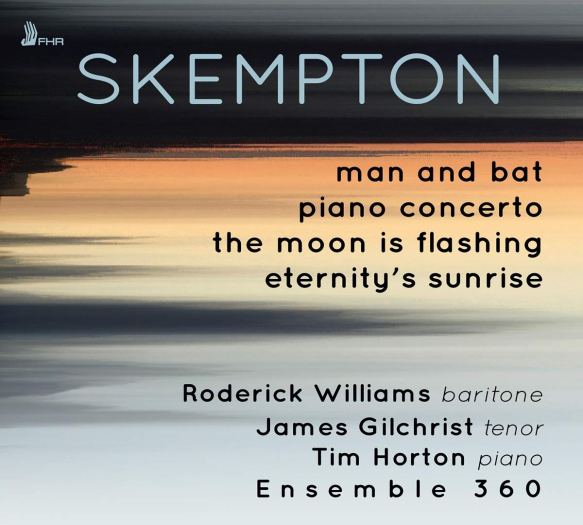
On record – Skempton: Man and Bat, Piano Concerto & The Moon is Flashing (First Hand Records)

Howard Skempton
Eternity’s Sunrise (2003)
The Moon is Flashing (2007, arr. 2018)
Piano Concerto (2015, arr. 2018)
Man and Bat (2017)

James Gilchrist (tenor, The Moon is Flashing); Roderick Williams (baritone, Man and Bat); Tim Horton (piano, Piano Concerto); Ensemble 360

First Hand Records FHR90 [70’25”]

English texts included
Producer Tim Oldham
Engineer Phil Rowlands

Recorded 20 July 2019 at Upper Chapel, Sheffield (Man and Bat), 5-7 February 2019 at All Saints’ Church, East Finchley, London (others)

Written by Richard Whitehouse

What’s the story?

A welcome addition to the recorded representation of Howard Skempton (b1947), including two pieces specially arranged by the composer for reduced forces and also two pieces written specifically for ensemble, all performed by artists closely associated with Skempton’s music.

What’s the music like?

Vocal writing has been a mainstay of Skempton’s in over recent years, the two largest pieces here setting poems by D.H. Lawrence. The term ‘setting’ is used advisedly, given Skempton’s approach is not one of expressive interpretation; rather one in which those individual words articulate a vocal line which, in its turn, articulates the instrumental writing so as to provide context.

Such is the premise on which Man and Bat operates – Lawrence’s highly descriptive, indeed discursive poem treated as a formal framework around which the ensemble unfolds a dialogue of constantly varying (not necessarily developing) motifs and phrases as provide an aural equivalent to what is being described. A not dissimilar approach is pursued in Snake, but here the musical treatment is audibly more static as befits a poem centred upon thought rather than action. This provides the concluding stage in a triptych preceded by a setting of Chris Newman’s self-deprecating A Day in 3 Wipes then, before it, the quizzical humour of Skempton’s own The Moon is Flashing which affords this diverse cycle its overall title.

The other two pieces are both instrumental, while being highly differentiated in themselves. Skempton has used generic titles only sparingly, his Piano Concerto predictable only in its avoidance of obvious models or precursors – the five movements (each lasting between two and four minutes) amounting to a series of vignettes in which the soloist variously combines with the ensemble, here a string quartet rather than string orchestra as originally conceived. Its title might suggest a natural piece with which to open, but Eternity’s Sunrise also makes for a persuasive rounding-off – a perfectly proportioned entity which amounts to a sequence of variations on an undulating theme apposite to the lines from William Blake that provided inspiration. Once again, Skempton’s writing is affecting through its sheer self-effacement.

Does it all work?

Very much so. From an output dominated by miniatures for the piano or accordion (his own instrument), Skempton has amassed a sizable and ever more varied catalogue from which the present release offers a judicious selection. It helps when the performances are so responsive to those qualities of emotional restraint and attention to detail that define the essence of this music. Roderick Williams and James Gilchrist can be relied upon for unforced insight, as too can the underrated pianist Tim Horton and the grouping of soloists which is Ensemble 360.

Is it recommended?

Indeed. Skempton now enjoys a substantial discography which features a number of releases devoted to his music (most notably those on the NMC label), to which should now be added this latest from the always enterprising First Hand Records. The sound has all the focus and detail necessary with this composer, whose succinctly informative notes on each piece are complemented by anecdotal observations from each of the soloists. Those who are new to Skempton will find this an ideal way into his compositional ethos, where little is as it seems.

Stream

Buy

For more information on this release and to purchase in multiple formats visit the Presto website

On record – Shostakovich: The Bedbug; Love and Hate (Naxos)

Shostakovich
The Bedbug Op.19 – complete incidental music (1929)
Love and Hate Op.38 – complete film-score (1935)

Mannheim Opera Chorus / Dani Juris; Deutsche Staatsphilharmonie Rheinland-Pfalz / Mark Fitz-Gerald

Naxos 8.574100 [58’54”]

Russian transliterations and English translations included
Producer Roland Kistner
Engineer Bernd Nothnagel

Recorded 18-21 February 2019 at Philharmonie, Ludwigshafen, Germany

Written by Richard Whitehouse

What’s the story?

Naxos continues its ground-breaking traversal of the film and theatre music by Shostakovich with this coupling of scores long unheard as originally conceived, thanks in part to the work of Mark Fitz-Gerald in having reconstructed these from extant sketches and soundtracks.

What’s the music like?

Shostakovich’s earliest theatre score was for The Bedbug, a scatological comedy by the ill-fated Vladimir Mayakovsky whose two parts were set in the then-present and 50 years later in 1979. The main items include several astringent dance numbers audibly akin to Stravinsky and Weill, while others were recycled for later dramatic projects (most notably the Wedding Scene [track 6] which soon became the Overture to Erwin Dressel’s opera Armer Columbus), with resourceful usage of such instruments as saxophone, mandolin and musical-saw. An air of sardonic detachment pervades this music which doubtless contributed to the production’s brief theatrical run and its subsequent oblivion, but the confidence and panache with which Shostakovich acquits himself can hardly be gainsaid. Although the parodying of such Soviet archetypes as firemen and pioneers soon became taboo in a Soviet Union beholden to Stalin, the experience gained served the composer well in subsequent ballets and revues, so making the present score a significant harbinger for what was to follow over the ensuing five years.

That said, it is the score for Love and Hate that leaves the stronger impression here. Directed by Albert Gendelshtein, this one of several films resulting from Soviet-German cooperation in the interwar period and which ceased in 1937 when the gulf between Stalin’s and Hitler’s ‘socialism’ became unbridgeable. In its quirkily compelling amalgam of post-expressionist and socio-realist elements, this film is more than mere historical curio – as Shostakovich’s music makes plain in an expressive directness evident from the outset. Most notable in this respect is the song How Long Will My Heart Ache and Moan?, initially allotted to mezzo and female chorus [track 19], and a series of searchingly descriptive pieces as culminates in the surging intensity of The Funeral [track 33]. It is at such junctures that the more elegiac aspect of the Fifth Symphony (two years hence) comes into focus, making one regret that no suite was previously compiled. Maybe this will now prove possible given the score’s timely availability, so enabling a vital link in its composer’s evolution to be properly appreciated.

Does it all work?

Yes, not least owing to the insight of Fitz-Gerald’s realizations with regard to those missing or fragmentary sections – where he captures the Shostakovich spirit in full measure – as also to the commitment of the Deutsche Staatsphilharmonie Rheinland-Pfalz in realizing the often wilful while always arresting nature of the composer’s inspirations. Forward but not unduly immediate sound, with extensive annotations by Fitz-Gerald, musicologist Gerard McBurney and Soviet cinema authority John Leman Riley, further enhance the attractions of this release.

Is it recommended?

Indeed, and it is to be hoped Fitz-Gerald will be continuing his exploration of this one facet of Shostakovich’s output as is still inadequately covered in terms of publication or recording. Several of the composer film and theatre scores from the 1930s still await such rehabilitation.

Stream

Buy

For more information on this release and to purchase in multiple formats visit the Naxos website, with an article on the recording here