Sebastian Rochford & Kit Downes @ Kings Place. Photo (c) John Earls
As part of Arcana’s 10th birthday celebrations, we invited our readers to contribute with some of their ‘watershed’ musical moments from the last 10 years.
Regular contributor John Earls writes:
A Short Diary consists of seven short piano pieces composed by Sebastian Rochford in memory of his father, the poet and academic Gerard Rochford, who died in 2019. An eighth piece was composed by his father. It is a profound and moving expression of loss. Rochford’s drumming combines beautifully with Kit Downes‘ piano playing.
When I heard it my own father had a few months before been diagnosed with Alzheimer’s disease (I am still a co-carer for him). This has been both an uplifting and consoling collection for me.
Carlos Simon Fate Now Conquers (2020) Ibert Flute Concerto (1932-33) Prokofiev Symphony no.7 in C# minor Op.131 (1952)
Studio 1, BBC Maida Vale Studios, London Tuesday 4 February 2025 (2:30pm)
by Ben Hogwood Photo of Vinay Parameswaran (c) Roger Mastroianni, courtesy of The Cleveland Orchestra
For this concert linking seventh symphonies, the BBC Symphony Orchestra made their first public appearance with conductor Vinay Parmeswaran.
They began with music from Vienna via America, Carlos Simon effectively remixing the second movement of Beethoven’s Symphony no.7 and applying some fresh paint of his own. The piece was inspired by an entry Beethoven made into his journal in 1815, and takes its lead from “the beautifully fluid harmonic structure” of the symphony’s second movement, Simon composing “musical gestures that are representative of the unpredictable ways of fate”. Though Beethoven’s structure could still be glimpsed, it was viewed through music incorporating the language of Sibelius, Copland and John Adams to create a relatively familiar but ultimately thrilling orchestral vista. Simon’s development of the material was enjoyable to witness, though the sudden end felt underpowered in context. Nonetheless, here is a composer to investigate further.
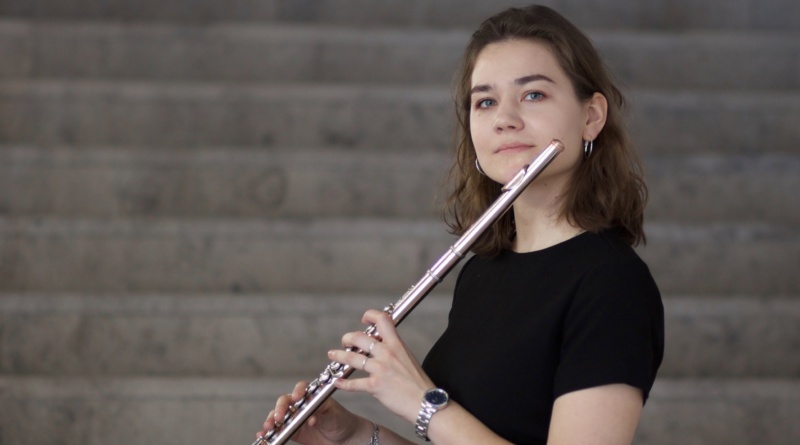
Ibert’s Flute Concerto is one of the instrument’s calling cards from the 20th century, though is heard in concert rather less than it could be. Here it was performed by Elizaveta Ivanova, a flautist recently recruited to the BBC New Generation Artists programme and making her first appearance with the BBC Symphony Orchestra. She brought to the piece a welcome freshness, rising to the challenge of Ibert’s virtuoso solo part while including stylish phrasing and thoughtful dialogue with the orchestra. The graceful second movement Andante is the emotional centre of the concerto, and recalls the equivalent movement in Ravel’s Piano Concerto in G major in its beauty and softer-hearted sentiments. This was in vivid contrast to the outer movements, whose syncopations took the music closer to New York rather than Paris, Ibert’s cosmopolitan style enjoyed by the reduced BBC SO forces as much as by the athletic soloist. A fine performance, and a welcome revival for a composer whose colourful orchestral music and abundant melodies are a tonic.
Melodies, bittersweet or otherwise, are at the core of Prokofiev’s late Symphony no.7, written the year before his death. In a short interview section Parmeswaran implied the work was ‘softer’ than its predecessors, but there were no shrinking violets to be found as the second movement reached a juddering conclusion. Here Prokofiev’s attempts to write a competition winner, simultaneously pleasing Stalin, were affected by his own personal angst, for he was living in poverty at the time.
The weighty bass of the first movement and graceful cello theme of the third movement, marked Andante espressivo, were indicators of the emotional range of the symphony, but the biggest tune, heard from the full orchestra, was the second theme of the first movement, a soaring and winsome melody that returns to crown the final movement. Under Parmeswaran’s affectionate direction it was beautifully judged, though he was careful to ensure the final word in the symphony carried equal impact, the strange ticking of the percussion indicating the creeping passage of time. The symphony ended as it should, its smiling countenance compromised by a frown.
Listen
This concert was recorded for future broadcast on BBC Radio 3. A link will appear here when that becomes available.
Published post no.2,433 – Wednesday 5 February 2025
The London Jazz Orchestra (full line-up below) / Scott Stroman
The Vortex, London, 2 February 2025
by John Earls. Photo credits (c) John Earls, picture of Kenny Wheeler (c) Scott Stroman
Kenny Wheeler (1930-2014) was a UK-based, Canadian born composer and trumpet and flugelhorn player who left a unique and significant mark on jazz and particularly UK and European jazz. He composed and played in a number of formats and was a master of writing for the big band and jazz orchestra.
Wheeler was a founder member of the London Jazz Orchestra (now in its 34th year), one of the best and most exciting big bands around. So it was more than fitting that the LJO paid tribute to what would have been his 95th birthday with this performance of his Long Suite 2005, written for his 75th birthday tour.
Wheeler’s tunes and arrangements are wonderfully and distinctively melodic and this concert was fine testimony to that quality. Yet they often also have a melancholy element to them which can be strangely uplifting. He is supposed to have said “Sad music makes me feel happy”and this is an attribute he delivers frequently and brilliantly.
I also recall jazz bassist Dave Holland at a Kenny Wheeler tribute concert in 2015 citing another classic Wheeler quote: “I don’t say much. And when I do I don’t say much”. I guess he said it all in the music.
To my knowledge this suite has still to be recorded and released, which is a real shame. It is a continuous piece of some 40 minutes that meanders beautifully without losing thread and combines some glorious ensemble unity with solo virtuosity.
Kenny Wheeler (c) Scott Stroman
For this performance Miguel Gorodi sat in the ‘Kenny Wheeler chair’, playing the flugelhorn admirably. Brigitte Beraha, sitting next to him, provided gorgeous vocal accompaniment. Stand out solos included trombone, saxophones and double bass. There was crisp and articulate drumming throughout from the LJO debutante drummer.
Special mention should go to trumpeter Henry Lowther, an LJO stalwart and longstanding collaborator of Wheeler’s (I have previously noted how both Lowther and Wheeler played trumpet on Nick Drake’s Hazey Jane II), who is not just a solid LJO force but something of a Wheeler encyclopaedia.
A shout out too to saxophonist Pete Hurt who does so much in transcribing the work of Wheeler (and others) and keeping it alive, a fact acknowledged by LJO Musical Director, Scott Stroman, whose own enthusiasm whilst conducting this performance saw him nearly jump through the ceiling.
The first set of this concert demonstrated that the LJO still has significant composing talent in its ranks with exciting new music by pianist Alcyona Mick and bassist Calum Gourlay. It was great to see and hear a concert that contained such a thread of continuity in what the LJO does.
The music of Kenny Wheeler deserves to always be heard. I’m sure that as long as the London Jazz Orchestra is around it will be.
The London Jazz Orchestra line-up for this concert, directed by Scott Stroman, was:
Miguel Gorodi (solo part in Long Suite 2005), Luke Lane, Ed Hogben, Henry Lowther, Andre Cannier (trumpets); Martin Gladdish, Richard Pywell, Richard Foote (trombones), Yusuf Narcin (bass trombone); Matt Sulzmann (alto and soprano sax), Alyson Cawley (alto sax and clarinet), Tori Freestone (tenor sax and flute), Pete Hurt (tenor sax), Mick Foster (baritone sax and bass clarinet)
with Brigitte Beraha (vocals), Joe Garland-Johnston (guitar), Alcyona Mick (piano), Calum Gourlay (bass), Luke Tomlinson (drums)
John Earls is Director of Research at Unite the Union. He posts on Bluesky and tweets / updates his ‘X’ content at @john_earls
Some Days Are Better: The Lost Scoresby Kenny Wheeler Legacy, featuring the Royal Academy of Music Jazz Orchestra and Frost Jazz Orchestra, was released by Greenleaf Music on 31 January 2025.
Clyne Overflow (2020) Mozart Serenade no.10 in B flat major K361 ‘Gran Partita’ (1781)
Town Hall, Birmingham Sunday 26 January 2025 (3pm)
Reviewed by Richard Whitehouse
An interesting and worthwhile strand in the City of Birmingham Symphony Orchestra’s current season is the series of Sunday afternoon programmes focussing on each of the orchestra’s sections. Last November brought the strings for a perceptive account of Bach’s Goldberg Variations, as arranged by Dmitry Sitkovetsky and the present recital duly centred upon the woodwind in what was dominated – not unreasonably so – by a performance of Mozart’s epic Gran Partita.
Still the finest and probably longest work ever composed for wind ensemble, it also remains the canniest example of ‘functional’ music raised to a level such as transcends its immediate purpose. Not the least of its virtues is the way in which its orchestration – comprising pairs of oboes, clarinets, basset horns and bassoons along with four horns and double-bass – suggests timbral and textural possibilities as profound as they are far-reaching. Put another way, this is ‘Harmoniemusik’ which makes of a localized and even provincial genre something universal.
Such a quality was rarely less than present in this performance. Right from its trenchant yet never portentous introduction, the opening Allegro found an enticing balance between poise and impulsiveness matched by that between tutti and ensemble passages. The first Menuetto was notable for the winsome elegance of its second trio, then the ensuing Adagio yielded no mean pathos without risk of sentimentality at a flowing tempo abetted by that effortlessness of dialogue which proved a hallmark of this movement as of the performance taken overall.
Although less overtly characterful than its predecessor, the second Menuetto did not lack for personality and while the Romanze feels the least essential part of the overall conception, it still made for a pertinent entrée into the Tema con variazioni. This longest and most varied movement also encapsulates the work overall in its expressive contrasts which were to the fore here – the last variation preparing unerringly for a final Allegro whose relative brevity was belied by a drive, even forcefulness that propelled the whole work to its decisive close.
It was a testament to the excellence of these musicians that one never suspected the absence of any guiding hand, for all that guest first oboist Nicholas Daniel could be seen encouraging the players whenever his part permitted. Neither was there any sense of the latter being other than integral to the overall ensemble, such was the underlying felicity and finesse with which it conveyed the depths of what must surely rank among its composer’s greatest achievements. Not a bad way, moreover, for the CBSO’s woodwind to savour its occasion ‘in the spotlight’.
The programme had commenced just over an hour earlier with Overflow, a short but eventful piece where Anna Clyne draws inspiration from Emily Dickinson’s poetry (and, in turn, that by Jelaluddin Rumi) in music which treads an audibly viable balance between the ruminative and capricious. It made an understated showcase for the CBSO woodwind, whose brass and percussion colleagues are heard in the next of these recitals when Alpesh Chauhan directs a varied programme climaxing in Pictures at an Exhibition arranged by the late Elgar Howarth.
List of players: Marie-Christine Zupancic and Veronika Klirova (flutes), Nicholas Daniel and Emmet Byrne (oboes), Oliver Janes and Joanna Paton (clarinets), Anthony Pike and Steve Morris (basset horns), Nikolaj Henriques and Tony Liu (bassoons), Elspeth Dutch and Neil Shewan (horns), Julian Atkinson (double bass)
Benjamin Grosvenor (piano, below), City of Birmingham Symphony Orchestra / Robert Treviño (above)
Mozart Symphony no.38 in D major K504 ‘Prague’ (1786) Mendelssohn Piano Concerto no.1 in G minor Op.25 (1830-31) Brahms Symphony no.1 in C minor Op.68 (1868-76)
Symphony Hall, Birmingham Thursday 23 January 2025 (2.15pm)
Reviewed by Richard Whitehouse Picture of Benjamin Grosvenor (c) Jenny Bestwick
Having worked with the City of Birmingham Symphony Orchestra on numerous occasions, Robert Treviño was well placed to take on a programme which was pretty demanding for all that its constituents were hardly unfamiliar – its two symphonies repertoire works to the core.
His cycle of Beethoven symphonies (Ondine) among the best of recent years, it was perhaps surprising to find Treviño boxing himself in interpretively with Mozart’s Prague symphony. If the first movement’s Adagio introduction was imposingly wrought, the main Allegro was taken at too consistently headlong a tempo for its intricacy of textures and its range of expression fully to register, though the CBSO admirably stayed the course. Nor was the central Andante wholly successful, the pervasiveness of its five-note motif not matched by the diversity of emotional responses to which this is put, with the development sounding harried rather than impetuous. Best was a final Presto that was a sizable-enough counterpart (first- and second-half repeats taken) to what went before, and its élan maintained through to the effervescent closing bars.
Fresh from having taken on Busoni’s epic Piano Concerto (most notably at last year’s Proms), Benjamin Grosvenor (above) met the very different challenge of Mendelssohn’s First Piano Concerto with comparable conviction. Written quickly but with nothing left to chance, this takes up the precedent of Weber’s Konzertstück (which, completed barely a decade earlier, had featured at Mendelssohn’s public debut) by eliding its individual movements into a succinct and cohesive whole. Vividly as Grosvenor projected its opening Molto allegro – no lack of ‘con fuoco’ – he came into his own with an Andante whose dialogue of piano and lower strings was meltingly rendered, then a final Presto both dextrous and exhilarating. The CBSO made a fine recording with Stephen Hough a quarter-century ago (Hyperion) and this was at the very least its equal.
Even so, it was Brahms’s First Symphony as proved the highlight of this afternoon’s concert. Whereas his Mozart had felt unduly beholden to ‘authentic’ concepts, Treviño was entirely his own man here – not least the opening movement whose implacable introduction linked effortlessly into an Allegro trenchantly characterized and with a cumulative impetus such as carried over into the fatalistic coda. Its eloquence never laboured, the Andante featured some felicitous woodwind and a poised contribution from guest leader Nathaniel Anderson-Frank.
Having had the measure of what feels more intermezzo than scherzo, pensive and playful by turns, Treviño steered a secure and always purposeful course through the lengthy finale. Its introductory Adagio preparing stealthily for a fervent if not over-bearing take on its majestic ‘alpine’ melody, the main Allegro was unerringly paced so that its formal elaboration never risked being discursive. Nor was the CBSO found wanting in a peroration that endowed the main motivic ideas with a resolution the more powerful for having been so acutely gauged.
There can be few seasons when Brahms’s First Symphony does not feature in this orchestra’s schedule, but Treviño’s was surely among the most impressive in recent memory; confirming demonstrable rapport between him and the CBSO one hopes will be renewed before too long.