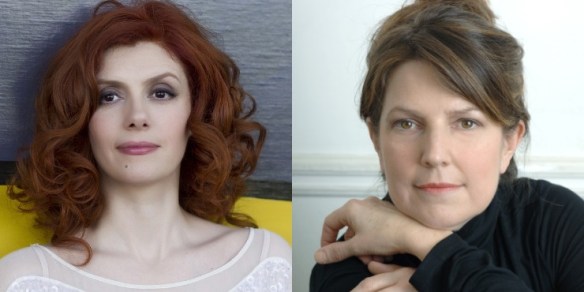
Patricia Petibon and Susan Manoff at the Wigmore Hall – La Belle Excentrique

petibon-manoff

Patricia Petibon (soprano) and Susan Manoff (piano) – La Belle Excentrique, Wigmore Hall, Wednesday 16 December 2015

Review by Ben Hogwood

It isn’t often you see a rubber chicken as part of a song recital, and I would wager one has not been seen on the Wigmore Hall stage for quite some time. If ever! But this wasn’t just any song recital, this was a concert where soprano Patricia Petibon and pianist Susan Manoff asked questions of their audience, expanding the format but making them laugh and cry in the process.

The concert, a memorable Wigmore debut for Petibon, reminded us how regimented and serious some song recitals can be. Not a criticism you understand, for sometimes it is only right and proper to sit and listen to a singer and pianist making music of raw emotion. It can be one of the very best live experiences in classical music. But this was so very different, Petibon and Manoff marrying humourous music with songs of deep emotion, punctuated with well-chosen piano pieces.

La Belle Excentrique was the title given to the recital, which fell neatly into two parts. Part one began with understated beauty, the crystalline music of one of Reynaldo Hahn’s finest songs A Chloris a daring way to start, especially when sung so quietly. Yet gradually it became clear Petibon was here to have some fun, the actions at the end of the third Hahn song Quand je fus pris au pavillon a notice of intent. Soon the soprano was barking (Manuel Rosenthal’s Fido, Fido) and then Manoff donned a trunk for the same composer’s story of L’éléphant du Jardin des Plantes, both brilliantly done. Hats were donned for songs by Satie and Poulenc, while charm and heart-rending emotion took hold in two wonderful songs by Fauré.

The second half also moved between extremes. France, Spain and the Swiss Alps dovetailed beautifully for songs of powerful impact from lesser-known composers such as Henri Collet and Fernando Obradors, as well as underrated song composers Joaquín Turina and Joseph Canteloube, whose Chants d’Auvergne have fallen out of fashion in the last few decades. Petibon’s performance of La delaïssádo (The forsaken girl) proved this to be an oversight, matched by exceptional playing from Manoff who effortlessly deconstructed the orchestral parts. Then we moved back to farce, and an exaggerated performance of Leonard Bernstein’s song cycle La Bonne Cuisine. For this, Petibon and Manoff went the whole hog by dressing up as chefs and using props relating to the food they were describing. It was hilarious! The recital ended with a no holds barred performance of Lara’s popular song Granada, before two encores – the popular French song Parlez-moi d’amour and a short excerpt, The Cat, from Ravel’s opera L’enfant et les sortileges.

These two performers were a breath of fresh air on the Wigmore Hall stage, heightening our appreciation for 20th century song while questioning the conventional format of the song recital. The strongest possible recommendation I can give lies in the fact I have since purchased two of Petibon’s albums on Deutsche Grammophon, La Belle Excentrique and Melancolia (see Spotify below!) – and would wholeheartedly recommend and Susan Banoff as a concert experience to completely blow away the cobwebs.

Wigmore Mondays – Elizabeth Watts and Julius Drake

Elizabeth Watts, Photo : Marco Borggreve

Elizabeth Watts, Photo : Marco Borggreve

Elizabeth Watts (soprano), Julius Drake (piano) – Wigmore Hall, London, live on BBC Radio 3, 26 October 2015

Listening link (open in a new window):

http://www.bbc.co.uk/programmes/b06kb0f0

on the iPlayer until 25 November

Spotify

In case you cannot hear the broadcast, here is a Spotify playlist of the music in this concert, from available versions on Spotify (which do not include the Liszt song Quand tu chantes bercée).

What’s the music?

Liszt: 6 settings of poetry by Victor Hugo (dates are for first versions only): Enfant, si j’étais roi (1849); S’il est un charmant gazon (1844); Comment, disaient-ils (1842); La tombe et la rose (1844); Quand tu chantes bercée (c1844-45); Oh! quand je dors (1842) (21 minutes)

Debussy: Ariettes oubliées (1885-1887) (17 minutes)

Hahn: 4 Hugo settings: Rêverie (1888); Si mes vers avaient des ailes (1888); L’Incrédule (1893); Fêtes galantes (1892) (9 minutes)

What about the music?

A recital bringing together some richly varied settings of two French poets, Victor Hugo and Paul Verlaine.

It also gives us the opportunity to listen to some of the large output of Franz Liszt, who is best known for his piano music but whose songs have enjoyed greater prominence in recent years. He and the poet Victor Hugo were friends, meeting in Paris in the 1830s, and Liszt went on to set a number of his poems to music.

Debussy’s Ariettes oubliées (Forgotten Songs) is a cycle of six songs for voice and piano, based on a poem written by Paul Verlaine, who the composer knew and whose verse was a profound influence throughout the composer’s career.

We return to Victor Hugo for several settings by the Venezuelan-born French composer Reynaldo Hahn, who is best known for his song settings. This group of four includes Si mes vers avaient des ailes, the song that really brought Hahn to public attention and which, in the words of Graham Johnson, ‘has become his motto song’.

Performance verdict

A note first of all to say Arcana did not attend this concert, so the review is directly from the radio performance.

What is abundantly clear is that Elizabeth Watts is becoming a soloist of real repute, and one who has a very impressive and diverse repertoire. It was especially gratifying to hear her accounts of the Hugo settings by Liszt, not heard much in the concert hall but invested with real passion here, Watts floating effortlessly through the high notes as Julius Drake set the scene. Drake is an experienced pianist in Liszt songs, and is in the process of recording his output for Hyperion – and his ability to find the detail to point up alongside the vocal line was a real asset.

The Debussy had an essential mystique that Drake was quick to create in his piano part, Watts controlling her voice wonderfully well in the tricky melodic intervals. Meanwhile the Hahn selection sparkled, showing off this composer’s flair for word setting as well as the natural chemistry between Watts and Drake.

What should I listen out for?

Liszt

1:57 Enfant, si j’étais roi (Child, if I were king) translation here – a typically grand setting from Liszt, with a big piano part, while the soprano sings boldly above. A brave piece with which to start a recital! In the second verse the piano adopts a more threatening bass line as the soprano extols the virtue of a kiss from her lover.

5:13 S’il est un charmant gazon (If there’s a lovely grassy plot) translation here – a more gentle and loving song, this, with a similar mood to the opening of Brahms’ Violin Sonata no.2. The music flows with a mood of relative contentment.

7:41 Comment, disaient-ils (How then, asked he) translation here a nervy piano accompaniment immediately puts this song on each, though the floated higher vocal counters that somewhat. This is a short song but the high note at the end from the soprano carries a lasting impact.

9:49 La tombe et la rose (The tomb says to the rose) translation here This time we hear the soprano in a much lower range and with a fuller voice as Liszt takes on the much heavier text. There is weight in the piano part, too, though here as with a couple of the other songs it feels like Liszt has a short attention span.

13:44 Quand tu chantes bercée (When you sing in the evening) translation here This song has much softer contours, with a restful piano part and a relatively smooth vocal line for the soprano. That is not to say passion is lacking though, especially when the soprano sings ‘Chantez, ma belle’ (‘Sing, my pretty one’)

16:17 Oh! quand je dors (Oh! When I sleep) translation here As the title suggests here is a lullaby, though this one doubles as a love song. Again the soprano has to sing high, especially given the passion of Hugo’s text. The piano immediately sets the scene of rapture.

Debussy

The words for Ariettes oubliées are here

24:12 – C’est l’extase langoureuse (It is ecstasy) A heady song as you might expect from the title, which hangs on the air heavily. This whole impression is helped by Debussy’s chromatic writing, with soprano and piano right hand often in unison. The rich harmonies and melodies might sound awkward in isolation but, in a performance such as this, they are totally natural.

27:28 – Il pleure dans mon cœur…(It weeps in my heart) One of Debussy’s most celebrated early songs, delighting – or finding sorrow, rather – in the sound of the rain ‘on the ground and on the roofs’. A wide range is called for on the part of the soprano, not to mention the restless yet easily flowing piano part.

30:28 – L’ombre de arbres (The shadow of the trees) ‘The shadow of the trees, in the mist-covered river’ find the soprano beginning in a lower range, the air thick with humidity. This is a more sorrowful lament, the piano essentially standing by while the singer emotes – nowhere more so than the high note of 32:06.

33:14 – Chevaux de bois (Merry-go-round) A brilliant evocation of the fairground, the merry-go-round burling around dizzily on the piano, over which the soprano sings of the hurrying horses. Debussy’s quick moving harmonies are ideally suited to this sort of setting. The song ends quietly.

36:31 – Green A love song. The soprano has to travel quite a way in the course of this song, from low asides to higher outpourings of intense feeling. The twinkling of the piano’s right hand provides an effective counterpoint.

38:36 – Spleen A downcast song, reflecting on how ‘all my despair is reborn’. This does still take place over some exotic harmony on the part of the composer, the song moving far and wide in its melodic and harmonic reach.

Hahn

43:09 – Rêverie – translation here A halting figure on the piano feels like an offbeat waltz, accompanying the soprano as she sings, lingering on the word ‘kiss’. The song is relatively conventional in its structure.

45:11 – Si mes vers avaient des ailes (If my verses had wings) – translation here – a bright and positive love song, the singer clearly lost in thoughts of her beloved – and reaching some beautifully spun high notes along the way, with twinkling piano account. The last notes need particularly impressive control as the music slows.

47:52 L’Incrédule (The Sceptic) – translation here – a softly coloured but rather moving song, which has its conviction in the last lines, where the singer declares ‘And my faith is so deep in all that I believe in that I live for you alone’

50:11 Fêtes galantes – translation here – one of Hahn’s most endearing songs to close, the sparkling piano introduction keeping a detached feel as the singer spins higher notes above. The ‘shivering breeze’ is brilliantly evoked in the piano.

Encores

53:32 An encore of a Victor Hugo setting, L’Attente, (1840) from Richard Wagner. As Elizabeth Watts says to the audience, it’s not exactly easy – whether it’s the full bodied, high register vocal or the heavily congested piano part!


Further listening

Something completely different to complement Elizabeth Watts’ artistry, and also to show just how versatile she is. This is a recently released album of vocal works by the Baroque composer Alessandro Scarlatti, given with The English Concert and Laurence Cummings:

https://open.spotify.com/album/1Crx7DHWHCAqV7za0K80oX


Wigmore Mondays – Dreams in the night with Sandrine Piau and Susan Manoff

sandrine-piau

Sandrine Piau (soprano), Susan Manoff (piano) – Wigmore Hall, London, live on BBC Radio 3, 5 October 2015

Listening link (open in a new window):

http://www.bbc.co.uk/programmes/b06fljk4

on the iPlayer until 4 November

Spotify

In case you cannot hear the broadcast, here is a playlist of the music in this concert, from available versions on Spotify. Where possible the versions used are those recorded by Sandrine and Susan themselves.

https://open.spotify.com/user/arcana.fm/playlist/4cTJZxw7IZDoP2W2Mrs3H5

What’s the music?

Mendelssohn: Neue Liebe (1834); Nachtlied (1847); Hexenlied (1827) (8 minutes)

Vincent Bouchot: Galgenlieder (1991-92) (9 minutes)

Richard Strauss: Die Nacht (1885); Morgen! (1894); Ständchen (1888) (10 minutes)

Debussy: Chansons de Bilitis (1898) (9 minutes)

Trad, arr. Britten: The Salley Gardens (1940); There’s none to soothe (1945); I wonder as I wander (c1940-41) (9 minutes)

What about the music?

Sandrine Piau and Susan Manoff begin with songs by Mendelssohn, an area of his output that doesn’t get a great deal of exposure in the concert hall, especially when you consider he wrote dozens of them! However the first song, Neue Liebe, shows an instance where the poetry of Heinrich Heine bought out the best in him.

Equally intriguing is the inclusion of music by Vincent Bouchot. Galgenlieder means ‘gallows songs’, dedicated to ‘the child that is within the man’, and Bouchot here uses some curious poems by Christian Morgentern, who appears to be writing about visions of hanged kings. They are strange and expressionist in nature, on occasion sounding like something the Second Viennese School of composers (especially Schoenberg) might write.

Debussy’s Chansons Bilitis are a relatively early work, setting the Sapphic poetry of Pierre Louys, who claimed these texts were adapted from the Greek – but Debussy knew otherwise. The flute of Pan was a topic that was particularly close to the composer at this time, and he used it as a basis for the famous orchestral piece Prélude a l’après-midi d’un faune.

Like Mendelssohn, Richard Strauss wrote a good number of songs, but apart from a few celebrated examples many of them lie undeservedly in the doldrums where the concert hall is concerned. Happily the recent celebrations of 150 years since the composer’s birth have brought many of the songs, which are highly original in form, back into the spotlight. Piau and Manoff give three of the most popular examples here, tending towards Strauss’s earlier work.

Britten amassed some 65 folksong arrangements for voice and piano so that he could perform them with his partner Sir Peter Pears. Often the piano parts are reinvented, casting the original melody into a very different light. The three examples in this concert are some of the very best.

Performance verdict

A note first of all to say Arcana arrived late due to a prior engagement, and so took in the Mendelssohn and Bouchot from the BBC iPlayer link above.

However even in half a concert Sandrine Piau showed just why she is one of the finest sopranos around today. While we often hear her in 18th century repertoire (Baroque operas, mostly) she has a voice perfectly suited to the recital hall.

What really shone through about this concert was that she had clearly taken time to get to know the resonance of the Wigmore Hall, for in Britten’s setting of I wonder as I wander, where she is largely unaccompanied, the high notes found an echo from the roof perfectly. This completed a spellbinding trio of Britten folksong arrangements, Piau sitting at the piano with Susan Manoff for There’s none to soothe.

Manoff, despite apparently not feeling her best, clearly enjoyed the Richard Strauss selection, where her full bodied piano parts were beautifully shaded in their portrayal of nocturnal scenes. The Debussy Chansons de Bilitis were heady, perfumed songs that spoke of sultry nights of passion.

Beginning the concert were the Mendelssohn songs, showing a natural writer at work and enjoying the unhinged Hexenlied especially. The Bouchard was intriguing, for although the text was very strange indeed at times, there was much to commend the musical language of this little known composer. Piau and Manoff brought out the expressive elements of his work.

What should I listen out for?

Mendelssohn

1:53 – a challenging start for any singer, Neue Liebe is full of big leaps, high notes and jumpy chords from the piano.

4:15 – a much calmer scene is set for Nachtlied, though this reaches a peak of intensity and a rapturous high note, as the singer beckons the Nightingale to strike up.

7:09 – there is no mistaking the devilish edge to Hexenlied (Witches’ Song) as the piano begins with an urgent figure that the singer takes up. Hers is an unhinged vocal, while the piano depicts the lightning and wind that whisk the witch away ‘through the howling gale to the Brocken’.

Bouchot

10:06 Mondendinge (Moon things) – quite a spooky intro from the piano, and an otherworldly atmosphere even when the singer comes in.

12:20 – Der Hecht (The Pike) – another surreal story, one that finds the singer leaping about like a distressed fish at the start. Seemingly random movements but an effective finish

13:40 – Die Mitternachtsmaus (The Midnightmouse) – another eerie song of the night time, the scene set by the higher right hand of the piano, which seems to be enacting the midnight chimes. The singer’s voice is also high and quite tense.

16:45 – Das Wasser (Water) – Bouchot’s style is loosely tonal, and even here where the rippling textures of the piano obscure pure harmony there is a clear centre. Again the soprano voice is high and pretty tense, but it is arguably the piano that is the more descriptive of the two here.

17:51 – Galgenkindes Wiegenlied (Gallows child’s lullaby) – this is a song with much less movement, but the piano part still suggests the darkness of the night with the odd beam of moonlight.

Richard Strauss

22:34 – Die Nacht – Strauss immediately captures the rarefied atmosphere of the night. At 24:22 the mood darkens as Strauss turns the music towards the minor key – though this mood does not prevail, with soaring notes from the soprano before a soft close from the piano.

25:44 – Morgen! – Possibly Strauss’s most famous song, this begins with an extended prelude. Here the twilight hours are exquisitely rendered by the piano, before the hushed voice enters at 26:56. The song is totally unrushed, reaching the utmost serenity when the piano adds a postlude from 29:02, fading into stillness.

29:48 – Ständchen – here the piano is much more active, portraying the rustling wind Highest note reached at 31:42 before a jubilant postlude.

Debussy

32:51 – La flûte de Pan – the piano immediately casts the spell of this poem through an enchanted and elaborate melody in the right hand. It is a beautiful intro and the mystery deepens with the soprano’s entry.

35:21 – La Chevelure – a sensual and heady poem, and the music wanders in a distracted state, almost falling under its own spell as the senses take hold.

38:39 – Le Tombeau des naiads – whereas the previous song was all about the sensuality of long hair, this song has icy tendrils and spreads a wintry chill, thanks to Debussy’s piano writing. There is however a more optimistic upturn near the end.

Trad, arr Britten

42:44 – The Salley Gardens – the first and one of the most popular of Britten’s folksong settings, The Salley Gardens has a powerful pull through its harmonies, which lie at the heart of the song, sitting underneath the simple melody.

45:18 – There’s none to soothe – Britten is one of the masters of economy, and that is clear in this simple yet deeply affecting setting, set in triple time but with an unusual stress on the second beat of the three. Piau’s voice soars beautifully above.

46:51 – I wonder as I wander – talking of economy, Britten splits the voice and piano for this incredibly powerful setting, keeping the purity of the melody on its own without accompaniment. You may be able to hear on headphones how Sandrine Piau moves around the stage while singing it, delivering the last verse with her back to the audience.

Encores

53:10 – Fantoches by Debussy, from the first book of Fêtes galantes. A lively, blustery encore lasting just a minute and a half.

55:47 – Le secret by Fauré, a lovely song whose two minutes are both intimate and serene.

Further listening

With such a variety of music in the concert it is difficult to know what to suggest next. Perhaps a good next move is to hear Sandrine in her ‘day job’, as a soprano of real class in earlier music. Even the music of Mozart is quite late for her – but here is a link to her Desperate Heroines release, featuring high voice arias by the composer:

https://open.spotify.com/album/3beRQIuFsm82SecRUz8GyY

To go back a little further, here she is in an album from 2012 of music by J.S. Bach:

https://open.spotify.com/album/1eqvWZu0VVPszG1PGXXQoC


Wigmore Mondays – Anna Caterina Antonacci & Donald Sulzen

antonacci

Anna Caterina Antonacci (soprano), Donald Sulzen (piano) perform Poulenc melodramas

Wigmore Hall, London, live on BBC Radio 3, 14 September 2015

Listening link (open in a new window):

http://www.bbc.co.uk/programmes/b069x6kh

on the iPlayer until 13 October

Spotify

In case you cannot hear the broadcast, here is a Spotify playlist of the music in this concert – none of which Anna Caterina Antonacci or Donald Sulzen have yet recorded. Poulenc wrote these pieces either for voice and piano or voice and orchestra, and the playlist opts for the latter as Felicity Lott is the vocalist.

https://open.spotify.com/user/arcana.fm/playlist/2Xn85iACUoZurViTV2qiFs

A voice and piano version can be heard from Denia Mazzola Gavazzeni and Eric Hull here:

https://open.spotify.com/album/0CM2nBzQxiGys75arYMAki

What’s the music?

Poulenc: La dame de Monte Carlo (1961) (7 minutes)

Poulenc: La voix humaine (1958) (36 minutes)

What about the music?

poulenc-cocteau

A brave program to start the Wigmore Hall’s new lunchtime season! Francis Poulenc (left picture above) is a composer loved for his humour and witty tunes, but these two melodramas bring out his darker side. The humour remains at a much-reduced level, as does the melodic interest which tends to be assigned more to the piano.

La dame de Monte Carlo, written to words by Jean Cocteau (right picture above), describes a suicidal woman who goes to the principality for a bout of gambling before ending her life in the Mediterranean.

La voix humaine is a much more substantial piece, written three years earlier. It was found by Poulenc and Cocteau to mimic their own lives, and Poulenc identified himself with the subject, a woman whose lover of five years is about to get married. We don’t meet the lover but the study of the woman, carried out in the form of a telephone call, builds a picture of both parties from her perspective. The woman is starting to come to terms with her lot, and has herself taken an overdose the previous night. Over the course of nearly 40 minutes Poulenc and Cocteau explore a wide range of feelings from earlier in the relationship, but above all they bring out the insecurities and terror of starting again alone without a loved one.

Their innovative script – telephones not being that widespread in 1958 – is well ahead of its time, still very relevant to the present day, and Poulenc portrays the phone ringing with uncanny accuracy through the piano. Not only that, he uses the piano to set the mood, describing not just the woman’s movements but also anticipating what is said on the other end of the line. It is an often uncomfortable but mesmerising experience.

Performance verdict

Anna Caterina Antonacci and Donald Sulzen were superb in this performance of both works, allowing a more light-hearted approach in La dame de Monte Carlo but getting right to the heart of the matter in La voix humaine, which turned into a harrowing experience as Antonacci walked restlessly up and down the stage.

Her text was especially clear, which proved to be a real asset when following the quick moving thoughts of the woman. Donald Sulzen was similarly profound in his communication of the piano part, even taking some elements from Poulenc’s orchestral arrangement to bolster his depiction of the unravelling emotions on stage. It all made for a powerful and unsettling concert – a bold season opener!

What should I listen out for?

La dame de Monte Carlo

Words are here, part of a massive Hyperion set of the complete Poulenc songs. The words can be found on Page 126

Described by the composer as ‘the lamentable story of an old, abandoned, miserable floozy who, instead of suicide, tries her luck at Monte Carlo and finally throws herself into the Mediterranean’.

2:16 – a gentle if quite sorrowful introduction from the piano, followed by the soprano with a downbeat assessment of life. Here Poulenc is describing sadness, and the different verses follow with descriptions of pride (from 4:24), lyricism (5:28), violence (6:37) and finally sarcasm (7:18). The sorrowful tale ends with the subject throwing herself into the sea – described impishly by the piano with a chord that sounds like a small ‘plop’!

La voix humaine

Words are here (no English translation available)

Antonacci played the role with a telephone either in her hand or on the table next to her, walking distractedly around the stage as the part demanded.

12:48 – the piano sets the rather fraught scene as the subject waits for the phone to ring – which it finally does (13:45). However it’s a wrong number, so the tension grows further until…

14:55 – the phone rings for a third time, and finally to her relief it is the woman’s lover. The conversation can begin. Initially she is strong but by 18:00 the façade is beginning to crack, as the husk in Antonacci’s voice shows. The speech is more faltering.

21:30 – the woman begins to panic, and then, as the two are momentarily disconnected at 22:15, her distress gets ever closer to the surface. Her lover does not sound the same – and then comes the confession, from 24:30, that ‘J’évite de me regarder’ (‘I no longer look at my face’)

26:06 – the quality of the line deteriorates, the piano becomes discordant and the operator has to intervene. The tension goes up another couple of notches!

29:37 – now the woman begins her confession, that she is close to ruin and took an overdose the previous night. She becomes agitated and starts to move around the stage, which you can hear as the perspective of the singer changes. The piano matches her mood.

32:22 – the music now reflects the sadness and emptiness of the subject, as the woman details the details of her overdose the previous night. Whenever the phone comes close to dying she becomes nearly hysterical.

35:43 – a tender moment as the woman recalls time with her lover, but the reverie is broken as the piano plays jazzy music, which she can hear over the phone.

38:39 – ‘I love to hear you speaking’, the woman confesses – and then she looks back on the five years they have spent together. Again this bout of nostalgia is rudely interrupted by an interloper on the line (39:31). Gradually the woman begins to imagine them making up – before around 42:00 declaring that ‘a telephone is cold, what we had is lost for ever’.

43:52 – the two become disconnected, and the woman feverishly wishes for her subject to call back. Her very life seems to depend on it.

44:51 – now the woman becomes gradually more resigned to the lovers’ fate, and the drama ends with a final declaration of love at 48:40. Here the waltz theme Poulenc has worked into the piano part returns in a poignant gesture, before a final piano chord.

Further listening

Normally Arcana would recommend a piece or two by the same composer, but in this case a strong recommendation is put forward for a live recording of Antonacci and Sulzen at the Wigmore Hall a few years back, performing a recital including French and Italian songs by Hahn, Tosti, Cilea and Respighi:

https://open.spotify.com/album/4MTzyat9ZtmmgHozyaUFwu

Ailish Tynan and James Baillieu – French Song at the Wigmore Hall

French Song at the Wigmore Hall

ailish-tynan

Ailish Tynan (soprano), James Baillieu (piano) – Wigmore Hall, London, live on BBC Radio 3, 22 June 2015

Listening link (opens in a new window):

http://www.bbc.co.uk/programmes/b05zh7pr

on the iPlayer until 21 July

Spotify

In case you cannot hear the broadcast, I have put together a Spotify playlist of most of the music in this concert, including recordings the artists have made where possible. The playlist can be found below:

What’s the music?

Hahn: Fêtes galantes; En sourdine; A Chloris (various) (9 minutes)

Poulenc: La courte paille (1960) (11 minutes)

Poulenc: Trois poèmes de Louise de Vilmorin (1937) (7 minutes)

Hahn: Venezia – Chansons en dialecte vénitien (1901) (16 minutes)

What about the music?

There is something rather special about a recital of French songs, and this intriguing program brings together one of its best exponents – the soprano Ailish Tynan – and one of the best up and coming accompanists, pianist James Baillieu. Of course to call him an ‘accompanist’ recognises just how important that role is, setting the tone and providing the colour.

The two composers here are well matched, despite their very different styles of writing. Reynaldo Hahn, born in Venezuela but moving to Paris when three years old, is best known for his songs, especially settings of Victor Hugo and Paul Verlaine. The BBC Radio 3 announcer Sara Mohr-Pietsch sums up the songs in the first trio as ‘a group of young men serenading their beloveds, the piano imitating a mandolin’ (Fêtes galantes), ‘a muted nocturnal love song’ (En sourdine) and ‘a love poem set with a loving nod to Bach (A Chloris). In contrast the cycle of five songs Venezia glorifies the gondoliers in the city, setting it as ‘the elegant playground of the rich and famous’, in Graham Johnson’s words.

Francis Poulenc, meanwhile, is completely different, writing with economy but also with an appealing brashness and humour that mean he gets away with some pretty outrageous settings. There are touching moments too, though, and in his last song cycle La coute paille (The short straw) he sets seven nonsense rhymes, a present for realised in music for the singer Denise Duval, so that she could sing them to her young boy. The simplicity of Poulenc’s musical language is perfectly suited to the text.

Complementing this is a short mini-cycle of poems set in 1937 to the poetry of another good friend, Louise de Vilmorin.

Performance verdict

Ailish Tynan is in her element in this sort of program, and the combination of Poulenc with Hahn is not one to miss. Poulenc can never resist humour in his songs and Tynan makes it her mission to seek it out, from the zany and oddball moments of La coute paille to the heady eroticism of his three de Vilmorin settings.

The performance of Venezia is glorious, and even listening on the radio you can tell just how much fun she gets from Che pecà. Before then however there are the heady heights of La barcheta, Tynan’s voice both flexible and incredibly well controlled.

James Baillieu’s setting of each scene is also carefully managed and vividly painted.

What should I listen out for?

Hahn

1:11 – Fêtes galantes A lively song, begun by the clang of the piano in the upper register, and a playful interplay between him and the singer, who has quite an unusual contour to the melodic line.

3:05 – En sourdine (Softly) A slower and much more languorous affair this, and it’s easy to imagine a hot and sultry evening where nobody is able to sleep. Verlaine’s text has something else in mind, reflected by Tynan’s wonderful higher note at 6’12” or thereabouts.

6:42 – À Chloris (To Chloris) the tread of the bass line and the profile are indeed similar to Bach, a kind of equivalent to his Sleepers Awake. Baillieu introduces the song with an admirable calm, before the rapturous entry of the singer. This rather wonderful song finishes softly at 10:08.

Poulenc

La courte paille (The short straw) – with words here

11:37 – Le sommeiil (Sleep) A light and graceful song to start the cycle – though there is a dark underside to it, as ‘sleep is on vacation’ and the mother is frustrated.

13:35 – Quelle aventure! (What an adventure!) This song trips along with outbursts in the higher register of the voice, reflecting the nonsense text of the flea pulling an elephant in a carriage. A surreal dream!

14:46 – La reine de cœur (The Queen of Hearts) This sleepy song depicts the enchantment of the queen, beckoning the listener into her castle.

16:40 – Ba, be, bi, bo, bu The nonsense is evident in the spiky piano part – depicting the cat who has put his boots on! – and in Tynan’s shrieks and whoops, brilliantly stage managed. It’s all over in a flash!

17:16 – Les anges musiciens (The musician angels) A more sombre and graceful affair, again suggesting the onset of sleep as the angels play Mozart on their harps

18:42 – Le carafon (The baby carafe) The alternation in the vocal part between swoops and gliding notes gives an indication of the surreal nature of the text.

20:01 – Lune d’Avril (April moon) Initially lost in thought, this final song of the cycle builds to an impressive climax

Trois poèmes de Louise de Vilmorin

23:45 – Le garçon de Liège (The boy of Liège) A fast moving and breathless song with plenty of ‘wrong’ notes in the piano part.

25:16 – Au-delà A colourful piano introduction alternating between two chords as the singer goes on a breathless voyage of self-examination.

26:43 – Aux officiers de la Garde Blanche (To the officers of the White Guard) A thoughtful mood runs through this song, which Graham Johnson notes to be unusual in Poulenc’s output for its contemplation.

Hahn

Ailish Tynan introduces this cycle as a portrayal of ‘sultry, steamy, sensual Venice – where young men lure you into gondolas’!

32:18 – Sopra l’acqua indormenzada (Asleep on the water) This song is notable for its high and clear sound from the soprano, as she entreats her subject to join her in the boat. As part of this she stylishly glides between notes, occasionally sliding between them (a technique known as ‘portamento’)

36:01 – La barcheta (The little boat) The boat itself is home to simmering passion in a minor key. There is a really nice ornamentation to the melody, then a vocalise on the word ‘Ah’ at the end of each verse.

39:26 – L’avertimento (The warning) An urgent song warning the lads off ‘the lovely Nana’, who ‘has the heart of a tiger’. There is an impressive outburst at the end.

41:02 – La biondina in gondoleta (The blonde girl in the gondola) A slower and longer song, describing the raptures of an encounter with the blonde girl. Heady music, with a breathless final verse!

45:35 – Che pecà! (What a shame) Described by Tynan as ‘one of my favourite songs of all time’, this is a stuttering march, perhaps suggesting the rickety man of the text. Tynan’s voice rings out on the high notes, before the ‘Che pecà’ response, a distinctive reply, falls lower down the scale to comedic effect.

Encores

48:59 The boy From… by Mary Rogers, with words by Stephen Sondheim. A send-up of The Girl from Ipanema. You may be able to hear Ailish dedicating the song to the Director of Wigmore Hall, John Gilhooly, before vividly illustrating her comic powers!

52:41 – Extase by the French composer Henri Duparc (1848-1933) The other side of the singer in a carefully controlled but poignant account.

Further listening

If you enjoyed this recital then the next recommendation can only be for more Ailish Tynan, for she is wonderful in French song. Here she is in a disc of Fauré, with the pianist Iain Burnside. Well worth hearing for the composer’s open-air writing style!

For more concerts click here