On Record – Gaspar Claus: Un Monde Violent OST (InFiné)

by Ben Hogwood

What’s the story?

In Maxime Caperan’s thriller Un Monde Violent, two brothers plunge into a spiral of violence, with uncomfortable results. For the soundtrack, he enlisted cellist and composer Gaspar Claus who has responded with a score in which he produces and performs.

What’s the music like?

In a word, tense. Claus has already shown a gift in his music to evoke scenes and emotions, and those qualities immediately come to the fore.

The Ouverture is laden with dread, its dark ambience creating waves of uncertainty, though it is still possible to admire the rich and fulsome colours Claus applies in his playing.

His Tancade album of 2021 showed how a wide range of techniques and skills with the cello can produce an unusually wide range of sounds, and that is again the case here, from the unsettling tremolo figures of Un meutre to the pizzicato thrumming of Moto joie or the existential dread of Moto Drame, with its widescreen panning.

Vers l’hôpital is a different story, its affecting chorale richly scored, and Claus moves from this to the flickering, wispy arpeggios of Le père, showing the sonic palette his cello has at its disposal.

The last two tracks are more substantial – Channel is a co-production with vocalist Caspar Clausen, but also features the disorientating appearance of a brass band in the middle of is cluster of chords. Peace is finally achieved in the closing credits, delivered in a concoction of softly voiced harmonics and drones.

Does it all work?

It does, provided you’re in a quiet room. Claus achieves a wide range of dynamics in his writing, and a silent backdrop will ensure all are brought to the fore.

Is it recommended?

It is. Gaspar Claus writes for the cello with great imagination and inventiveness, and this response to the story of Un Monde Violent is as dramatic as it is musically convincing. Strongly recommended.

For fans of… Julia Kent, Sarah Neufeld, Hildur Guðnadóttir, Peter Gregson

Listen / Buy

Published post no.2,460 – Saturday 1 March 2025

Switched On – Optometry: Lemuria (Palette Recordings)

by Ben Hogwood

What’s the story?

OptometryJohn Tejada and March Adstrum – return with a second album. Lemuria is described as a ‘sci-fi musical diary – a deeply personal record that processes the year’s events through introspection and creative exploration’.

By way of background, Tejada is known as a quality source of largely instrumental techno, while Adstrum is a guitarist and vocalist, whose parents played baroque violin. She toured backstage with a number of their ensembles.

This time the pair share production duties, realising the whole project in person and with lyrics taken from Adstrum’s diary entries. The songs ‘explore themes of rebirth, loss and closure.

What’s the music like?

There is certainly a wider range of emotions on this album than the pair’s After-Image debut, though there is a strong sense of melancholy that can be felt in the downtempo offerings. Unanswered captures this keenly, Adstrum singing of “another step on the treadmill”, before changing gears for the excellent Never Coming Back, a compelling quicker number.

Fear (Is The Mind Killer) is expressed through a twisted synth line, whose presence is a vivid source of anxiety. Distortion of a different kind pervades the slow and stately Target Practice. Emphasising the contrasts on the album, resignation is the overriding feeling on Antidote, but Bon Voyage promises a great deal more with its bubbling energy.

Does it all work?

It does, largely – with an instinctive meeting of minds that works well. Lemuria is defined as “an annual event in the religion of ancient Rome, during which the Romans performed rites to exorcise any malevolent and fearful ghosts of the restless dead from their homes”. This is not necessarily a dramatic rite, but a therapeutic one.

Is it recommended?

It is. Tejada and Adstrum have a compelling musical chemistry and their storytelling is well worth following.

For fans of… Steffi, John Tejada, Francis Harris, Michael Mayer

Listen / Buy

Published post no.2,459 – Friday 28 February 2025

Switched On – Tim Hecker: Shards (Kranky)

by Ben Hogwood

What’s the story?

This is effectively a collection of big and small screen offcuts, written over the last half decade. They have been selected and sequenced by Tim Hecker into a short LP.

The compositions were originally written for scoring projects including Infinity Pool, The North Water, Luzifer, and La Tour.

What’s the music like?

This is an intriguing collection from Hecker, whose work is never less than descriptive. In his company we move easily between electronic and acoustic music, the running order set by the mood.

The slow-moving Heaven Will Come is cold and eerie, oddly majestic but fragile at the same time as it slowly takes shape, its slowly descending motif compromised by glitches at the bass end. Monotone 3 is distinctly unnerving, with quarter tones that spread unease.

Morning is more restful, led by an easy piano figure, while Icesynth is also more consonant in its language. Sars Requiem feels transported in from a much earlier period in musical history.

Joyride Alternate is the most immediate track, warm and consoling as its keyboards inhale and exhale, a natural complement to the following Sunset Key Melt and its airy panorama of the end of the day.

Does it all work?

While understandably fragmented, Shards is a successful grouping of disparate pieces.

Is it recommended?

While not necessarily the right starting place for a full appreciation of Tim Hecker’s craft, this is certainly recommended for those familiar with his work. The vivid evocations of place create lasting and memorable pictures in the mind’s eye.

For fans of… Lawrence English, Stars Of The Lid, Fennesz, William Basinski

Listen / Buy

Published post no.2,457 – Wednesday 26 February 2025

Switched On – Ela Minus: DÍA (Domino)

by Ben Hogwood

What’s the story?

Colombian producer and vocalist Ela Minus made waves with her debut LP for Domino, Acts Of Rebellion, in 2020.

Now DÍA, the follow-up, is described as “a record about becoming, from a process that entailed self-discovery at a deliberate pace to songs that seem to collectively ask where we go from here, long after we’ve been broken but long before we intend to be broken forever.”

Minus worked with the same team as her debut, Marta Salogni and Heba Kadry providing the critical studio support.

What’s the music like?

There is a notable urgency in the way Ela Minus makes her music, and a confidence that she is saying exactly what she wants to say, with a compelling mixture of pop sensibility, underground electronic creativity and a willingness to try new things.

After Abrir Monte gives us an airy introduction, Minus goes for broke with the epic Broken, and the glitchy track IDK. Onwards drives forward with impressive intent and focus, while Upwards takes those qualities to the next level with terrific momentum, a suitable way to crown the short but urgent tracklist.

Does it all work?

It does. While DÍA could arguably benefit from being longer, it is a statement of intent, a compressed but vital piece of work.

Is it recommended?

Yes, enthusiastically – a telling reminder of the abundance of talent in South American electronic music. Ela Minus is an original voice who, on this evidence, has plenty more to say and plenty more places to go.

For fans of… Miss Kittin, Ellen Allien, Sofia Kourtesis, The Hacker

Listen / Buy

Published post no.2,457 – Wednesday 26 February 2025

In concert – Jong-Gyung Park, Tonbridge Philharmonic Orchestra / Oliver Cope: Tchaikovsky, Rachmaninov & Brahms

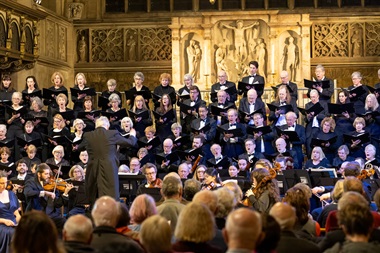
Jong-Gyung Park (piano, below), Tonbridge Philharmonic Orchestra / Oliver Cope (above)

Tchaikovsky Romeo & Juliet Fantasy Overture (1869, rev. 1880)
Rachmaninov Rhapsody on a Theme of Paganini Op.43 (1934)
Brahms Symphony no.4 in E minor Op.98 (1884-5)

Chapel of St Augustine, Tonbridge School, Tonbridge
Saturday 22 February 2025

Reviewed by Ben Hogwood Photos of Oliver Cope, Chapel of St Augustine (c) Ben Hogwood

This was the first concert for the Tonbridge Philharmonic Orchestra under their interim musical director Oliver Cope, in the position while current incumbent Naomi Butcher is on maternity leave. On this evidence he has quickly built a rapport with the orchestra, already in fine fettle under Butcher’s recent direction. On this occasion they responded with a memorable concert of Romantic favourites, given in the spectacular setting of the Chapel of St Augustine in Tonbridge School.

It is easy to take Tchaikovsky’s inspiration for granted, for his storytelling and melodic gifts are so abundant that his best music flows irrepressibly. Such is the case with the Romeo & Juliet Fantasy Overture, in spite of the two revisions required for its composer to be fully satisfied. Cope was an athletic presence on the podium as the orchestra responded with a dramatic account of the lovers’ story, the sword duel between Mercutio and Tybalt particularly vivid, while the soaring love theme tugged at the heartstrings. With fire and brimstone, and crisp ensemble playing, this performance lit the touch paper at the start of the evening.

If anything, Rachmaninov’s Rhapsody on a Theme of Paganini was even better. This was because Jong-Gyung Park (above), the popular rehearsal pianist with the Tonbridge Philharmonic Choir, delivered a sparkling account of the theme and its 24 variations. Cope threw down the gauntlet with a brisk tempo, yet Park rose to the challenge by taking control of even the quickest exchanges. There was an instinctive flow through the first six variations, the mood acquiring an appropriate chill as the Dies Irae was introduced in the seventh. From here the music travelled down darker roads, though still found time for a baleful sixteenth variation, before a shiver could be felt in the air as the seventeenth took hold. The famous eighteenth variation was lovingly delivered, before a flight to the finish that saw Park dazzle with her virtuosity, never losing sight of the whole picture.

To complete a challenging program, Brahms’s Symphony no.4 – and after initial hesitation, a convincing interpretation revealing this work’s unique bridges to the past – notably Bach – and the future, with Schoenberg on the horizon. There was an attractive open-air quality to much of the orchestra’s music making, with the second movement becoming a spring-like counterpart to the obdurate first. The scherzo built on this, dancing with a smile on its face. Flautist Rebecca Rees led a fine woodwind section in the second movement, where the horns, led by Paul Kajzar, were suitably fulsome. They were to prove critical to the success of the finale as the passacaglia developed, capping a performance with serious outlines but shot through with bursts of optimism suggesting Brahms still had a great deal to be thankful for later on in life. It put the seal on an extremely impressive concert.

For details on their 2024-25 season, head to the Tonbridge Philharmonic Society website. Click on the names to read more about pianist Jong-Gyung Park and conductor Oliver Cope

Published post no.2,456 – Tuesday 25 February 2025