In concert – Kirill Gerstein, BBCSO / Sakari Oramo: Bacewicz & Busoni @ Barbican Hall

Kirill Gerstein (piano), BBC Symphony Chorus (lower voices), BBC Symphony Orchestra / Sakari Oramo

Bacewicz Symphony no.2 (1951)
Busoni Piano Concerto in C major Op. 39 (1901-04)

Barbican Hall, London
Friday 1 November 2024

Reviewed by Richard Whitehouse Pictures (c) BBC / Sarah-Louise Bennett

Wait years for a performance of Busoni’s Piano Concerto then (at least) two come (almost) at once. As 2024 sees the centenary of the composer’s death and it is much his largest work for the concert hall, this was doubtless to be expected though a welcome occurrence all the same.

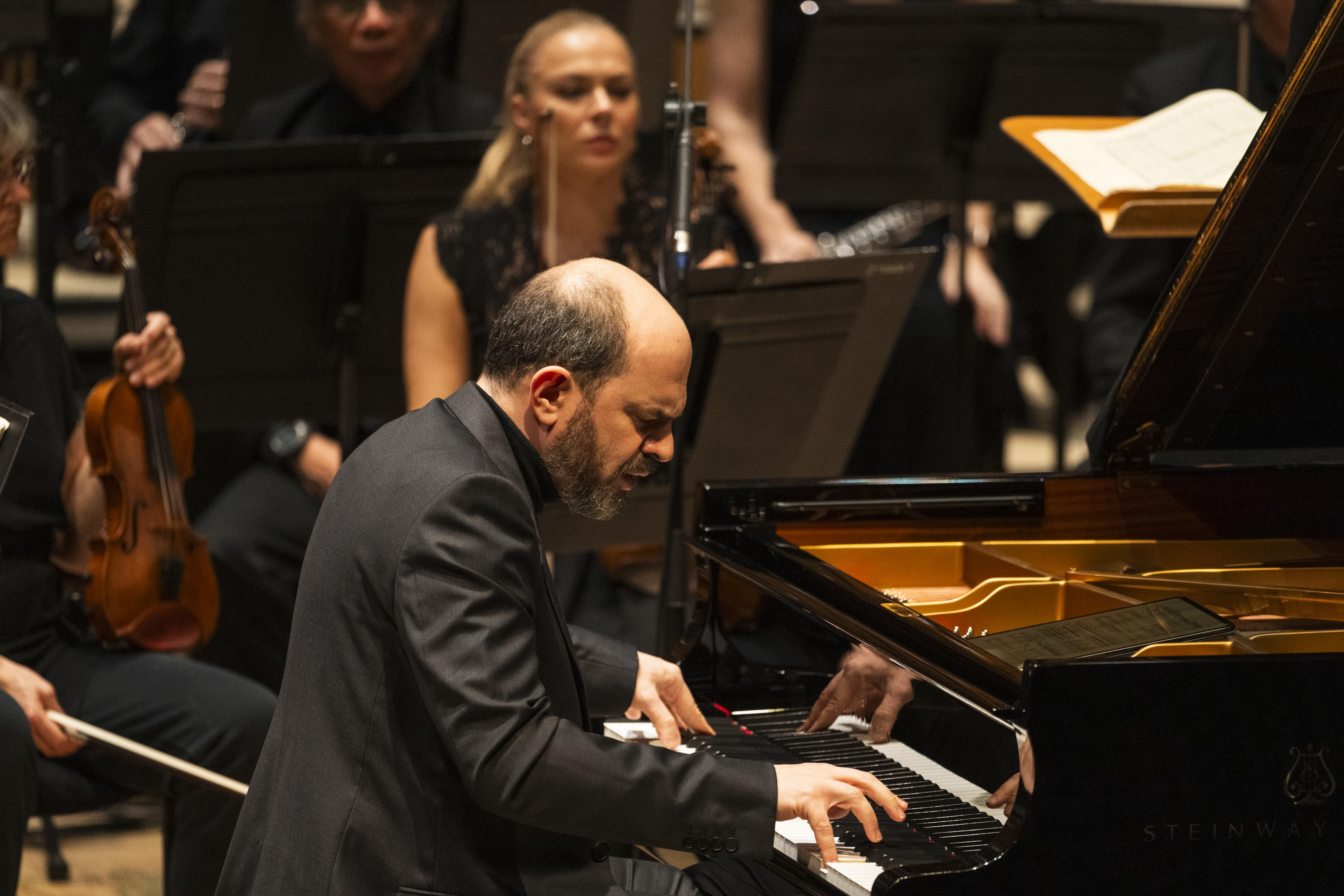
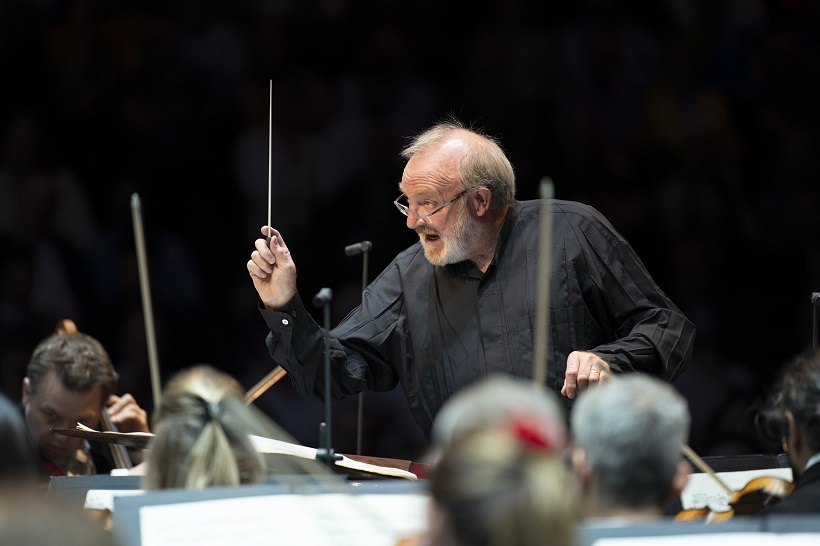
Having first played it in Boston seven years ago (later released on Myrios), Kirill Gerstein (below) and Sakari Oramo were intent on utilizing an experience unusual in the context of this work. This was evident at the outset of its Prologo e introito – the long orchestral introduction having a cumulative impetus that carried into the soloist’s imposing entry, with this physicality finding contrast in the delicacy of passagework and the sensitivity of dialogue later in this movement. Nor was there any lack of capriciousness in a Pezzo giocoso whose more ambivalent asides pointedly underlined, and its more populist elements always integrated into the ongoing flow.

Centrepiece in every respect, Pezzo serioso made a memorable impression. The sombreness of its introduction complemented by the undulating poise of Gerstein’s playing in the ensuing barcarolle section, before a remorseless build up of intensity towards its central climax found piano and orchestra in true accord; the re-emergence of earlier themes of a pathos abetted by a conclusion whose gently insistent rhythmic undertow led to an ending of exquisite finesse.

Rarely can the All’italiana have conveyed such scintillating appeal at this headlong a tempo, making for a tarantella of infectious wit but one whose ever more daring flights of fancy never threatened to lose focus – the BBC Symphony Orchestra responded with unfailing conviction, while the climactic cadenza made for a seamless link into the Cantico. Here male voices, placed at the rear of the platform instead of offstage, assumed the musical foreground as this finale built in a rising arc of tension to an apotheosis of a triumph the more cathartic for its sense of release.

How Busoni’s epic work comes over in performance is in part determined by what has been heard earlier in the programme. Tonight’s concert got it just right with a rare hearing (at least in the UK) for the Second Symphony from Polish composer and violinist Grażyna Bacewicz.

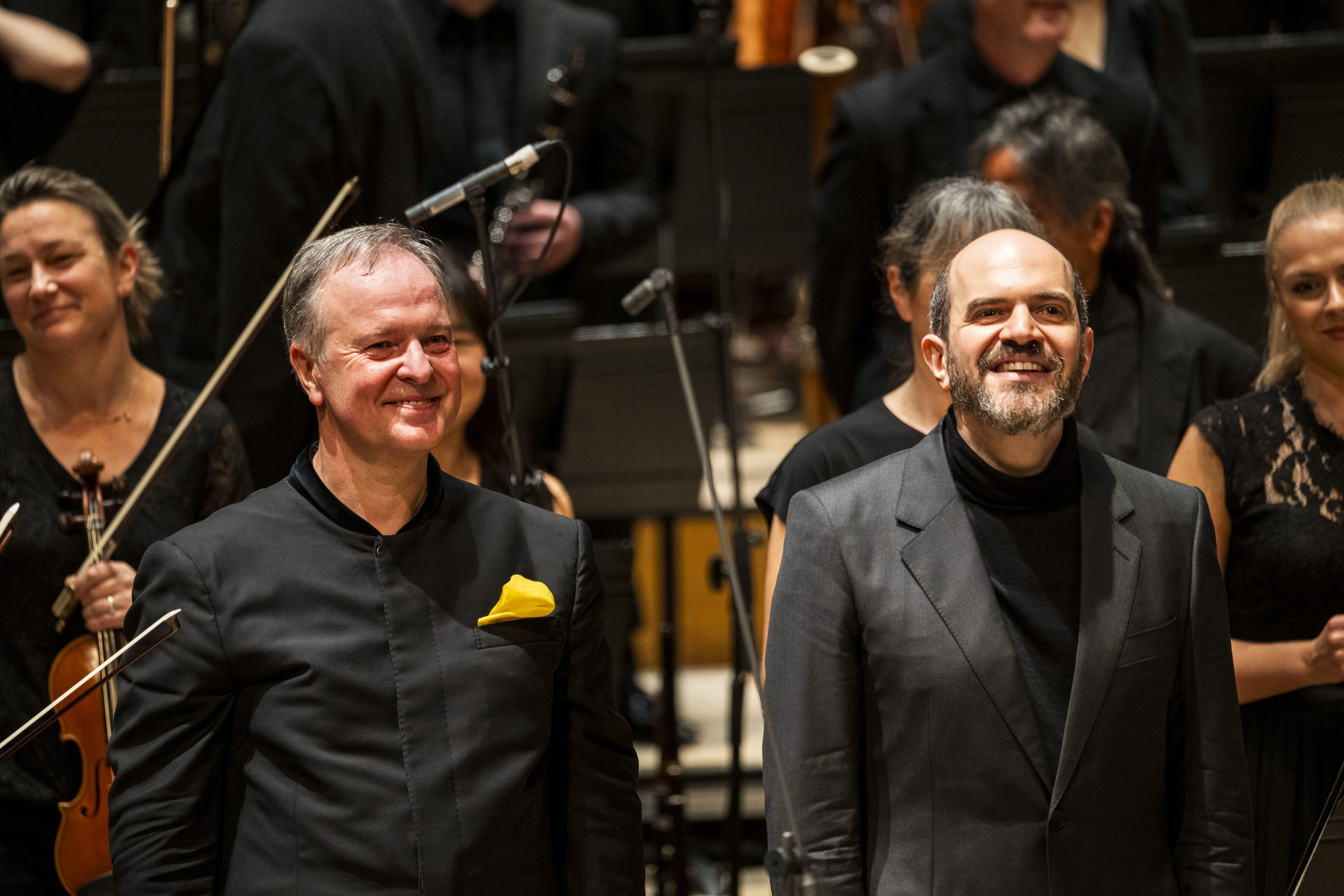
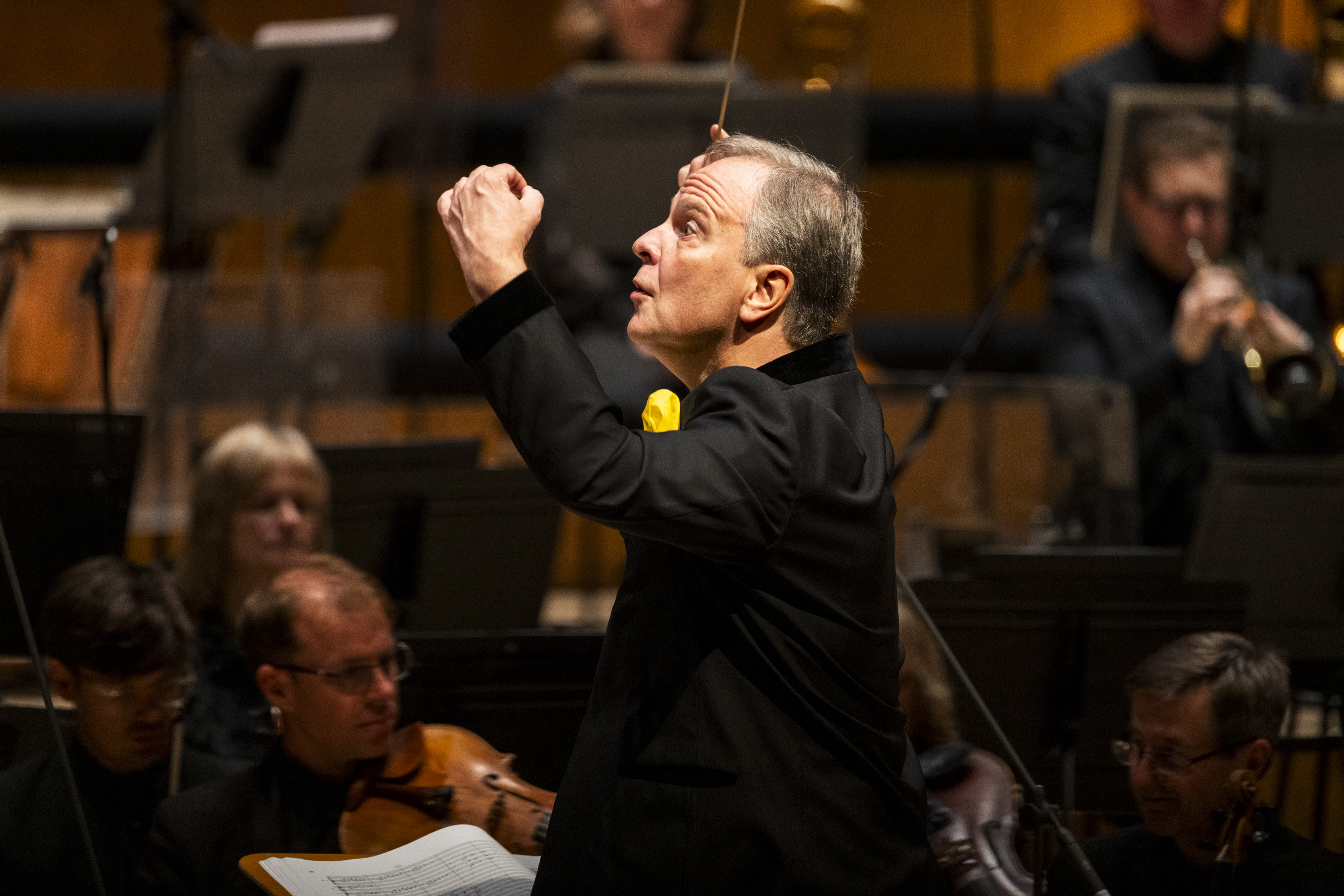
Oramo (above) had previously given notice of his sympathy for her music via recordings of the Third and Fourth Symphonies (Chandos), and this performance did not disappoint. Playing for just over 20 minutes, the Second has a variety of incident and overall impact out of all proportion to its length – whether in the opening movement as this alternates between equivocation and resolve, the eloquence of a Lento in which Bacewicz’s orchestration is at its most resourceful, a Scherzo whose poetic asides never threatened to offset its prevailing vivacity, then a Finale that (as with Roussel’s Fourth Symphony which may have provided the model) ended almost too soon yet whose incisiveness always felt apposite to the whole. Throughout, Bacewicz was conscious of the implications of Socialist Realism while steering clear decisively of its values.

Hopefully this and Bacewicz’s First Symphony will be appearing in due course as a follow-up volume. For now, it gave ready enhancement to a concert whose enterprise and conviction are further proof, is such were needed, of that continued rapport between Oramo and the BBCSO.

For details on their 2024-25 season, head to the BBC Symphony Orchestra website. Click on the names to read more about pianist Kirill Gerstein, conductor Sakari Oramo and composer Grażyna Bacewicz

Published post no.2,351 – Sunday 3 November 2024

In concert – BBC Symphony Orchestra / Sakari Oramo: Mahler Symphony no.6

BBC Symphony Orchestra / Sakari Oramo (above)

Mahler Symphony no.6 in A minor (1903-04)

Barbican Hall, London
Thursday 26 September 2024

Having just extended his contract with the BBC Symphony Orchestra until 2030, which at 17 years will make him its longest serving chief conductor after Sir Adrian Boult, Sakari Oramo began the new season with this frequently impressive account of Mahler’s Sixth Symphony.

Impressive but equally unpredictable – not least in an opening movement whose tensility and even terseness was emphasized by mostly swift tempos and the nowadays rare omission of its exposition repeat, which predicated martial aggressiveness over any more yielding expression. There was no lack of deftness in the central interlude, for all that the off-stage cowbells were distinctly unevocative in their tinkling, yet the developmental passages either side exuded an unwavering purposefulness so that the arrival of the reprise more than usually made its mark. Stealthily launched, the coda duly emerged rather than burst forth though this was audibly in accord with the ambivalence of its affirmation as Oramo perceived it. Those closing bars had no lack of finality, for all that there was more of ruthlessness than joyousness in their arrival.

Speaking recently, Oramo stated his conviction in the revised order of the central movements with the Scherzo placed second. He might profitably have headed into this without pause, as to underline the consistency of rhythmic profile with what went before, but there was no hint of inflexibility here or in the trio sections which effortlessly elided between the winsome and sardonic. Equally in evidence was that fatalistic sense pervading the music as it unfolds, and so made possible a coda whose evanescent poise could not conceal more ominous portents.

From this vantage, the Andante provided if not balm to the soul, then a measure of unforced pathos. Enticingly rendered with some notably felicitous playing by the BBCSO woodwind, it was shaped by Oramo with unerring rightness through to a climax whose emotional force was the greater for its being held in check. Surprising that this movement has never attained the popularity of the Adagietto from the Fifth Symphony: then again, its salient qualities are conveyed even more completely when experienced within the context of the work as a whole.

By a similar token, it arguably matters less in what order the middle movements are played if the finale proves a culmination in all respects. That it certainly was here – Oramo imbuing its lengthy introduction with acute expectancy balanced by the visceral impact of what followed. Nor did tension fall off in those quiet but eventful interludes, strategically placed between the larger formal sections, and in which cowbells are overlaid by tubular bells for what became a haze of resonance as affecting as any more demonstrative expression elsewhere. Oramo also restored that third hammer-blow which does not so much alter the course of this movement, as confirm its resignation before fate in even more graphic terms. Nothing could have sounded more matter of fact than the baleful rumination of brass prior to that explosive closing gesture. While not the most inclusive performance, this was undoubtedly one to renew admiration in the audacity of Mahler’s conception or his conviction in bringing it off. It also gave notice of continued rapport between Oramo and the BBCSO as they begin their 12th season together.

For more on their 2024/25 season head to the BBC Symphony Orchestra website – and click here to read more on their chief conductor Sakari Oramo

Published post no.2,315 – Saturday 28 September 2024

Arcana at the Proms – Prom 53: Remembering Sir Andrew Davis

Stravinsky Symphony in Three Movements (1942-5)
Reich Jacob’s Ladder (2023) [BBC co-commission: UK premiere]
Tippett The Midsummer Marriage – Ritual Dances (1946-52)
Elgar Variations on an Original Theme ‘Enigma’ Op.36 (1898-9)

Synergy Vocals [Tara Bungard (soprano), Micaela Haslam (soprano/director), Will Wright, Ben Alden (tenors)], BBC Symphony Orchestra / Martyn Brabbins

Royal Albert Hall, London
Friday 30 August 2024

reviewed by Richard Whitehouse Photos (c) Andy Paradise

What should have been the 133rd concert that Sir Andrew Davis conducted at the Proms became a commemorative event after his untimely death in April but, with Martyn Brabbins presiding over a thoughtfully amended programme, the outcome could not have been more appropriate.

Proceeding unaltered, the first half began with Stravinsky’s Symphony in Three Movements in a performance redolent of Otto Klemperer in its deliberation if without that conductor’s heft – not least an opening movement whose rhythmic trenchancy felt a little dogged as it unfolded. Best was the Andante – its deadpan humour complemented by the beatific poise at its centre, then a transition of hushed expectancy to launch the finale. Here the closing build-up might have been more visceral, but the conclusiveness of that final chord could hardly be doubted.

Davis (above) was hardly known as proponent of Minimalism in general or Steve Reich in particular, thus his scheduling this first UK performance of the latter’s Jacob’s Ladder could be taken as significant. Playing just under 20 minutes, this is artfully structured as four short ‘expository’ sections followed by four longer ‘developmental’ ones. The former pitted its four vocalists – a telling number in this context of eight strings, six woodwind, two vibraphones and one piano – against an instrumental ensemble that took precedence in those latter sections; the final one brings them together in new-found accord. Dealing with scalic patterns in all their conceptual and metaphorical implications, the musical content typifies late Reich in ruminative elegance or subdued intensity which, if it offers no revelations, is yet satisfying in its stylistic deftness.

Schumann’s Second Symphony had been planned for a second half as now commenced with the Ritual Dances from Tippett’s The Midsummer Marriage – an opera, and composer, close to Davis’ heart. Unfailingly cohesive to the degree its series of elemental and seasonal dances interwove with their respective ‘transformations’ and ‘preparations’, this account was equally notable for its textural clarity even in those most contrapuntally intricate passages, along with a colouristic sense sustained up to the climactic return of its initial music for a magical envoi.

When Brabbins last conducted Elgar’s ‘Enigma’ Variations at the Proms, it was the final item in a 60th-birthday tribute that began with Pictured Within – a latter-day equivalent involving 14 different composers. Tonight’s account gave eloquent insight into what has become almost too familiar a work, evident from the outset in a ‘Theme’ of melting pathos. Highlights from those that followed included the soulfulness of ‘C.A.E.’, pensiveness of ‘R.P.A.’ or elegance of ‘Ysobel’ with its lilting viola from Sebastian Krunnies. ‘Nimrod’ started imperceptibly but built towards a nobly wrought apex, with the affectionate portrayed ‘Dorabella’ or searching evocation of ‘***(Romanza)’ no less affecting. The ‘E.D.U.’ finale moved confidently to an organ-clad peroration exuding what Elgar elsewhere termed a ‘‘massive hope for the future’’.

Just before this performance, Brabbins spoke for a capacity house in paying tribute to Davis with his dedication to music-making in the UK and beyond; something Sir Andrew brought to every one of his 132 appearances at the Proms, across 54 years of dedication to his cause.

You can get details about this year’s season at the BBC Proms website – and you can click on the names to read more about the BBC Symphony Orchestra, their conductor Martyn Brabbins, and an obituary of Sir Andrew Davis himself

Published post no.2,287 – Sunday 1 September 2024

Arcana at the Proms – Prom 33: Christopher Maltman, BBC Symphony Orchestra / Martyn Brabbins – Elgar, Holst, Stanford & Vaughan Williams London Symphony

Elgar Overture ‘Cockaigne’ (In London Town) Op.40 (1901)
Holst Hammersmith (Prelude and Scherzo) Op.52 (1930)
Stanford Songs of Faith Op. 97 (1906): no.4 (To the Soul), no.5 (Tears), no.6 (Joy, ship-mate, joy); An Irish Idyll in Six Miniatures Op.72 (1901): no.2 (The Fairy Lough)
Vaughan Williams A London Symphony (Symphony no.2) (1912-13, rev. 1918-20)

Christopher Maltman (baritone), BBC Symphony Orchestra / Martyn Brabbins

Royal Albert Hall, London
Friday 9 August 2024, 6pm

reviewed by Richard Whitehouse

Concerts devoted to British music are by no means an unknown quantity at the Proms, but to have one as judiciously planned as that featuring Martyn Brabbins with the BBC Symphony Orchestra, on the conductor’s 65th birthday, was as unexpected as its realization ‘on the night’ proved consistently impressive.

Whether or not this account of Elgar’s Cockaigne ranked among the best of the previous 70 or so hearings at these concerts, it assuredly did the piece justice. Not its least attraction was Brabbins integrating this evocation of London on the cusp of Victorian and Edwardian eras with due perception of its ingenious sonata design, resulting in a reading as characterful as it was cohesive. Such as the emergence of the marching band at its centre and final peroration (Richard Pearce making his presence felt at the organ console) were the highpoints intended.

Whereas Elgar conveys London in its midst, Holst renders Hammersmith at a remove – his Prelude and Scherzo evoking those sights and sounds where the latter long made his home with a poise and precision no less involving for its objectivity. The orchestral version might be less often revived than its wind-band original but it yields little, if anything, in terms of expressive immediacy; not least with Brabbins mindful to underline how its two sections do not just succeed each other but are juxtaposed, even superimposed, prior to the rapt ending.

In the centenary of Stanford’s death, this selection of songs provided a welcome reminder of its composer’s prowess in the genre. The final three Songs of Faith denote an appreciation of Walt Whitman comparable to that of the next generation – whether in the eloquent musing of To the Soul, surging anguish of Tears or effervescence of Joy, shipmate, joy. Christopher Maltman then brought his burnished tone and clarity of diction to an affecting take on Moira O’Neill’s The Fairy Lough – proof Stanford could do ‘lightness of touch’ where necessary.

Whereas Stanford’s songs have barely featured here for almost a century, Vaughan Williams’s A London Symphony has accrued 36 performances, but what might be thought its ‘intermediate version’ had not been heard in nine decades. Actually, this is much closer formally to the final version of 1933 than the original – its main differences centring on those more extensive codas in the Lento and finale which, by aligning them more audibly with the introduction to the first movement, arguably ensures a more thematically close-knit trajectory across the work overall.

The performance was very much in accord with Brabbins’ recording (Hyperion). An unforced traversal of the opening Allegro, impetuous in its outer sections and affecting in that rapturous passage for solo strings at its centre, then a slow movement whose brooding introspection did not omit a sustained fervency at its climax. Nor did the Scherzo lack those ambivalent asides that find focus in its sombre close, while the nominally discursive finale built purposefully to a seismic culmination then an epilogue which drew solace from the aftermath of catastrophe.

‘‘The river passes – London passes – England passes’’. Whether the closing words from H.G. Wells’ Tono-Bungay determined or even influenced it, a sense of renewal was palpable as the music faded towards silence at the end of this persuasive performance and memorable concert.

For more on this year’s festival, visit the BBC Proms website – and to read more on the artists involved, click on the names: baritone Christopher Maltman, conductor Martyn Brabbins and the BBC Symphony Orchestra. Click on the name for more on The Stanford Society

Published post no.2,270 – Wednesday 14 August 2024

Arcana at the Proms – Prom 27: Silja Aalto, Anssi Kartunen, Seong-Jin Cho, BBC Symphony Orchestra / Sakari Oramo – Saariaho, Mozart & Richard Strauss ‘Alpine’ Symphony

Saariaho Mirage (2007) [Proms premiere]
Mozart Piano Concerto no.9 in E flat major K271 ‘Jeunehomme’ (1777)
Richard Strauss Eine Alpensinfonie Op.64 (1911-15)

Silja Aalto (soprano), Anssi Karttunen (cello), Seong-Jin Cho (piano), BBC Symphony Orchestra / Sakari Oramo

Royal Albert Hall, London
Friday 9 August 2024, 6pm

reviewed by Richard Whitehouse Photos (c) Mark Allan

Soon to begin his 12th season as chief conductor of the BBC Symphony Orchestra, Sakari Oramo made his second Proms appearance this season for what proved a typically diverse and resourceful programme whose stretching over 230 years of Western music was the least of its fascinations.

Her untimely death last year made a memorial to Kaija Saariaho more necessary and Mirage was a judicious choice, its setting lines by Mexican shaman María Sabina drawing a suitably theatrical response from Silja Aalto (above) – alongside who, Anssi Karttunen (long-time collaborator with this composer) weaved between the vocal and orchestral writing almost as an ‘alter-ego’ of subdued if beneficent presence. Musically the piece is typical of Saariaho from this period in aligning intricate texture with a mounting fervour at times ecstatic and ultimately fulfilled.

It may have been a ‘jeunefemme’ for whom Mozart actually wrote his Ninth Piano Concerto, but this remains its composer’s earliest unequivocal masterpiece and one with which Seong-Jin Cho (below) evidently feels real affinity. Not least in an opening Allegro whose arresting repartee at the start set the tone for an incisive traversal whose pianistic agility, not least in the first of Mozart’s cadenzas, was never without its inward asides. Such introspection came to the fore in the Andantino, its interplay of archaic and ‘modern’ harmonies yielding a plangency which found soloist and conductor as one. Nor was the finale’s central Menuetto without ruminative poise, set in relief by the buoyant Presto sections either side. Impressive music-making, then, that Cho continued with his deftly eloquent take on the second movement of Ravel’s Sonatine.

The last and most inclusive of Richard Strauss’s tone poems, An Alpine Symphony has received more than its share of tendentious reviews (and perfunctory programme notes), so credit to Oramo for emphasizing those purely musical qualities which, much more than its being a ‘bourgeois travelogue’ or even existential statement, duly determine this most formally and expressively integrated of its composer’s such works. As was evident at the outset: Alpine vistas emerged via a preludial crescendo that headed seamlessly into the ascent with its assembly of offstage horns, placed to advantage on the right of the gallery, then frequently arduous traversal above the treeline and on to the glacier prior to the summit. Its attendant ‘Vision’ drew an affecting soliloquy from oboist Tom Blomfield, then resplendent response from a 125-strong BBCSO.

What goes up tending to come down makes the following portion most difficult to sustain in terms of its ongoing momentum. The present account marginally lost focus here, but not in a mesmeric evocation of that eerie calm before the thunderstorm; organ and percussion adding to the overall mayhem before the relative calm of encroaching sunset. Ausklang is no mere epilogue – here, it afforded transcendence in the amalgam between those human and natural domains, while ensuring an overall fulfilment in the face of night with its inevitable closure.

The piece has come into its own since first appearing at these concerts 42 years ago and, if tonight’s reading did not quite touch all relevant bases, it conveyed the work’s measure like few others in tribute to the continuing creative partnership of this conductor and orchestra.

For more on this year’s festival, visit the BBC Proms website – and to read more on the artists involved, click on the names: Seong-Jin Cho, Silja Aalto, Anssi Karttunen, the BBC Symphony Orchestra and their chief conductor Sakari Oramo, and the official website of Kaija Saariaho and her works

Published post no.2,268 – Monday 9 August 2024