Summer Music in City Churches is a festival in the City of London. Founded in 2018, it presents beautiful music to engage, divert and inspire, in ancient and architecturally stunning churches in the Square Mile. Standing cheek by jowl with City offices, these churches are glorious settings in which to listen and reflect: oases of history, beauty and peace amidst the 24-7 hurly-burly of City life.
It’s only a month until the opening night of this year’s Summer Music in City Churches. If you haven’t got your tickets yet, don’t lose any time.
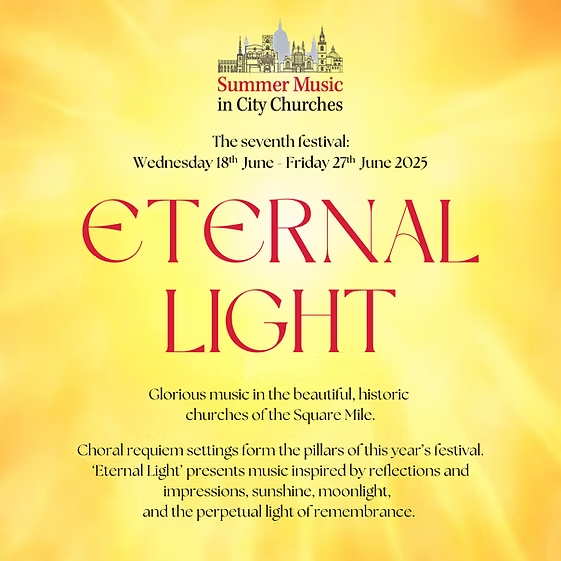
‘Eternal Light’ is a series of stunning concerts presented during evenings and lunchtimes from 18th to 27th June. Along with some of the great choral requiem settings (Fauré, Duruflé, Verdi), you’ll find an enticing variety of luminous music performed in beautiful, historic churches.
It is our pleasure to welcome back the Royal Philharmonic Orchestra, conducted this year for the first time by Sir John Rutter. Other returning festival favourites include string quartet Brother Tree Sound, Tier3 Trio, RPO Brass, and pianists Iain Farrington, Mark Bebbington and Viv McLean.
We are thrilled to feature a number of up-and-coming talented young musicians, including: duo Eleanor Grant (voice and double bass) & Gus McQuade (guitar); soprano soloist Hannah Dienes-Williams; organist Paul Greally; award-winning guitarist Jack Hancher; and the exquisite sound of Corvus Consort.
There’s a special chance to hear Lucy Parham‘s composer portrait of Debussy, ahead of a sell-out performance at the Wigmore Hall later in the year.
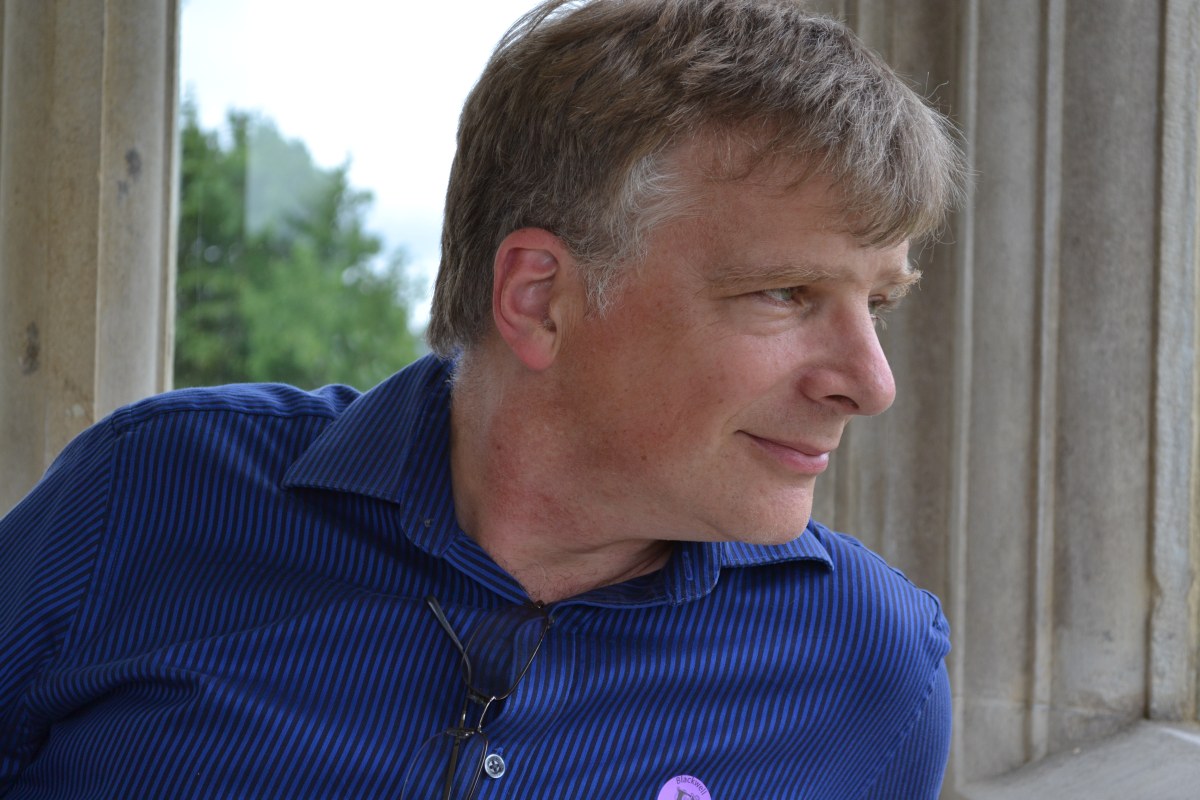
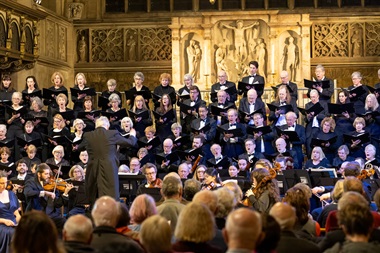
Finally, don’t miss Verdi’s immortal Requiem in the remarkable new version by Richard Blackford performed by the City of London Choir under Daniel Hyde.
Evening concerts take place in St Giles Cripplegate; at lunchtimes we visit light-filled St James Garlickhythe, St Mary Abchurch and St Botolph-without-Bishopsgate for the first time. Click below for full details and to book tickets.
As a subscriber to our newsletter, you can buy tickets to all concerts – lunchtime and evening – with 20% off by quoting KESEL20 when you book. Or buy a season ticket to the whole festival for just £100.
Roberts Balanas (electric violin, below), Ealing Symphony Orchestra / John Gibbons (above)
Bernstein orch. Kostall & Ramin Symphonic Dances from West Side Story (1957 arr. 1961) Luq Electric Violin Concerto ‘Machina Humana’ (2023-24) [World Premiere] Coleridge-Taylor Valse de la reine Op.22/3 (1899) Bliss A Colour Symphony Op.24 (1921-22, rev, 1930)
St Barnabas Church, Ealing, London Saturday 10 May 2025
Reviewed by Richard Whitehouse Picture of Roberts Balanas (c) Kiril Kozlov
Another typically enterprising concert by the Ealing Symphony Orchestra and its longstanding music director John Gibbons, featuring the first performance (albeit not designated such) of a major work for electric violin and pieces from a diverse trio of British or American composers.
It might have been orchestrated by regular collaborators Irwin Kostall and Sid Ramin, but the Symphonic Dances from Leonard Bernstein’s West Side Story is as characteristic of the latter’s idiom as it is representative of his most successful musical. Rhythmically a little straightlaced in the Prologue, the performance audibly hit its stride with a Somewhere of melting pathos then a vivacious Scherzo leading to an impulsive Mambo, before the insouciant Cha Cha and ominous fugal Cool presaged a visceral Rumble then a Finale of heartfelt eloquence.
Lauded for her work with electronics, Spanish composer Ángela Luq evidently had no qualms when tackling a full-scale concerto for electric violin. Comprising four contrasted movements, Machina humana duly exploits those timbral and expressive possibilities of its solo instrument – whether in the intricate rhythmic dialogues of its opening Machina, the lucid textures and sensuous harmonies of Sueño (Dream), the impulsive conflict between soloist and orchestra of Animal, then the surging emotions of the final Amar (Love). Musical content may have lacked memorability, with the work rather falling short of its ambition (at least as expressed in the composer’s programme note), but the virtuosity or finesse of Roberts Balanas in realizing this innovative project was unarguable, with the Ealing SO audibly relishing its involvement.
No doubt this piece will secure even greater attention when soloist, orchestra and conductor tour it to Latvia in due course. Maybe on that occasion Gibbons will take the opportunity to give what would likely a first hearing there of Valse de la reine by Samuel Coleridge-Taylor. Third in a sequence of Four Characteristic Waltzes, this is a reminder that its composer was highly adept at ‘light’ music; its halting gait and its affecting lyricism to the fore in what was a welcome revival and a pertinent reminder of his legacy at the time of his premature death.
It also made a telling entrée into A Colour Symphony by Arthur Bliss. This 50th anniversary-year of his passing has led to a notable upsurge in performance and not least of what remains his best-known orchestral work. Whether or not Gibbons has previously conducted it, he had the measure of this piece. Purple made for a thoughtful yet never turgid prelude; one whose stately processional found immediate contrast in the alternate impetus and effulgence of the scherzo that is Red. Nor was there any underplaying of that ambivalent and even ominous element which underpins the outwardly placed unfolding of Blue, a slow movement which leads effortlessly into the finale that is Green with its intricately arrayed double-fugue that builds to a peroration whose outcome is a true declaration of intent thrillingly conveyed here.
An impressive performance, then, which once again confirmed Gibbons’s prowess across the broad spectrum of British orchestral music. Hopefully the Ealing SO will be able to include more Bliss in future programmes, this being music it had clearly taken to its collective heart.
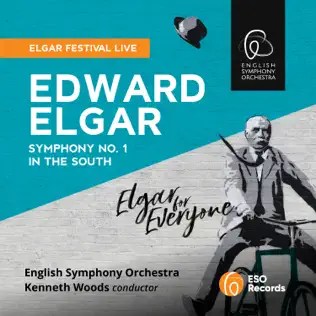
Elgar Symphony no.1 in A flat major Op.55 (1907-08) In the South (Alassio) Op.50 (1903-04)
English Symphony Orchestra / Kenneth Woods
ESO Records ESO2501 (80’10″] Producer and Engineer Tim Burton
Live performances at Worcester Cathedral on 4 June 2022 (In The South) and 3 June 2023 (Symphony)
Reviewed by Richard Whitehouse
What’s the story?
There could hardly been a more fitting release to launch the English Symphony Orchestra’s own label than these performances drawn from past editions of the Elgar Festival, with both of them a reminder of the ESO’s formidable prowess over the range of symphonic writing.
What are the performances like?
The First Symphony may not have the usual number of strings to complement its triple wind, but due to the resonance of Worcester Cathedral this is not evident as regards internal balance. Not least in an opening movement whose motto-theme is never indulgent, setting the tone for an Allegro where expressive variety goes hand in hand with formal focus. Especially fine is a hushed transition into the reprise, then a coda that distils the equivocal mood as this subsides into ruminative calm. Woods is mindful to invest scherzo and trio with consistency of pulse, so if the former feels reined in on return, the latter has an ideal poise and wistfulness. Nor is the transition other than indicative of the Adagio’s profundity, Woods negotiating its soulful main theme and wistful episodes with unerring rightness through to the ineffable closing bars.
If the finale has any marginal falling-off of inspiration, it is not apparent here. Sombre if shot through with expectancy, its introduction launches an Allegro whose alternating incisiveness and suavity holds good over an impulsive development, then a transformation of the codetta whose pathos intensifies for an apotheosis where the motto-theme carries all before it. Not that the closing pages are bombastic or grandiloquent in import – rather, they set the seal on a work whose affirmation is made the greater for its having been so purposefully attained.
As for In the South, the main issue is in setting a tempo flexible enough to accommodate this concert overture’s extended sonata design without it becoming episodic. Here a surging main theme, its speculative transition and suave second theme emerge seamlessly – the underlying tension carried into a development whose impulsiveness is maintained across the intervening first episode. Amply evoking the grandeur of ‘empires past’, this is astutely handled such that its implacability eschews bathos. If the second ‘canto populare’ episode is just a little reticent, its expressive raptness – and Carl Hill’s eloquent playing of its indelible viola melody – more than compensates. Nor is there any loss of continuity during the reprise, Woods’s building of momentum near the start of the coda ensuring an irresistible yet never overbearing peroration.
Does it all work?
Almost always. ESO concerts at the Elgar Festival have yielded numerous performances of note, with In the South among the finest yet in vindicating a work that can all too easily fall victim to its seeming indulgencies. Nor is that of the First Symphony far behind in revealing the formal intricacy and expressive variety of music as personal as is any of this composer’s major works. Anyone who may have harboured doubts about either piece is likely to be won over, confirming an empathy as augers well for the Second Symphony at this year’s festival.
Is it recommended?
Absolutely. These readings are far more than mementos of their concerts, this being ‘Volume 1’ suggests that further performances from the Elgar Festival will be made available. Note too the first instalment of a Sibelius cycle is downloadable as the second release on ESO Records.
Petroc Trelawny (orator), The London Chorus, New London Orchestra / Adrian Brown
Vaughan Williams Six Choral Songs (1940) Martinů Memorial to Lidice (1943) Walton Spitfire Prelude and Fugue (1942) Bliss Morning Heroes (1929-30) Holst/Rice I Vow to Thee My Country (1921)
Holy Trinity Church, Sloane Square, London Thursday 9 May 2025
Reviewed by Richard Whitehouse
The London Chorus and New London Orchestra have put on notable concerts in recent years, few more ambitious than this programme to mark not merely the 80th anniversary of Victory in Europe Day but also the 50th anniversary of Sir Arthur Bliss’s death in appropriate manner.
The first half comprised an unlikely but effective sequence of pieces written at the start of or during the Second World War. Rarely revived as such, Vaughan Williams’s Six Choral Songs to be Sung in Time of War works well as a whole: settings of Shelley that touch on aspects of courage, liberty, healing, victory, then pity, peace and war – before A Song to the New Age characterizes its utopian leanings in subdued and even ambivalent terms which seem typical of its composer. Suffice to add that the London Chorus had the full measure of its aspiration.
Two succinct if otherwise entirely different pieces brought out the best from the New London Orchestra. Rarely so overt in emotion, Martinů was well-nigh explicit when commemorating Nazi atrocities in music of plangent harmonies and chorale-like fervency both evocative and affecting. Derived from his score to the film The First of the Few, Walton had come up with a showpiece whose ceremonial prelude is vividly countered by its incisive fugue – making way for a brief if poignant interlude before matters are brought to a head in the rousing peroration.
Although intimately bound up with the First World War, Morning Heroes is wholly apposite for the present context. Conceived as the exorcism of his wartime experiences, Bliss’s choral symphony elides deftly between a distant past and its present; the first of its five movements featuring an orchestral introduction to set out the underlying mood and salient motifs, before Hector’s Farewell to Adromache had Petroc Trelawny eloquently evoking that scene on the ramparts of Troy without excess rhetoric. Adrian Brown’s understated direction meaningfully pointed up the expressive contrast between this and The City Arming – the setting of Walt Whitman whose interaction of chorus and orchestra was powerfully sustained right through to the simmering unease at its close, with the onset of hostilities in the American Civil War.
The two parts of the central movement saw each section of the London Chorus come into its own: the women in Vigil, a confiding take on lines by Li-Tai-Po (Li Bai) such as relates the emotions of those left behind; and the men in The Bivouac’s Flame, plangently evoking life at the front with further lines from Whitman’s Drum Taps. Choral forces reunite in Achilles Goes Forth to Battle, a setting from later in The Iliad which brings about the work’s climax via The Heroes – a rollcall commemorating those of Antiquity. After this, the starkness of Wilfred Owen’s Spring Offensive is the greater for its sparse accompaniment – Trelawny’s oration a model of understatement as this segued into the setting of Robert Nichols’s Dawn on the Somme with those ‘morning heroes’ themselves evoked affirmatively if fatalistically.
A concert which ended in fine style with Holst’s stirring anthem had begun in subdued fashion with Dawn on the Somme – Ronald Corp’s elegy, given hours after his death was announced. Someone who had always given his all to this chorus and orchestra, he will be greatly missed.
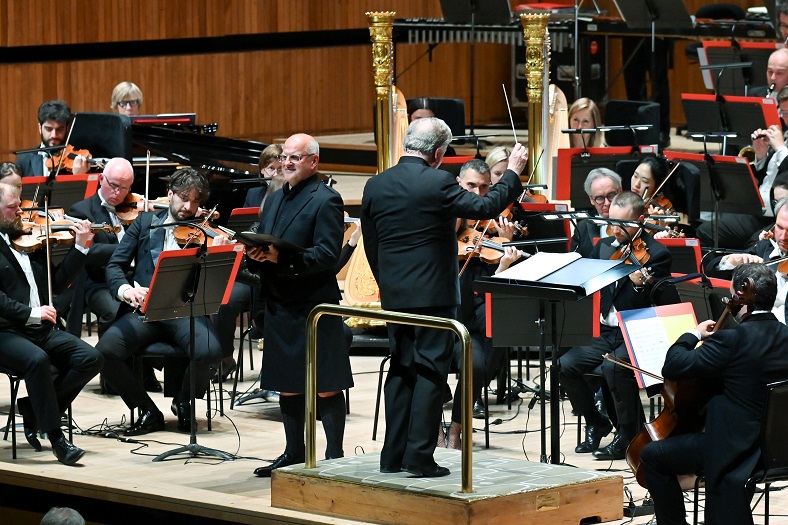
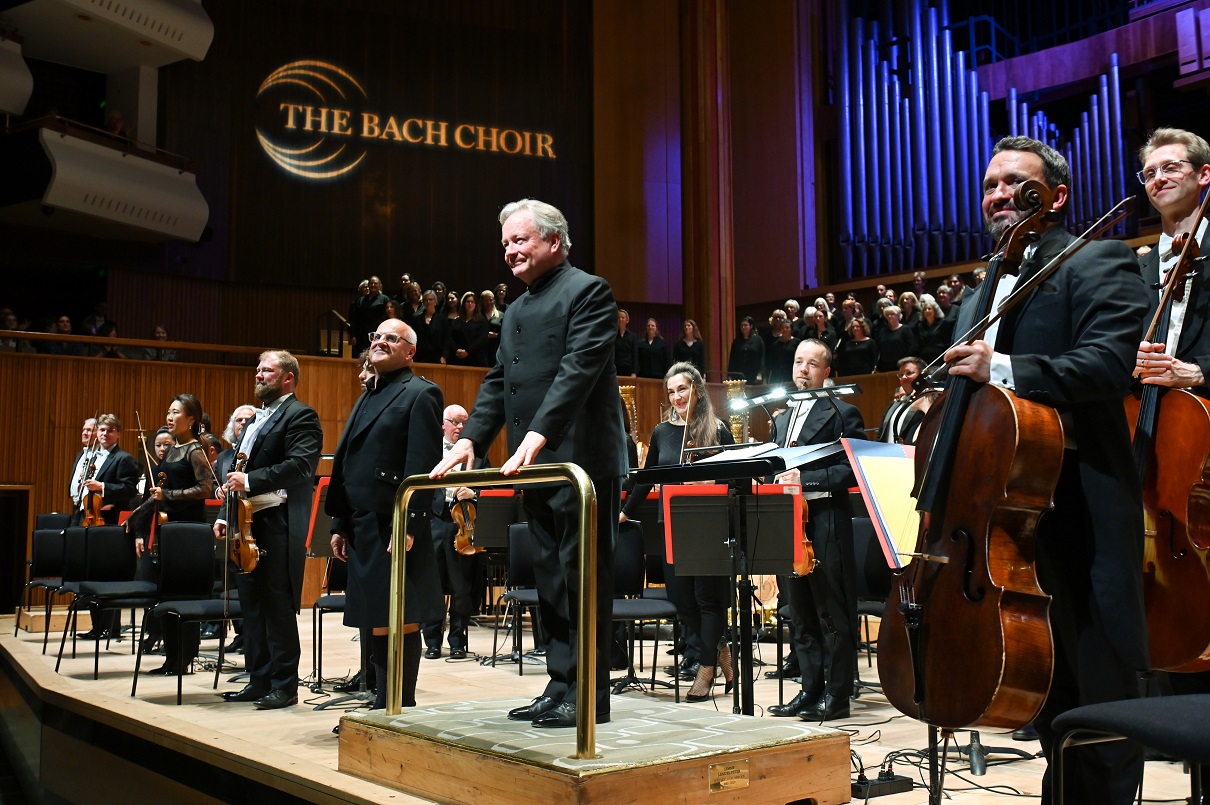
Amy Carson (soprano), Harry Jacques (tenor), Christopher Purves (baritone), The Bach Choir, Philharmonia Orchestra / David Hill
Delius The Song Of The High Hills (1911) Blackford La Sagrada Familia Symphony (2022, world premiere) Walton Belshazzar’s Feast (1931)
Royal Festival Hall, London Thursday 8 May 2025
Reviewed by Ben Hogwood Pictures (c) Chris Christodoulou
This imaginative concert presented three British works telling stories from overseas, their reach extending to Norway, Spain and Babylon respectively.
Although born in Bradford, Frederick Delius spent much of his life abroad, living in America and then France – from where he would visit Norway for many a summer holiday with his wife. One such vacation in 1911 inspired him to write The Song Of The High Hills, a continuous sequence in three sections for wordless choir and orchestra capturing the mountain plateau, or ‘vidda’, that they found on their walks. Images from the plateau were shown on a screen behind the chorus as they performed.
Musically the work draws from Grieg and Debussy (his Nocturnes in especially) but inhabits a world all of its own, Delius achieving an unusual, rapt stillness when describing the high plains. David Hill, a long time exponent of his music, marshalled a strong performance, albeit one that didn’t quite sustain the rarefied atmosphere of the central section. It did cast quite a spell, mind, thanks to a beautiful oboe solo from Timothy Rundle on the approach, and some superbly controlled singing from The Bach Choir, headed by soloists Amy Carson (soprano) and Harry Jacques (tenor). The climax of the middle section was bolstered by three timpani, before the orchestra returned us to base camp. Speeds were on the fast side, but the Philharmonia Orchestra gave consistently luminous textures.
London-born composer Richard Blackford has shown considerable flair when writing for orchestra, and this was immediately evident in the world premiere of his La Sagrada Famila Symphony. Completed in 2022 and already recorded on the Lyrita label, it is a musical response to a 2019 encounter with Gaudí’s vision, concentrating on three great facades of the building – Nativity, Passion and Glory.
Blackford’s symphony was rich in colour but also vividly descriptive, his responses matched by an accompanying film, directed by the composer. Nativity began with awe-inspiring salvos from the brass but grew into a more intimate study, with elements of Hindemith and Berg in the orchestral writing, before a propulsive passage threw off the shackles. Passion was the emotional centrepiece, a vivid study in the brutality of the Good Friday story. Grotesque elements were emphasised by sudden closeups of Josep Maria Subirachs’s sculptures, their drawn expressions reflected in the music. The death of Christ was especially notable, marked by a solo of moving eloquence from cellist Martin Smith, then a sharp cry of dismay from Mark van de Wiel’s clarinet.
Glory was less obviously jubilant than might have been expected, mystical and reverent, but again it was an accurate response to the imagery as the film briefly went inside the massive structure. Blackford’s imagery danced in the listener’s mind on its own merits, with the thrilling surge at the end, bolstered by the organ, reminiscent of Messiaen or Scriabin. David Hill secured a fine performance from the Philharmonia, bringing the splendour of Gaudí’s cathedral to the concert hall. The emphatic finish brought with it a reminder of the building’s likely completion in 2026, a mere 144 years after construction began!
A British choral classic followed in the second half. Belshazzar’s Feast was initially denounced by Sir Thomas Beecham (a Delius fan, coincidentally) but Walton’s cantata has become a popular occasion piece. It is a vivid account of Babylonian decadence, before a human hand appears, writing on the wall of the banqueting hall to prophesy Belshazzar’s downfall. David Hill applied expert pacing to the storytelling, the Bach Choir on top form as the tension grew, spilling over into the exultant Praise Ye section. The paeans to the Babylonian Gods were starkly thrilling, contrasted by the terrifying unison shout of “Slain!” at Belshazzar’s death. The Philharmonia were superb, too, offstage brass bringing widescreen sound from either side of the stage and the percussion giving brilliant descriptions of the elements – iron and wood especially.
When the writing on the wall began, an ominous hush descended on the choir, the orchestra spreading a macabre chill through the hall – before the triumph of the closing pages, the Israelites free at last. Baritone Christopher Purves was a fine soloist, narrating the events and capturing the mood throughout. With 220+ in the choir, our ears were ringing long after the concert had finished, a timely reminder of a ruler whose inflated ego had brought about his downfall. Could there be any parallels in today’s world, I wonder?