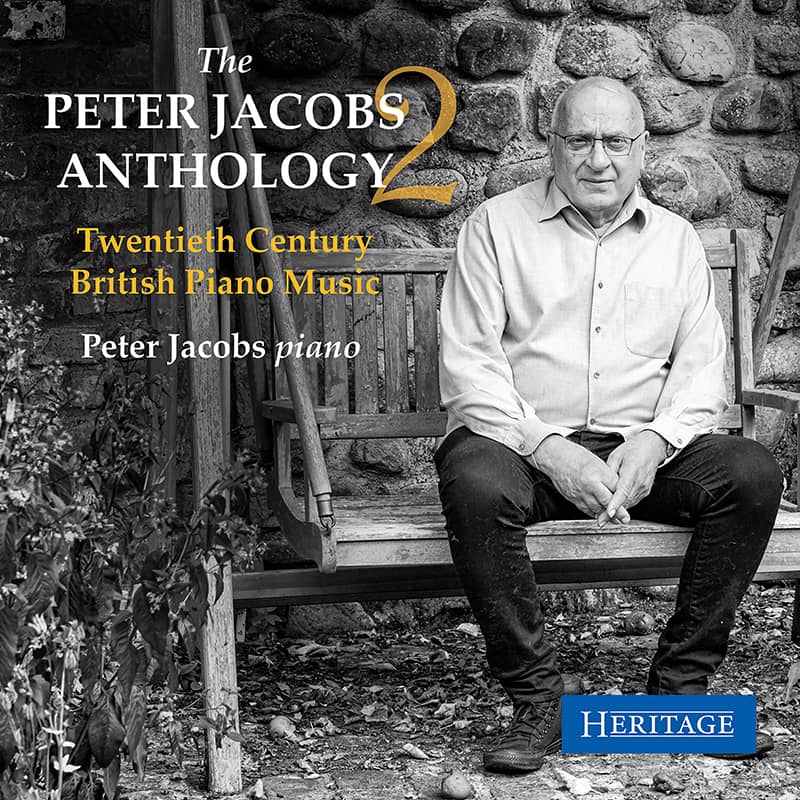
On Record – The Peter Jacobs Anthology Vol. 2 – Twentieth Century British Piano Music (Heritage)

Coleridge-Taylor Petite Suite de Concert Op.77 (1911)
Cooke High Marley Rest (1933)
Delius Mazurka and Waltz for a Little Girl RTIX/7, 1 & 2 (1922-3)
Headington Toccata (1963)
Rubbra Eight Preludes Op.131 (1967)
Scott Lotus Land Op.47/1 (1905)
Armstrong Gibbs Lakeland Pictures Op.98 (1940) – no.2, After Rain (Rydal Beck); no.8, Quiet Water (Tarn Howe)
Baumer Idyll (1935)
Mayer Calcutta-Nagar (1993)

Peter Jacobs (piano)

Heritage HTGCD131 [73’30″]
Producer & Engineer Paul Arden-Taylor

Recorded 14 & 16 September 2014 at Wyastone Concert Hall, Wyastone Leys, Monmouth

Reviewed by Richard Whitehouse

What’s the story?

Heritage extends an already extensive discography of British music with its follow-up to the Peter Jacobs Anthology, a further volume featuring collections of or standalone miniatures with a wide range of musical idioms given focus through the persuasiveness of the pianism.

What’s the music like?

Among the miscellaneous pieces included here are Greville Cooke’s ruminative ‘portrait’ of the home of pianist (and his former teacher) Tobias Matthay, Delius’s respectively pert and fey offerings, or Christopher Headington’s scintillating study for John Ogdon. Cyril Scott’s evergreen is treated to a subtly understated reading, while two out of a set of eight by Cecil Armstrong Gibbs provide enticing evocations of Rydal Beck then Tarn Howe – their innate Englishness sounding removed from the overtly Russian manner of that from Cecil Baumer.

Forming the backbone of this collection are three sets that in themselves attest to the variety of the music featured. Best known in its orchestral guise (a recording of which can be found on Heritage HTGCD249), Samuel Coleridge-Taylor’s Petite Suite de Concert is light music of a superior kind – witness its flighty initial Caprice, its ingratiating Sonnet or its lively closing Tarantelle, though its ostensible highlight is Demande et Réponse whose alluring sentiment helped with keeping the composer’s memory alive prior to his belated rediscovery.

Other than figuring among its composer’s later works, the Eight Preludes by Edmund Rubbra could hardly have been more different. As with his Eighth Symphony written soon afterward, these short while arresting pieces likewise focus on specific musical intervals rather than any overall key scheme, though their cohesiveness heard as an integral sequence could never be in doubt. Introspective without being inscrutable, this is wholly absorbing music and Jacobs accords ample justice to what is only the second complete recording this set has yet received.

As the most unlikely inclusion, John Mayer’s Calcutta-Nagar proves nothing less than a total delight. Known primarily for his syntheses of Indian and European elements, notably through the group Indo-Jazz Fusions, Mayer wrote extensively for Western media with this collection a notable instance. Only two of its 18 pieces last over a minute, yet their capturing of places recalled from the Calcutta of the composer’s youth is absolute. Jacobs notes his favourite as being the 13th (Kali Temple), but listeners will doubtless come up with their own favourites.

Does it all work?

Yes, whether as a judiciously planned collection or an anthology from which one can select individual items as preferred. The three collections are each among the most distinctive of its kind, while they and the various individual pieces provide ready-made encores in recital. Evidently this is music which Jacobs has long included in his repertoire, the performances exuding that combination of technical finesse allied to a probing insight as have long been hallmarks of his interpretations. Those who are unfamiliar with this music are in for a treat.

Is it recommended?

Indeed, not least as the sound has a combination of clarity and warmth ideal for piano music. The pianist pens informative notes, and one hopes that there will be further such anthologies. Meanwhile, Jacobs approaches his 80th birthday (this August) with his pianism undimmed.

Listen & Buy

For purchase options, you can visit the Heritage Records website

Published post no.2,448 – Monday 17 February 2025

On Record – Corelli Orchestra / Warwick Cole – William Hayes: Instrumental Music (Heritage Records)

William Hayes
Harpsichord Concerto in G major (c1740)
Harpsichord Concerto in D major (1755)
Concerto Grosso in D major (1758)
Concerto Grosso in G minor (1758)
Trio Sonata in E minor (1775)
The Fall of Jericho – Sinfonia (c1750)

Corelli Orchestra / Warwick Cole (harpsichord)

Heritage HTGCD134 [74’]
Producer Simon Heighes Engineer Paul Arden-Taylor

Recorded February 2010 at Prince Michael Hall, Dean Close School, Cheltenham; July 2018 at Church of St Philip and St James, Cheltenham

Reviewed by Richard Whitehouse

What’s the story?

The Heritage label adds yet another enterprising release to its expanding catalogue with this representative selection of instrumental music by William Hayes (1708-1777), idiomatically rendered by the Corelli Orchestra and its founder director, the harpsichordist Warwick Cole.

What’s the music like?

The most substantial works are two harpsichord concertos. That in G major is notable for the close-knit interplay between soloist and strings of its lively initial Allegro or the deft humour of its closing Minuetto, but it is the central Andante which leaves the strongest resonance – its intricate solo part (with two elaborate cadenzas) and its plangent expression both anticipating the ‘Sturm und Drang’ inclinations of a subsequent generation. That in D major (derived from an organ concerto) follows a not dissimilar trajectory, its buoyant and harmonically questing Allegro followed by a brief yet affecting Adagio for the soloist unaccompanied then a finale that takes in a wider expression than its Tempo di Menuetto marking might indicate. Equally effective are those transitions for soloist then strings as afford this work its overall continuity.

Taken overall, the six concerti grossi are Hayes’s most substantial legacy to the instrumental domain. That in D major duly alternates Andante movements of subdued pathos with Allegro movements in which this composer’s much-heralded contrapuntal facility is to the fore, while that in G minor owes its larger scale to the ruminative Larghetto which, preceded by a wistful Affetuoso and coursing Allegro then rounded off by a lilting Pastorale, is a sure pointer to the Classicism that lay ahead. It may be the shortest piece featured here, but the Trio Sonata in E minor (itself the final contribution to a set of six) is overall even more most forward-looking as it unfolds from a pathos-laden Adagio, via an incisive Allegro (which is pointedly marked ‘staccato’) followed by a gravely eloquent Largo, to the gracefully elegant closing Grattioso.

That just leaves the Sinfonia to the oratorio The Fall of Jericho which was likely the largest work Hayes completed. More than a mere curtain-raiser, this substantial piece begins with a purposeful Andante notable for trenchant oboe writing – as also the Largo into which it leads and whose plaintive melodic line makes it an aria in its own right. There follows an Allegro of deftly propelled impetus, then an Andante such as provides overall balance in terms of its undulating gait. A performance of the complete work can also be obtained at Fall of Jericho

Does it all work?

Yes, and not only viewed within its aesthetic remit. Acknowledged during his lifetime as one of the few English composers able to hold his own against Handel, Haynes (who dominated academic life at Oxford for three decades) left an output whose scope is evidently in advance of its size. Historically significant for being on the cusp between Baroque and Classical eras, his work is always appealing – not least given the poise and finesse of the Corelli Orchestra, an ensemble whose ‘authentic’ credentials never draw attention away from its music-making.

Is it recommended?

Indeed, and not least with annotations by Simon Heighes (no doubt recalled by some readers for his insightful reviews in International Record Review), whose book The Lives and Works of William and Philip Hayes (Garland Press: 1995) is the standard study about this composer.

Listen & Buy

For buying options, you can visit the Heritage Records website

Published post no.2,444 – Thursday 13 February 2025

On Record – Kate Moore: Velvet (Heritage Records)

Ole Böhn (violin) (Heather, Dies Irae, Way of the Dead); Minah Choe (cello) (Velvet), Daniel Herscovitch (piano) (all) with Benjamin Kopp (piano) (The Body is an Ear)

Kate Moore
Zomer (2006)
Velvet (2010)
The Body is an Ear (2011)
Heather (2013)
Dies Irae (2015)
Way of the Dead (2017)
Lucidity: Eyes of Hands (2018)

Heritage HTGCD137 [79’38’’]
Producers Kate Moore, Daniel Herscovitch Engineers David Kim-Boyle, David Kinney Recorded 3 March, 8 August and 9 October 2023 at Verbrugghen Hall, Conservatorium of Music, Sydney

Reviewed by Richard Whitehouse

What’s the story?

Heritage rings the changes on its schedule of welcome reissues with this release of music by Kate Moore (b1979), Australian composer born in the UK who currently resides in the Netherlands, all played by a notable roster of musicians based at Sydney Conservatorium.

What’s the music like?

As the booklet notes make plain, any tendency to Minimalism in Moore’s music is rendered from a distinctly maximalist perspective. Hence an inexorable build-up of tension in the two-piano version of The Body is an Ear (initially for organ and recast for two such instruments), with its inspiration in Sufist legend, or growing plangency of Dies Irae where violin intones elements of that plainchant against some ominously undulating harmonies on piano in what the composer has aptly described as a ‘‘spiritual meditation on forgiveness and redemption’’.

Arguably even more revealing of Moore’s aesthetic is the title-track. Velvet draws cello and piano into a sustained and increasingly intense dialogue whose ostensible depiction of cloth in Renaissance painting yields great textural and colouristic diversity, while building toward an impassioned culmination from which the coda is more affecting for its brevity and pathos. Hardly less absorbing, Way of the Dead takes a not dissimilar formal trajectory – this ‘danse macabre’, as inspired by a Mexican festival, fusing melodic eloquence from the violin with an implacable rhythmic accompaniment on piano such as comes to the fore in those seismic final bars. At the opposite end of the scale in all senses, Zomer takes extracts from a sermon by John Donne for this piano rumination with the simple and profound artlessly combined.

The duo for violin and piano Heather takes its cue from the composer’s Hebridean hike – the incidence of vegetation growing in patterns according to outlines of now-vanished buildings effecting a piece where instrumental coordination becomes ever more exacting, as the music’s emotional velocity gradually while also remorselessly accelerates towards another of Moore’s reticent and poignant apotheoses. Lucidity: Eyes of Hands draws on the legend of St Lucie, as related by Dante, for a solo piano work whose polyrhythmic intricacy is in constant evolution as the music unfolds – though, on this occasion, there is no crystallizing of tension at the end; rather, the accrued impetus spills over into a forceful and even unnerving peroration to leave no doubt as to Moore’s identity with the narrative that made possible this piece’s conception.

Does it all work?

Yes, given that Moore’s is an arresting and appealing idiom, one whose outward consistency is countered by its variety of technical procedures along with its underlying expressive range. It certainly benefits from the advocacy of these musicians, their dedication and commitment coming across at every turn, while the clarity of recording emphasizes its visceral immediacy. Informative notes from the composer and Daniel Herscovitch. Those listening via download have an additional item – a Prelude for piano, whose limpid poise makes for a welcome tonic.

Is it recommended?

Indeed, and hopefully those who have acquired this Heritage project will investigate further releases of Moore’s music – the volume of piano pieces Dances and Canons (ECM) and the collection of vocal items Stories for Ocean Shells (Canteloupe) proving no less worthwhile.

Listen & Buy

You can hear excerpts and look at purchase options on the Presto website. For more information on Kate Moore head to her website – and for more on the artists click on the names Daniel Herscovitch, Ole Böhn, Minah Choe and Benjamin Kopp.

Published post no.2,128 – Monday 25 March 2024

On Record: A Child’s Christmas – Orchestral Music For Christmas (Heritage)

Hely-Hutchinson Overture to a Pantomime (1946)
Hewitt Jones Christmas Party (2016)a; Overture: The Age of Optimism (2023)
Kelly Sing a Song of Sixpence (2020)
Lanchbery Tales of Beatrix Potter – excerpts (1971)
Lane/Nicholls Suite: The Adventures of Captain Pugwash (1999)b
Moore Santa’s Sleigh Ride (2019)
Saunders A Magical Kingdom (2003)a; Journey to Lapland (2020)
Thornett A Child’s Christmas (2016)a

Royal Ballet Sinfonia / Barry Wordsworth, aGavin Sutherland; bCity of Prague Philharmonic Orchestra / Julian Bigg

Heritage HTGCD139 [66’03’’]

written by Richard Whitehouse

What’s the story?

Heritage adds to the festive cheer with this latest anthology of music for, about or appropriate to Christmas as heard from a child’s perspective, expertly realized by this brace of orchestras and three conductors, in what should prove the ideal addition to anyone’s Yuletide listening.

What’s the music like?

The effervescence of Victor Hely-Hutchinson’s Overture to a Pantomime sets the ball rolling ideally, replete with Sullivan-like melodiousness whatever its lack of seasonal tunes, then into the title-track by Gordon Thornett – an appealing concocted medley with more than a hint of Tijuana to the brass (anyone recall the Torero Band’s 1968 masterpiece Tijuana Christmas?) and winsome writing for the woodwind. Adam Saunders displays his light-music credentials in the catchiness of A Magical Kingdom, then a deftly evocative touch in Journey to Lapland.

The youngest composer here, Thomas Hewitt Jones contributes two of the most substantial pieces in the cinematic Christmas Party, unashamedly old-style (not just musically) and with brother Simon the animated violinist, while The Age of Optimism makes for a stirring curtain -raiser. Roy Moore duly adds to what has become a notable Christmas sub-genre with Santa’s Sleigh Ride, while Bryan Kelly proves to be the present-day Roger Quilter with Six a Song of Sixpence – an extensive and resourceful fantasia on children’s songs both witty and amusing.

Prolific conductor and arranger for ballet, John Lanchbery (whose centenary fell this May) is well remembered for Tales of Beatrix Potter, drawing judiciously on a range of 19th-century light music – hence the graceful ‘Introduction’ and whimsical ‘Tale of Jemima Puddleduck’, before those lively goings-on of ‘The Picnic’ head straight into the jauntiness of the ‘Finale’. Launched with its indelible signature-tune, The Adventures of Captain Pugwash finds Philip Lane and Ian Nicholls in absolute accord for this saunter through the world of the sea-shanty.

Does it all work?

Yes, given that this is a miscellany only loosely unified by its Christmas theme – most of the pieces being ideal for listening at any other time of the year. The playing of the Royal Ballet Sinfonia is finely attuned under the direction of such ballet stalwarts as Barry Wordsworth or Gavin Sutherland, and the City of Prague Philharmonic Orchestra evidently enjoyed making acquaintance with Captain Pugwash (was the cartoon shown in the former Czechoslovakia?). Nor do these recording sessions suggest anything like a 24-year timespan in terms of sound.

Is it recommended?

Indeed, given this is a worthwhile addition to the Christmas music discography and features a succinctly informative note from Philip Lane. Those who get the seasonal bug should look no further then Heritage’s volume The Spirit of Christmas [HTGCD299] for a follow-up release.

Listen & Buy

You can explore purchase options at the Heritage Records website

Published post no.1,983 – Thursday 19 October 2023

On Record: Richard Deering – William Wordsworth: Piano Music; Wilson & McGuire (Heritage)

Wordsworth
Piano Sonata in D minor Op.13 (1939)
Cheesecombe Suite Op.27 (1945)
Ballade Op.41 (1949)
Valediction Op.82 (1967)
Wilson
Incanabula (1983)
McGuire
Prelude 7 (1983)
Six Small Pieces in C (1971)

Richard Deering (piano)

Heritage HTGCD142 [77’42’’]
Producer/Engineer Paul Arden-Taylor (Piano Sonata), Robert Matthew-Walker
Recorded 1985 at University of Wales, Cardiff, 2023 at Wyastone Concert Hall, Wyastone Leys, Monmouth

written by Richard Whitehouse

What’s the story?

Heritage here continues its extensive coverage of British music with a release of piano music primarily by William Wordsworth, complemented with short pieces by Thomas Wilson and Edward McGuire, all of them heard in idiomatic and insightful readings by Richard Deering.

What’s the music like?

Although his music is now relatively well covered in terms of recording (thanks to Lyrita and, more recently, Toccata Classics), Wordsworth remains a difficult composer to pin down – not least because this understated and often taciturn idiom does not lend itself to casual listening.

Piano music features prominently in his earlier output, notably a Piano Sonata that can rank with the finest such works from the inter-war period. Its initial movement is introduced by a Maestoso whose baleful tone informs the impetuous and expressively volatile Allegro that follows. The central Largamente probes more equivocal and ambivalent emotions before it leads directly into a final Allegro whose declamatory and often martial character is briefly offset by an aching recall of previous material, prior to a conclusion of inexorable power.

His status as conscientious objector saw Wordsworth engaged in farm-work during wartime, the experiences and friendships of this time being commemorated in the Cheesecombe Suite whose lilting Prelude and lively Fughetta frame a quizzical Scherzo then a Nocturne of affecting pathos. Written for Clifford Curzon, Ballade is a methodical study in contrasts that makes for an ideal encore; as, too, might Valediction, but here emotions run deeper and more elusively as befits this memorial to a lifelong friend written later in the composer’s maturity.

As with Wordsworth, Thomas Wilson was an incomer to Scotland (albeit from the United States rather than England), and Incanabula typifies the searching though accessible quality of his later music – the six sections unfolding as if variants on each other before concluding in a mood whose calmness does not preclude a degree of restiveness. Scottish by birth and among the most wide-ranging composers of his generation (not least through a half-century association with traditional group The Whistlebinkies), Edward McGuire has written widely for piano – notably a series of Preludes, of which the seventh integrates minimalist and folk elements into its fluid and cumulative overall design. Simpler as to form and expression, Six Small Pieces in C Major evoke Satie and Cage in their lucid textures and disarming naivete.

Does it all work?

It does, and not least when Deering is so evidently attuned to this music – having premiered the Wilson piece and MacGuire Prelude. Margaret Kitchin recorded those three earlier pieces by Wordsworth in the 1960s (Lyrita), and Christopher Guild recently set down all four items with various miniatures in his complete survey (Toccata), but those wanting the major works cannot go wrong with this anthology. Other than McGuire, booklet notes are by John Dodd – a tireless advocate of British music with whom this reviewer was fortunate to be acquainted.

Is it recommended?

Indeed. The sound has a clarity and focus such as belies the almost four decades between the two sessions, and this makes a worthwhile follow-up to Deering’s recent collection of piano music by Parry [HTGCD140-141]. Hopefully there will be further releases from this source.

Listen & Buy

You can explore purchase options at the Heritage Records website, and find out more about Richard Deering here. Meanwhile for more on the composers, click on the names William Wordsworth, Thomas Wilson and Edward McGuire.

Published post no.1,983 – Thursday 19 October 2023