As part of Arcana’s 10th birthday celebrations, we invited our readers to contribute with some of their ‘watershed’ musical moments from the last 10 years.
David Gutman writes:
This is a peculiar time for music and politics but perhaps it’s been that way for longer than we think.
Christopher Rouse, my favourite ‘living composer’, has been dead since 2019 and is rarely played in the UK but we’re continuing to discover ‘new’ works by him online and on disc. Rouse began as an academic evangelist for rock music as it was understood in the 1970s but took his ‘classical’ calling seriously enough to take an unfashionable stand: “I’m not going to talk about rock ‘n’ roll any more. It doesn’t need my help. It’s not that I no longer like that music, but I feel the wagons have been circled, and I’m going to stick with my high-falutin’, élitist, dead white European male brethren and, if necessary, go down fighting.”
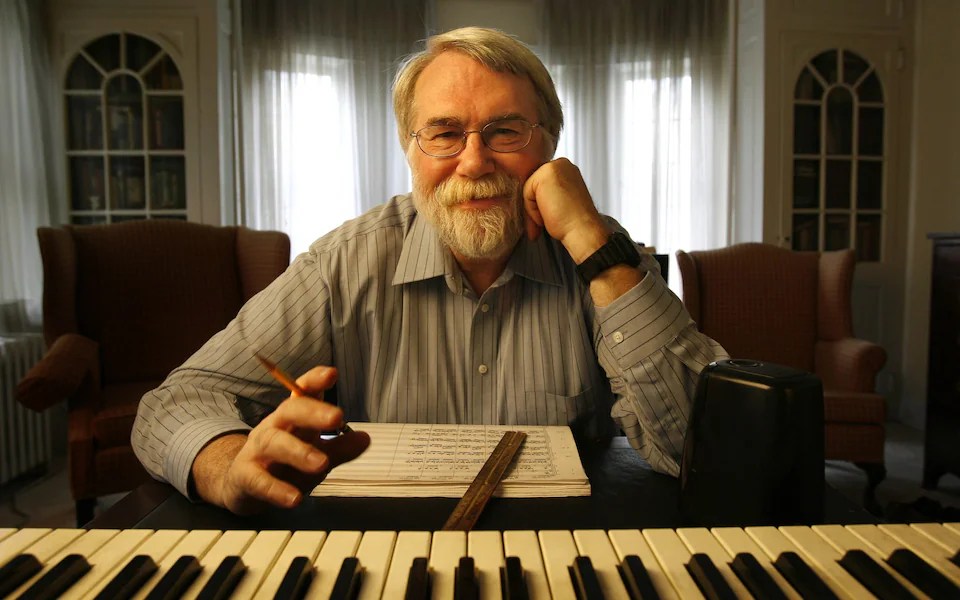
His Organ Concerto of 2014 appeared only last year in a Naxos collection of American Organ Concertos played by Paul Jacobs. The Rouse is the highlight, his usual wildly eclectic mix, only around 20-minutes in length and traditional in form but pugnacious in content, whether tonal or atonal. There is also drumming. Its central Lento, which hostile critics have already misheard as ‘sentimental’, is another of the composer’s heartfelt meditations on the nature and acceptance of grief. This matters as we age (this listener is 67 ½) while the finale’s return to consonance and affirmation despite noises off is not just for show. It moved me very much. Rouse wrote the piece ‘the old-fashioned way’ with pencil and paper, on a table.
You can listen to the whole piece on Tidal below – the Rouse is tracks 5 – 7:
If you’ve been near any social media platform in this country, you’ll have surely worked out why, as BBC Radio 2 is undergoing an overhaul on its daytime schedule. You will probably have been blasted by the massed choirs heralding the arrival of Scott Mills on breakfast…but I would argue that the real star of the show so far has been Trevor Nelson.
On the evidence of the shows I’ve heard so far, his transition from late evenings to afternoons has been a seamless one – helped by bringing the ’5 Seconds To Name’ feature quiz with him and bolstering it with the superb ‘Old School Run’.
Yet there is another factor to his early success – his new jingle. Trevor has been fortunate with jingles – he had a couple of crackers on the Rhythm Nation show – but this one, co-written and sung by Zoe Birkett, is a proper ‘diva moment’. Listen to the jingle and watch its recording here:
📻ITS OUT !!! Waghhhhh!! 📻 Buzzing to have recorded the vocal jingle for Dj Trevor Nelson @DjSpoonyofficial new radio show on @BBC Radio 2 I had so much fun with the writer in the studio, I was given a brief 2 days before recording but when I got into the booth the writer let me go loose vocally to pop my own spin on it , they were all so supportive and loved what I gave , and I can’t wait to tune in tonight to hear Spoonys jingle as hearing them LIVE on radio is there first time I’ve heard them ! Did anyone hear it ? ☺️ #singer#radio#bbcradio2#fy
From personal experience, writing such a short piece of music is anything but easy. The Darkness singer Justin Hawkins, no less, started out in music writing adverts for IKEA and Yahoo. He and his contemporaries deserve so much more credit than they get, for everyone recognises the old start-up for Microsoft Windows, the double, slightly stuttered chord that brings the start of another Netflix show, or even the cosmic flash with which ITVX is introduced.
Trevor’s jingle has a lot going on. Birkett – who finished fourth in the original Pop Idol competition – has gone for broke with a killer vocal, her convictions backed up by some spicy harmonies and a production suggesting big room funk from the 1980s, with an especially big cadence that brings the likes of Parliament to mind.
Birkett hasn’t stopped there either, delivering a similarly classy jingle for DJ Spoony’s Good Groove show. Proof that the art of the jingle is alive and kicking – those writers and performers deserve a good deal of credit!
Clyne Overflow (2020) Mozart Serenade no.10 in B flat major K361 ‘Gran Partita’ (1781)
Town Hall, Birmingham Sunday 26 January 2025 (3pm)
Reviewed by Richard Whitehouse
An interesting and worthwhile strand in the City of Birmingham Symphony Orchestra’s current season is the series of Sunday afternoon programmes focussing on each of the orchestra’s sections. Last November brought the strings for a perceptive account of Bach’s Goldberg Variations, as arranged by Dmitry Sitkovetsky and the present recital duly centred upon the woodwind in what was dominated – not unreasonably so – by a performance of Mozart’s epic Gran Partita.
Still the finest and probably longest work ever composed for wind ensemble, it also remains the canniest example of ‘functional’ music raised to a level such as transcends its immediate purpose. Not the least of its virtues is the way in which its orchestration – comprising pairs of oboes, clarinets, basset horns and bassoons along with four horns and double-bass – suggests timbral and textural possibilities as profound as they are far-reaching. Put another way, this is ‘Harmoniemusik’ which makes of a localized and even provincial genre something universal.
Such a quality was rarely less than present in this performance. Right from its trenchant yet never portentous introduction, the opening Allegro found an enticing balance between poise and impulsiveness matched by that between tutti and ensemble passages. The first Menuetto was notable for the winsome elegance of its second trio, then the ensuing Adagio yielded no mean pathos without risk of sentimentality at a flowing tempo abetted by that effortlessness of dialogue which proved a hallmark of this movement as of the performance taken overall.
Although less overtly characterful than its predecessor, the second Menuetto did not lack for personality and while the Romanze feels the least essential part of the overall conception, it still made for a pertinent entrée into the Tema con variazioni. This longest and most varied movement also encapsulates the work overall in its expressive contrasts which were to the fore here – the last variation preparing unerringly for a final Allegro whose relative brevity was belied by a drive, even forcefulness that propelled the whole work to its decisive close.
It was a testament to the excellence of these musicians that one never suspected the absence of any guiding hand, for all that guest first oboist Nicholas Daniel could be seen encouraging the players whenever his part permitted. Neither was there any sense of the latter being other than integral to the overall ensemble, such was the underlying felicity and finesse with which it conveyed the depths of what must surely rank among its composer’s greatest achievements. Not a bad way, moreover, for the CBSO’s woodwind to savour its occasion ‘in the spotlight’.
The programme had commenced just over an hour earlier with Overflow, a short but eventful piece where Anna Clyne draws inspiration from Emily Dickinson’s poetry (and, in turn, that by Jelaluddin Rumi) in music which treads an audibly viable balance between the ruminative and capricious. It made an understated showcase for the CBSO woodwind, whose brass and percussion colleagues are heard in the next of these recitals when Alpesh Chauhan directs a varied programme climaxing in Pictures at an Exhibition arranged by the late Elgar Howarth.
List of players: Marie-Christine Zupancic and Veronika Klirova (flutes), Nicholas Daniel and Emmet Byrne (oboes), Oliver Janes and Joanna Paton (clarinets), Anthony Pike and Steve Morris (basset horns), Nikolaj Henriques and Tony Liu (bassoons), Elspeth Dutch and Neil Shewan (horns), Julian Atkinson (double bass)