In concert – Laurence Kilsby, Christopher Parkes, Sinfonia of London / John Wilson: Serenade @ Barbican Hall, London

Laurence Kilsby (tenor), Christopher Parkes (horn), Sinfonia of London / John Wilson

Vaughan Williams Fantasia on a Theme by Thomas Tallis (1910)
Britten Serenade for Tenor, Horn and Strings Op.31 (1943)
Bliss Music for Strings B66 (1935)
Delius arr. Fenby Late Swallows (1916, arr. 1962)
Elgar Introduction and Allegro Op.47 (1904-05)

Barbican Hall, London
Wednesday 22 October 2025

Reviewed by Richard Whitehouse

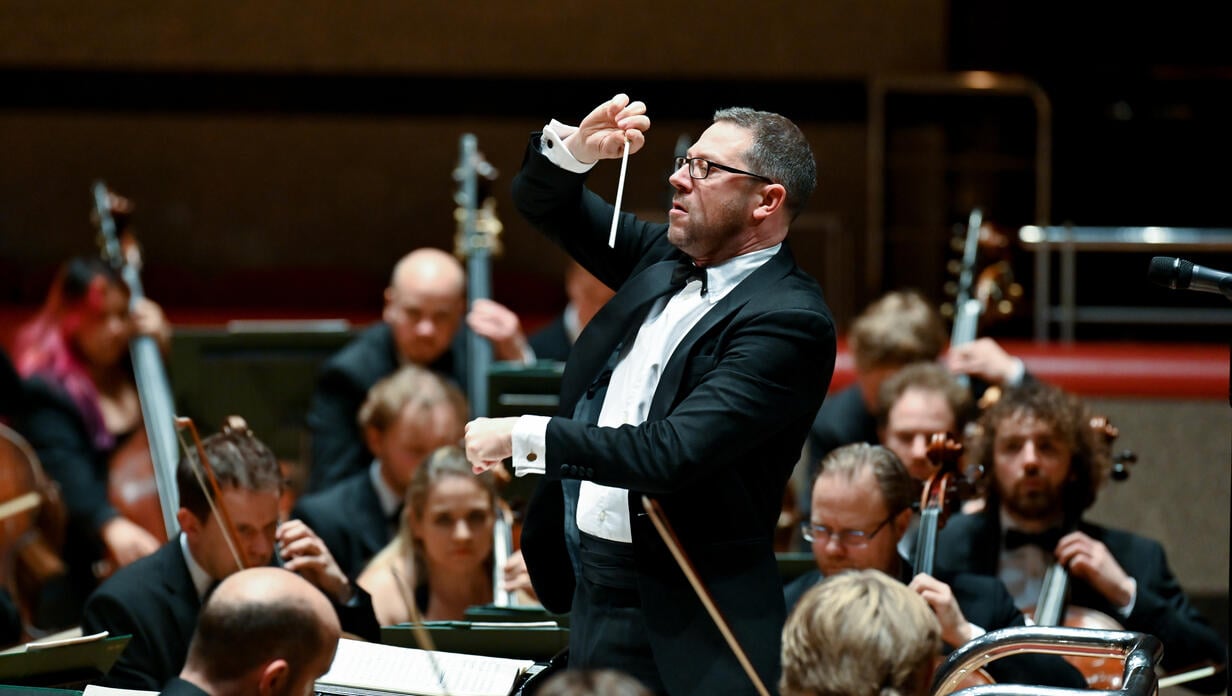
One can only commend John Wilson and Sinfonia of London for, in addition to an ambitious recording schedule for Chandos, frequently taking its programmes on tour – as has been the case with this judicious selection of works for string orchestra tonight being heard in London.

There could hardly be an acoustic less suited to Vaughan Williams’s Tallis Fantasia than that of Barbican Hall, yet Wilson went a good deal of the way toward making it succeed by having the main string body – and solo quartet – to the front of the platform with the subsidiary group arrayed along its rear. The outer section were taken slowly and almost impassively, but there was no lack of impetus or fervency as the central phase built cumulatively towards its climax.

The relatively modest number of strings seemed ideally suited to Britten’s Serenade. Laurence Kilsby (who made a fine contribution to Bliss’s The Beatitudes at this year’s Proms) brought real tenderness to Pastorale and ardour to Nocturne, while Christopher Parkes was suitably plangent in Elegy and dextrousness itself in Dirge. Tenor and hornist joined delightfully in Hymn, then Wilson drew playing of fastidious poise in Sonnet. Just a little unsteady in the Prologue, Parkes excelled in the offstage Epilogue with its ethereal reprise of that opening music – so rounding off a performance that proved affecting and unaffected in equal measure.

Live and in the studio, Wilson has affirmed a commitment to the music of Bliss which could hardly have been more evident than in Music for Strings which formed the centrepiece of this concert. It had been written for the Vienna Philharmonic to premiere at the Salzburg Festival and, if its formidable technical demands no longer sound forbidding, there can have been few performances of this virtuosity or insight. Trenchant and impulsive, the opening Allegro was followed by an Andante whose sustained eloquence never excluded lightness of touch – with the speculative transition into the final Allegro as deftly handled as the Presto with which this work surges to its headlong close. Not merely a timely revival, this was no less a vindication.

Introducing this second half, Wilson had remarked how Delius’ music needs to be coaxed into yielding up its secrets as surely as it needs selling to the musicians. Late Swallows succeeded on both fronts. As arranged by Eric Fenby from the composer’s only mature string quartet, it takes its place among the latter’s most haunting evocations, and not least in a central section whose rapt intensity brought an emotional frisson that tangibly held its listeners spellbound.

Elgar’s Introduction and Allegro may, by contrast, be a piece that plays itself but it still calls for interpretive input of a high order. Wilson responded with an unusually swift reading such as emphasized its nervous intensity and often volatile changes of mood, though there was no lack of cohesion or underlying momentum in a performance that took such testing passages as the central fugato assuredly in its stride prior to a glowing apotheosis then decisive close.

A performance, moreover, as set the seal on a memorable evening’s music-making. All these pieces, save the Britten, have been recorded by Wilson and Sinfonia of London for Chandos, their advocacy of Bliss hopefully continuing well beyond this 50th anniversary of his death.

Click here to read Arcana’s review of English Music for Strings, the Chandos album containing the Bliss and Vaughan Williams works performed in this concert.

Click also on the links for more information on the Sinfonia of London and their conductor John Wilson, along with soloists Laurence Kilsby and Christopher Parkes. For more information on Bliss, you can visit the Arthur Bliss Society

Published post no.2,697 – Friday 24 October 2025

In concert – Sheku Kanneh-Mason, Sinfonia of London / John Wilson: Hesketh, Shostakovich & Rachmaninov @ Barbican Hall

Sheku Kanneh-Mason (cello), Sinfonia of London / John Wilson

Hesketh PatterSongs (2008)
Shostakovich Cello Concerto no.2 in G major Op.126 (1966)
Rachmaninov Symphony no.1 in D minor Op.13 (1895-7)

Barbican Hall, London
Tuesday 15 October 2024

Reviewed by Ben Hogwood Picture (c) Mark Allan

This memorable concert enhanced the Sinfonia of London’s status as orchestral game changers. Conductor John Wilson re-established the ensemble in 2018 as a group taking on special projects, both in the studio for Chandos and in the concert hall. To date these have included early musicals, with Oklahoma! and Carousel in the bag, alongside top drawer recordings of orchestral works by Korngold, Ravel and Rachmaninov. The latter’s Symphony no.1, set down the previous week, completes a cycle of his symphonies.

Before that, we heard an orchestral tour de force from Kenneth Hesketh, fully established as a striking voice in British contemporary music. PatterSongs is a dense orchestral collage of music drawn from his opera The Overcoat, after Gogol. Its colourful score is decorated and ultimately dominated by the woodblock, part of a vibrant percussion section whose contributions bring the piece to theatrical life. They were brilliantly played here, as Wilson kept a tight grip on proceedings. With moods ranging from exuberant to grotesque, the sonics panned between slithering trombones, luscious strings and smoky, jazzy interludes with a slow drumkit. All contributed to the spirit of the dance in an ideal modern concert opener.

The Cello Concerto no.2 by Shostakovich offered a marked contrast. Sheku Kanneh-Mason has a special affinity with the composer’s music, having won the BBC Young Musician of the Year in 2016 with a performance of his first cello concerto. Since then he has also played the scarcely heard Cello Concerto by his contemporary and close friend Weinberg. The second concerto is a very different animal to the first, a private and often worrisome affair whose attempts at jollity and light-heartedness are compromised by music of latent menace. The personality of the concerto’s dedicatee, Mstislav Rostropovich, is never far from the music’s mind.

Kanneh-Mason and Wilson found the work’s qualities, if not its beating heart. This was down to a desire to push for faster tempi, their account not always pausing for breath where it might, as though the silence between notes might give something away. The first movement Largo was ideally pitched, questioning and with the occasional hint of a smile. Ultimately it succumbed to the brooding, omnipresent lower strings, who often finished the soloist’s sentences. The Allegro released this tension with impressive solo cadenzas from Kanneh-Mason, who inhabited the outbursts of energy but received the ideal complement in similar phrases from the outstanding horns (Chris Parkes and Jonathan Quaintrell-Evans), bassoons (Todd Gibson-Cornish and Angharad Thomas), timpani (Antoine Bedewi) and percussion (the superb quintet of Alex Neal, Owen Gunnell, Paul Stoneman, Fiona Ritchie and Elsa Bradley).

The transfer to the finale, while Allegretto as marked, felt breathless, the cello’s recurring sweep up to a top ‘B’ robbed of the room it needed for maximum impact. Similarly the macabre ticking of the percussion was clipped. In spite of this, however, Shostakovich’s feverish statement – direct from the sanatorium where he spent his sixtieth birthday – still made a profound impact. As a side note, how gratifying it was to see Kanneh-Mason, a gracious soloist, acknowledge the orchestral contributions mentioned above, before a well-chosen encore of Weinberg, the 18th of his 24 Preludes for solo cello.

Rachmaninov’s Symphony no.1 received a famously disastrous premiere in 1897, one that would affect its composer’s mental health for many years. Indeed he did not hear the work again in his life, the memory of its ragged and disrupted performance under an intoxicated Glazunov fuelling monumental bouts of self doubt. This account could hardly have been more different, John Wilson presiding over a performance of feverish intensity and white hot rhythmic precision. The Sinfonia of London were simply outstanding, led by a first violin section so fully invested in the music they were practically burning a hole in their musical scores!

Wilson clearly loves this piece, and as they set out the immediate drama of the first movement fugue the Sinfonia added clarity to their list of qualities. The silvery strings and rolling timpani of the Intermezzo were beautifully turned, Wilson heightening the connections with Tchaikovsky, whose Pathétique symphony predated this piece by just one year. It was possible to sense a passing of the baton between the two, such was the strength of feeling generated in this performance.

The slow movement had heavenly strings, its central section with increasingly fractious brass that dissolved with the return of the main theme, Wilson crouching towards the floor as he cajoled the strings to greater heights, with hints again of Tchaikovsky’s Romeo and Juliet.

Everything cut loose in the finale, a thrilling drive to the finish from the jubilant main theme to the crash of the gong at the end – where the percussion section were once again on top form, the full force of Rachmaninov’s orchestra laid bare. In these hands it was difficult to see how the first symphony could be perceived as anything other than a masterpiece, its lean structure supporting powerful emotions and meaningful tunes. Wilson and the Sinfonia of London had them all in spades, finishing a concert that will live long in the memory. My ears are still ringing!

You can find more information on further 2024 concerts of this program at the Sinfonia of London website

Published post no.2,333 – Wednesday 16 October 2024

On record: Sinfonia of London / John Wilson – John Ireland: Orchestral Works (Chandos)

John Ireland
Satyricon Overture (1946)
A Downland Suite [1941, arr. Ireland (movements 2 & 3), Geoffrey Bush (1 & 4)]
Mai-Dun (1920-21)
The Forgotten Rite (1913)
A London Overture (1936)
The Holy Boy (1941, Ireland’s string orchestra arrangement)
Epic March (1941-42)

Sinfonia of London / John Wilson

Chandos CHAN 5293 [67’16”]
Producer Brian Pidgeon
Engineer Ralph Couzens

Recorded 26-28 August 2021, Church of St. Augustine, Kilburn, London, UK

Reviewed by Ben Hogwood

What’s the story?

John Ireland is a well-respected composer in the scope of early 20th century British music. Often writing in shorter forms, his songs and piano music present a fine body of work and enable the listener to get to know this bittersweet musical personality. Meanwhile the more substantial chamber music shows Ireland was capable of handling larger structures.

A good way in to the composer’s output is through his orchestral music, and there are several attractive anthologies already available – from Sir Adrian Boult and from John Wilson himself, conducting the Halle Orchestra. Wilson returns to the composer here in the company of the Sinfonia of London to give us a collection of suites, tone poems and pictorial overtures. Perhaps inevitably, The Holy Boy – Ireland’s best-known song – is also included, in its arrangement for string orchestra.

What’s the music like?

Ireland’s music is simultaneously elusive, heartfelt, melodic and elegiac – and these fine performances get right to the heart of his thinking.

Wilson and his charges begin with a good-natured account of the overture Satyricon, enjoying its syncopations before a smooth and elegant second theme from the strings, who impress with their command of the longer phrases. They come to the fore in a co-arranged version of A Downland Suite, two movements each recast from the brass band original by Ireland himself an Geoffrey Bush. This is music of silvery tone and generous melodic content, with an incisive Prelude, solemn Elegy, poised Minuet and a crisp, upward looking Rondo. Contrasting this with Mai-Dun is a good move, revealing Ireland’s colourful orchestrations and some lavish harmonies while digging deep emotionally.

The Forgotten Rite, a prelude serving as Ireland’s first published orchestral work. also has deep underlying emotion, while The Holy Boy – Ireland’s favoured song – is more sentimental but not excessively so. Bigger sounds are promised by the Epic March, which certainly lives up to its billing and stature, and A London Overture, which may have less bustle than its Elgarian counterpart (Cockaigne) but creates a studied portrait of the English capital city.

Does it all work?

Yes. Wilson has an innate understanding of this music, and with top class performances and clarity of recording there is little if anything to dispute here. The bigger pieces fare particularly well, with a crisply deployed Epic March and a detailed account of A London Overture that has particular insight in the work’s quieter moment. The Sinfonia’s account of A Downland Suite is subtle but affecting, with a gently dancing Minuet and a thoughtful Elegy that tugs softly but insistently at the heartstrings.

Perhaps the most successful piece is Mai-Dun, exploring some glorious shades of colour and texture, while the dappled sunlight of The Forgotten Rite is also exquisitely painted.

Is it recommended?

Yes – even in comparison with the Halle anthology, which shares much of the repertoire recorded here – though that one includes the suite The Overlanders rather than A Downland Suite. Either are very fine collections, but this Sinfonia of London set of recordings is extremely well recorded and performed with rare insight, capturing the composer’s personality to a tee.

Listen

Buy

You can view buying options for this release – on download or SACD – on the Chandos website

On record: Sinfonia of London / John Wilson – English Music for Strings (Chandos)

Sinfonia of London / John Wilson

Britten Variations on a Theme of Frank Bridge Op.10 (1937)
Bridge Lament (1915)
Berkeley Serenade for Strings Op.12 (1938-9)
Bliss Music for Strings (1935)

Chandos CHAN 5264 [64’46”]
Producer Brian Pidgeon
Engineers Ralph Couzens, Alex James

Recorded 9-11 January 2020, Church of St. Augustine, Kilburn, London, UK

Reviewed by Ben Hogwood

What’s the story?

After three wonderful albums extolling the virtues of French orchestral music, Korngold and Respighi, John Wilson and his Sinfonia of London charges turn much closer to home with a set of British music for strings drawn from the 1930s. They begin with an established classic, Britten’s Variations on a Theme of Frank Bridge, complemented by two neglected works from Sir Lennox Berkeley (his Serenade for Strings) and Sir Arthur Bliss (the Music for Strings), neither of which appears to have been recorded in the last 20 years. There is also room for the brief Lament from 1915 by Bridge himself.

What’s the music like?

Britten’s Variations on a Theme of Frank Bridge will be familiar to many, but rarely in a performance as good as this. The theme, lovingly drawn from the Second Idyll for string quartet of Britten’s teacher, receives a virtuoso treatment, taken through a number of wildly differing dance forms before a powerful fugue and finale. The variations are sharply contrasted, with a crisp March at odds with the loving Romance that follows; the fulsome Wiener Walzer countered by the rush of a Moto perpetuo.

Berkeley’s Serenade for Strings works really well in this company. It is a work beginning with outward optimism but which ultimately falling under the shadow of the imminent Second World War. A busy first movement, its Baroque influences brought out by Wilson, is complemented by an inward looking but tender Andantino. Berkeley finds renewed energy in a quickfire Scherzo, but that is trumped by the closing Lento, which leaves a lasting impression, reflecting the anxiety felt as the 1930s drew to a close.

There is a good deal of positive energy in Bliss’ Music for Strings. Taking a lead from Elgar’s Introduction and Allegro of 1905, the composer writes for a full string orchestra but often picks out a smaller group of soloists. The substantial three movements show a masterly command of the string orchestra, from the wide span of the vigorous first movement to the meaningful Romance that follows, with lovely rich contributions from violas and cellos. The third movement starts hesitantly, in the depths, but soon the light breaks through to an effervescent finale.

Does it all work?

Everything works here, thanks to the thoroughly assertive performances secured by Wilson. He is quite quick on the draw with the theme for Britten’s variations, maybe quicker than some would like, but the thrills and spills that follow make this one of the finest versions available. The Aria Italiana has all guns blazing in a wonderful display of precision and power, while the Funeral March has a searing and chilling clarity.

Successful though the Britten is, it is the Berkeley and Bliss that ultimately give the disc its importance. The Berkeley is keenly felt, positive in its fast music but anxious in its two slower movements and raising emotional questions in the fourth. Wilson catches its air of uncertainty at the world in which we live, as relevant now as it was then.

The Bliss has terrific drive in its faster music, which builds up a thoroughly convincing momentum while succeeding in bringing forward the writing for the chamber ensemble at the front. The textures are beautifully clear thanks to the Chandos recording, the quicker melodies’ punchy phrasing cutting through easily.

The Bridge Lament, though short, proves a mellow complement to the Britten, a chance for the listener to collect their thoughts while the Sinfonia play with a beautiful, muted sound.

Is it recommended?

In every way. John Wilson and the Sinfonia of London breathe new life into this music, and their programme is superbly judged to bring two neglected and very fine works back into contention. The cover, a painting of Bliss’s Pen Pits house by Edward Wadsworth, is the icing on the cake with its classic 1930s style.

For further information on this release, visit the Chandos website.

Arcana’s best of 2020

written by Ben Hogwood

Before finishing for Christmas and New Year celebrations, I wanted to offer some thoughts on the musical year that has been 2020. And what a year. I doubt we will experience its like again, that’s for sure – and those of you reading this will no doubt have had some incredible challenges to overcome, or have been instrumental in helping other with their challenges. Everything is firmly in perspective, that is for sure.

In the year of a global pandemic, as in all times of strife, music has been there offering a consoling shoulder to lean on. Much of my listening this year has been of the ambient kind, a place of retreat when all has been too frenetic / inhuman / scary. Music has really shown us its true colours again this year, offering the required escape route along with some real inspiration.

Live music, of course, has suffered greatly, and my thoughts are with all those musicians and people working behind the scenes in the arts, their lives irrevocably affected by COVID. As listeners we thank them for their remarkable resilience and inventiveness, bringing live-streamed concerts of such quality they have been the best possible substitute for the real thing. Wigmore Hall set the scene in June, and many others have followed. The orchestras and choirs should be held in the highest regard for their efforts.

Needless to say I did not attend many concerts in 2020, but two of great note were from soprano Louise Alder (above) and pianist Joseph Middleton, showcasing their exceptional album Lines written during a sleepless night at Wigmore Hall in January, and the Orchestra of the Age of Enlightenment under Iván Fischer performing the last three Mozart symphonies at the Royal Festival Hall in February.

I wanted to share with you my favourite music on record this year. It was of course Beethoven 250, and my aim was to listen to the composer’s entire works. That aim continues, but the deadline has been extended massively! It is proving a thoroughly enjoyable experience but circumstances mean it has taken much longer than expected. To enjoy the listening project to its full potential, I look forward to reconvening with the first Sonatas for cello and piano in 2021, and taking it over the finishing line later in the year.

This year’s new releases have been extremely fine – and I have eight to share with you here, beginning with Steven Osborne’s remarkable disc of three Prokofiev piano sonatas on Hyperion. This appeared at the same time as the Coronavirus and felt like a direct response to it. Prokofiev was writing these works during the Second World War, in part a reaction to intense world and personal strife, and what a performance they get from the Hyperion pianist. You can read about them here

On the orchestral front, John Wilson and his Sinfonia of London came out with a simply outstanding program of French music. Escales did the wonderful job of blending seasoned favourites such as Chabrier’s España with gems that benefited from a dusting off – Duruflé’s Trois Danses and Ibert’s Escales among them. My thoughts on the disc are here

One of the most striking contemporary releases this year capped a fine showing from Kenneth Woods, both with the English Symphony Orchestra and as here with the BBC National Orchestra of Wales. Philip Sawyers’ Symphony no.4 and Hommage to Kandinsky are captured by Richard Whitehouse in this review of two exceptional pieces of new music, given great performances under conductor Kenneth Woods.

Of the electronica that I mentioned, there are some rather special examples. First among them is Kaitlyn Aurelia Smith’s The Mosaic Of Transformation, an enchanting journey of vividly coloured musical motifs. I attempted to describe them and their impact here

https://www.youtube.com/watch?v=iB4uqD1IOiw

For something closer to home, Erland Cooper’s Hether Blether signed off his Orcadian trilogy with deeply emotive recollections and portraits of home. Complementing the previous instalments Solan Goose and Sule Skerry, it was a life affirming, communal piece of work uniting thoughts at just the right time. You can read Arcana’s interview with Erland here

Meanwhile Bruce Brubaker & Max Cooper took a minimalist composer as their inspiration for Glassforms, a set of electronic reworkings of the music of Philip Glass. Rather than simply dress up the originals, it is an imaginative and very well thought-out set of recastings, detailed here

Also taking inspiration from similarly minimal sources were New York’s Bing & Ruth, through the excellent Species long player. You can read about it here – and the background to the album in an emotive interview with leader David Moore here

On the other end of the scale sit Rick Wakeman and the English Rock Ensemble. After a series of stripped back piano albums this is Wakeman at his progressive best, in the company of some exceptional musicians, creating some dramatic and involving music. You can read Arcana’s review here – and an extensive interview with the keyboard wizard here

For music of great verve and positivity, drummer Tony Allen’s collaboration with trumpeter Hugh Masekela, posthumously published, took some beating. The recordings were made in 2010, but were unfinished at the time of Masekela’s death. The passing of Allen himself this year lent their completion extra poignancy. It was the closest I could find to pure musical joy in 2020, as documented here!

Meanwhile, returning after a long break was Charles Webster, making Decision Time – an album of very fine, futuristic soul and deep house. Much has changed since we last heard from Webster in this way, but his musical values remain the same, as reported here

It is not too much of a stylistic shift from Webster to Róisín Murphy, where we find my personal album of the year. Róisín Machine is a brilliant combination of Murphy’s effervescent, spiky personality and some really fine future disco, created with the help of Crooked Man (aka Richard Barratt). As noted here, it has the resilience and strength in the face of adversity we all needed in 2020, but crucially the sense of fun we will still need – and will surely get back – in 2021. Happy Christmas!