Arcana at the Proms – Prom 33: Christopher Maltman, BBC Symphony Orchestra / Martyn Brabbins – Elgar, Holst, Stanford & Vaughan Williams London Symphony

Elgar Overture ‘Cockaigne’ (In London Town) Op.40 (1901)
Holst Hammersmith (Prelude and Scherzo) Op.52 (1930)
Stanford Songs of Faith Op. 97 (1906): no.4 (To the Soul), no.5 (Tears), no.6 (Joy, ship-mate, joy); An Irish Idyll in Six Miniatures Op.72 (1901): no.2 (The Fairy Lough)
Vaughan Williams A London Symphony (Symphony no.2) (1912-13, rev. 1918-20)

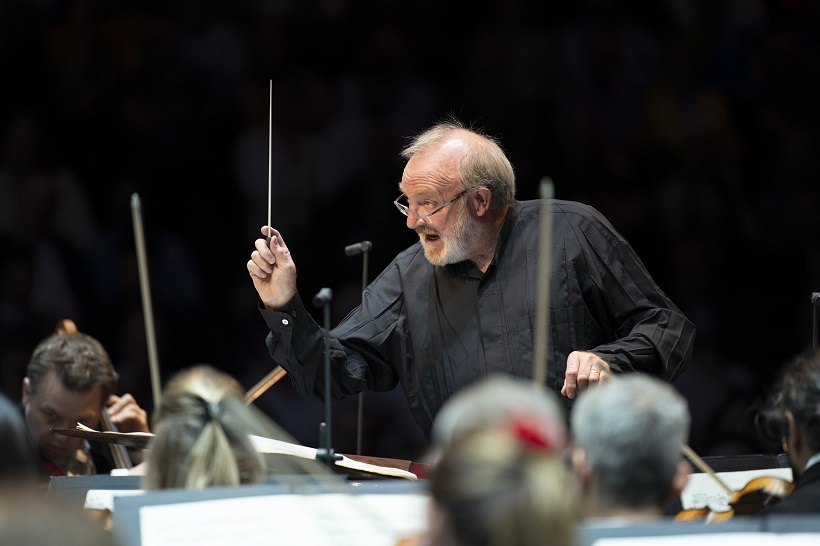
Christopher Maltman (baritone), BBC Symphony Orchestra / Martyn Brabbins

Royal Albert Hall, London
Friday 9 August 2024, 6pm

reviewed by Richard Whitehouse

Concerts devoted to British music are by no means an unknown quantity at the Proms, but to have one as judiciously planned as that featuring Martyn Brabbins with the BBC Symphony Orchestra, on the conductor’s 65th birthday, was as unexpected as its realization ‘on the night’ proved consistently impressive.

Whether or not this account of Elgar’s Cockaigne ranked among the best of the previous 70 or so hearings at these concerts, it assuredly did the piece justice. Not its least attraction was Brabbins integrating this evocation of London on the cusp of Victorian and Edwardian eras with due perception of its ingenious sonata design, resulting in a reading as characterful as it was cohesive. Such as the emergence of the marching band at its centre and final peroration (Richard Pearce making his presence felt at the organ console) were the highpoints intended.

Whereas Elgar conveys London in its midst, Holst renders Hammersmith at a remove – his Prelude and Scherzo evoking those sights and sounds where the latter long made his home with a poise and precision no less involving for its objectivity. The orchestral version might be less often revived than its wind-band original but it yields little, if anything, in terms of expressive immediacy; not least with Brabbins mindful to underline how its two sections do not just succeed each other but are juxtaposed, even superimposed, prior to the rapt ending.

In the centenary of Stanford’s death, this selection of songs provided a welcome reminder of its composer’s prowess in the genre. The final three Songs of Faith denote an appreciation of Walt Whitman comparable to that of the next generation – whether in the eloquent musing of To the Soul, surging anguish of Tears or effervescence of Joy, shipmate, joy. Christopher Maltman then brought his burnished tone and clarity of diction to an affecting take on Moira O’Neill’s The Fairy Lough – proof Stanford could do ‘lightness of touch’ where necessary.

Whereas Stanford’s songs have barely featured here for almost a century, Vaughan Williams’s A London Symphony has accrued 36 performances, but what might be thought its ‘intermediate version’ had not been heard in nine decades. Actually, this is much closer formally to the final version of 1933 than the original – its main differences centring on those more extensive codas in the Lento and finale which, by aligning them more audibly with the introduction to the first movement, arguably ensures a more thematically close-knit trajectory across the work overall.

The performance was very much in accord with Brabbins’ recording (Hyperion). An unforced traversal of the opening Allegro, impetuous in its outer sections and affecting in that rapturous passage for solo strings at its centre, then a slow movement whose brooding introspection did not omit a sustained fervency at its climax. Nor did the Scherzo lack those ambivalent asides that find focus in its sombre close, while the nominally discursive finale built purposefully to a seismic culmination then an epilogue which drew solace from the aftermath of catastrophe.

‘‘The river passes – London passes – England passes’’. Whether the closing words from H.G. Wells’ Tono-Bungay determined or even influenced it, a sense of renewal was palpable as the music faded towards silence at the end of this persuasive performance and memorable concert.

For more on this year’s festival, visit the BBC Proms website – and to read more on the artists involved, click on the names: baritone Christopher Maltman, conductor Martyn Brabbins and the BBC Symphony Orchestra. Click on the name for more on The Stanford Society

Published post no.2,270 – Wednesday 14 August 2024

Arcana at the Proms – Prom 19: Jess Dandy, Senja Rummukainen, BBC SO & Sakari Oramo – Holst ‘Cloud Messenger’, Harvey & Elgar

Harvey Tranquil Abiding (1998) [Proms Premiere]
Elgar Cello Concerto in E minor, Op. 85 (1918-19)
Holst The Cloud Messenger, H111 (1909-10, rev. 1912) [Proms Premiere]

Jess Dandy (contralto), Senja Rummukainen (cello), BBC Symphony Chorus, BBC Symphony Orchestra / Sakari Oramo

Royal Albert Hall, London
Saturday 3 August 2024

reviewed by Richard Whitehouse Photos (c) Chris Christoudoulou

Now approaching his 12th season as chief conductor of the BBC Symphony Orchestra, Sakari Oramo tonight gave his first Prom of the season with this typically well-balanced programme of British music framing unfamiliar pieces past or (relative) present with a classic of its genre.

First came a welcome revival for Tranquil Abiding – doubtless one of Jonathan Harvey’s most immediately appealing works and one where the rhythm of ‘breathing’ central to so much of his later output is afforded lucid expression. The degree to which its melodic content emerges out of then returns into the surrounding texture was duly conveyed by Oramo, who ensured a real sense of expectation as this music took on an almost tangible impetus towards its climax. A pity that some restless and inattentive listeners robbed the final stage of its ‘ultimate calm’.

Long before it had the eminence it now enjoys, Elgar’s Cello Concerto was a regular Proms item through advocacy from Beatrice Harrison, Anthony Pini and, latterly, Jacqueline du Pré. Senja Rummukainen (above) thus joined a distinguished roster of soloists and, in the first movement at least, seemed a little inhibited in this context. Her arresting lead-in to the scherzo brought playing of greater involvement, both here and in an Adagio whose autumnal eloquence never risked sentimentality. The relatively lengthy finale was securely rendered, its themes incisive then genial, and if the development culminated a little portentously, the reprise was tellingly subdued before a moving apotheosis and curtly inevitable coda. Rummukainen can be heard again in London in the Dvořák concerto, with the BBC Concert Orchestra, this October 4th.

In the 150th anniversary of his birth, and the 90th anniversary of his death, a major revival by Gustav Holst was almost mandatory. Setting his translation from the Sanskrit of a poem by Kālidāsa, The Cloud Messenger never quite recovered from its evidently disastrous premiere such that revivals have been occasional. At almost 45 minutes, it is a demonstrable statement of intent whose expansive choral gestures are assured but almost anachronistic given Holst’s chamber opera Sāvitri redefined his conceptual approach and musical idiom barely a year before. Yet the present work amply foreshadows much of what was achieved over the next two decades, notably a freely evolving melisma mostly unimpeded by rhythmic precedent and a harmonic subtlety such as only needed greater refinement in its handling to realize its fullest potential.

That much of this latter aspect was already in place is clear from those intimate passages for semi-chorus to the fore during its later stages, while the third of its five continuous section brought a confiding soliloquy that Jess Dandy (above) – contralto in the truest sense – realized with distinction. A pity she was not heard again, but the BBC Symphony Chorus was not found wanting beforehand or in that ethereal leave-taking with which the work evanesces, ‘Venus’-like, to its close. Whatever the stylistic inconsistencies, the best of it is Holstian to its core.

Now it is available in an expert reduction for chamber orchestra by Joseph Fort, The Cloud Messenger should attract more frequent hearings, but the Royal Albert Hall proved a fitting venue for this expansive original while Oramo’s perceptive performance did not disappoint.

For more on this year’s festival, visit the BBC Proms website – and for more on the artists involved, click on the names to read more about Jess Dandy, Senja Rummukainen, the BBC Symphony Chorus, BBC Symphony Orchestra and chief conductor Sakari Oramo

Published post no.2,261 – Monday 5 August 2024

Arcana at the Proms – Prom 10: Laura van der Heijden, BBC Scottish Symphony Orchestra & Ryan Wigglesworth – Britten, Frances-Hoad & Elgar

Britten Gloriana – Symphonic Suite Op.53a (1953)
Frances-Hoad Cello Concerto ‘Earth, Sea, Air’ (2022) [Proms Premiere]
Elgar Symphony no.2 in E flat major Op.63 (1909-11)

Laura van der Heijden (cello), BBC Scottish Symphony Orchestra / Ryan Wigglesworth

Royal Albert Hall, London
Friday 26 July 2024

reviewed by Richard Whitehouse

He might not be the only composer-conductor of his generation, but Ryan Wigglesworth has rapidly established himself among the best – as this concert with the BBC Scottish Symphony Orchestra, whose chief conductor he has been over these past two seasons, amply confirmed.

Other than Peter Grimes, the coolly received Gloriana was his only opera from which Britten extracted a concert suite. The vaunting syncopation of Tournament then wrenching fatalism of Gloriana moritura make for a telling framework, with this account at its most perceptive in the wistful poise of the Lute Song – the oboe being an eloquent replacement for the tenor thanks to Stella McCracken – then the evocative sequence of Courtly Dances where Britten effortlessly bridges the historical and the aesthetic divide between the eras of two Elizabeths.

Next a first Proms hearing (just over a year after its Glasgow premiere) for the Cello Concerto by Cheryl Frances-Hoad. Drawing inspiration from recent research into diverse aspects of the natural world, the three continuous movements provide an arresting vantage on an outwardly traditional form. Hence the trajectory of swifts in flight, carbon-absorbing algae over oceanic expanses and gravitational force of volcanic activity each influencing the musical content of a rhythmically impulsive Allegro, harmonically diaphanous Larghetto and melodically soaring Presto giocoso; the whole afforded unity through its composer’s motivic resourcefulness and the engaging commitment of Laura van der Heijden (above) in her realizing of its solo part. She then responded to deserved applause with a limpid reading of Pablo Casals’ The Song of the Birds.

Elgar is a composer evidently close to Wigglesworth’s heart and this evening’s account of his Second Symphony did not disappoint. Launched a little too circumspectly, the initial Allegro duly found a persuasive balance between bounding energy and that musing uncertainty to the fore in the otherworldly processional near its centre. Its overall extroversion was countered by the Larghetto – circumstantial association with the death of Edward VII having tempted many into a funereal pacing but not Wigglesworth, whose handling of its cumulative halves brought sustained emotional intensity framed by the stark lamentation with which it begins and ends.

One of Elgar’s most formally subtle and expressively audacious movements, the scherzo had the requisite impetuousness and nonchalance, thrown into relief by the mechanistic violence towards its core and unnerving energy at its close. Moderate in tempo and not overly majestic in outlook the finale might have been thought anti-climactic, but Wigglesworth’s keen sense of its long-term unfolding emerged in the searching ambivalence of its development and the understated grandeur of a peroration which did not require reinforcing with an organ pedal. Those closing pages could have yielded even greater pathos, but their suffused fatalism was wholly in accord with the conductor’s conception of this movement, as of the work overall.

Just over a year before, Wigglesworth presided over an inspirational account in Birmingham of The Dream of Gerontius. Tonight’s performance of the Second Symphony might not have been quite its equal, but it more than confirmed him as an Elgar interpreter of genuine stature.

For more on this year’s festival, visit the BBC Proms website – and for more on the artists involved, click on the names to read more about Laura van der Heijden, the BBC Scottish Symphony Orchestra and conductor Ryan Wigglesworth, and composer Cheryl Frances-Hoad

Published post no.2,253 – Sunday 28 July 2024

A serenade for an early summer evening…

…in the form of an early work by Sir Edward Elgar. Here is his Serenade for Strings in E minor Op.20, performed by the Royal Philharmonic Orchestra, conducted by Sir Charles Groves:

Published post no.2,204 – Sunday 9 June 2024

In concert – Geneva Lewis & Georgijs Osokins @ Wigmore Hall: Brahms, Scarlatti & Elgar

Geneva Lewis (violin, above) and Georgijs Osokins (piano, below)

Brahms Violin Sonata no.2 in A major Op.100 (1886)
Domenico Scarlatti Sonata in D minor Kk213
Elgar Violin Sonata in E minor Op.82 (1918)

Wigmore Hall, London
Monday 20 May 2024 (1pm)

by Ben Hogwood

The Violin Sonata no.2 is one of Brahms‘s chamber music perennials, a popular recital fixture – but in this recital from BBC New Generation Artist Geneva Lewis and Latvian pianist Georgijs Osokins it was as though the work had received a fresh coat of paint.

The tempo marking Brahms applied to the first movement, Allegro amabile, is seldom found in classical music – ‘amabile’ meaning ‘lovely’. That was certainly the case in this performance, though Lewis and Osokins took a much slower tempo than is the norm. Their daring approach succeeded, however, for the melodic phrasing blossomed, the spring-like main tune given plenty of room to shine. The second theme was laid bare, but again the slow tempo allowed for greater insight, followed attentively by the Wigmore Hall audience.

The dynamic range of both players was also notable, Lewis very much aware of her surroundings in the quiet passages, the audience subconsciously leaning in to the music. At points the music was so quiet that Osokins’ pedalling could be heard…but conversely the pair were not afraid to put the pedal down and play out, as they did in the finale. In between came a tender and affectionate middle movement, its dreamy opening certainly tranquillo, before a most appealing central vivace section.

Elgar’s Violin Sonata was completed when the composer had just turned 60 – and although he would live for another 16 years, very few major works followed. To hear the sonata played by performers in their twenties was eye-opening indeed, with more youthful elements of the piece revealed and a different light shed on a work that often has autumnal reflections to cast.

The first movement was notable for its commanding first paragraph, Lewis setting the tone for the movement as she became immersed in Elgar’s broad phrasing. Osokins, for his part, mastered the full piano textures most impressively, before both performers drew back for a thoughtful second theme. The second movement became a fascinating mini-ballet between the two instruments, its shadowy colours a clue to the composer’s darker thoughts, though the bittersweet melodies were given extra charm by the dance-inflected rhythms.

The finale took flight immediately, the violin surging forward with penetrating melodies that led to a sense of sunlight breaking through the clouds in the closing phrases, Elgar allowing his thoughts to brighten as the music turned to the major key. The imaginatively chosen encore capitalised on this, Lewis and Osokins giving us the rustic finale of Busoni’s Violin Sonata no.2 in E minor, music which might have passed for one of Brahms’s Hungarian-influenced works were it not for some particularly scrunchy harmonies.

In between the two big sonatas, Osokins (above) had the chance to shine alone, one he took with a profound account of one of Domenico Scarlatti‘s many keyboard sonatas. The Sonata in D minor Kk213 is a bittersweet piece, a reminder of how forward looking this composer’s music can. Rooted in the 18th century it may be, but in reality we could have been listening to a Satie Gnossienne, especially with Osokins’ poetic licence drawing out the final harmonic resolution.

Published post no.2,184 – Monday 20 May 2024