In concert – St. John’s College Choir Cambridge / Christopher Gray – Christmas Carols @ Wigmore Hall

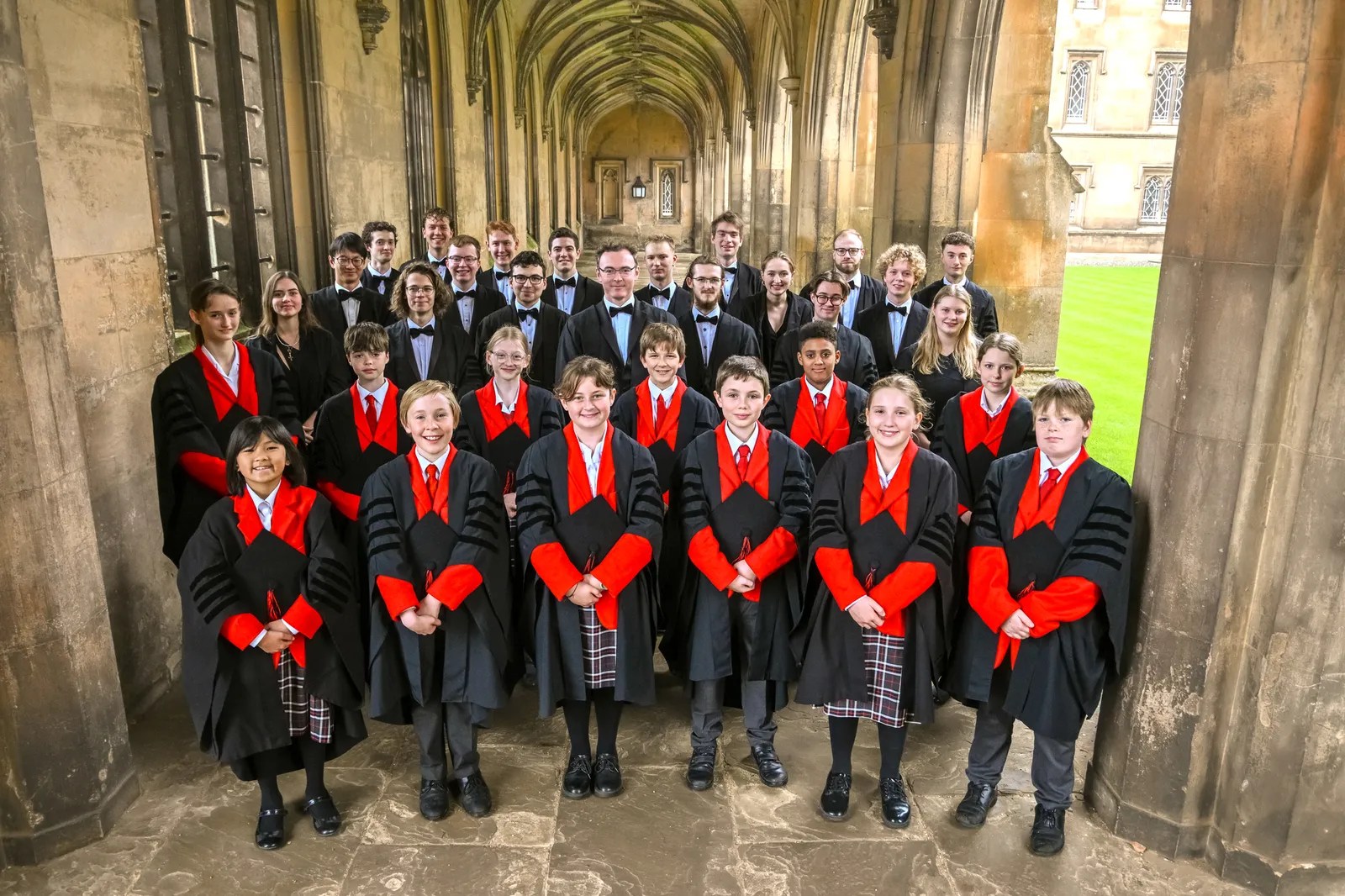
Choir of St. John’s College Cambridge / Christopher Gray

Beamish In the stillness (2007)
Rutter There is a flower (1986)
Parsons Ave Maria (c1560)
Hassler Verbum caro factum est (1591)
Britten A Hymn to the Virgin (1930, rev. 1934)
Walton All this time (1970)
Trad/German arr. Pearsall In dulci jubilo
Hieronymus Praetorius Magnificat quinti toni (pub. 1622)
Daley Love came down at Christmas (2004)
Poston Jesus Christ the Apple Tree (1967)
Kirbye Vox in Rama (c.1620)
Anon Coventry Carol
Dove The Three Kings (2000)

Wigmore Hall, London
Monday 15 December 2025

Reviewed by Ben Hogwood

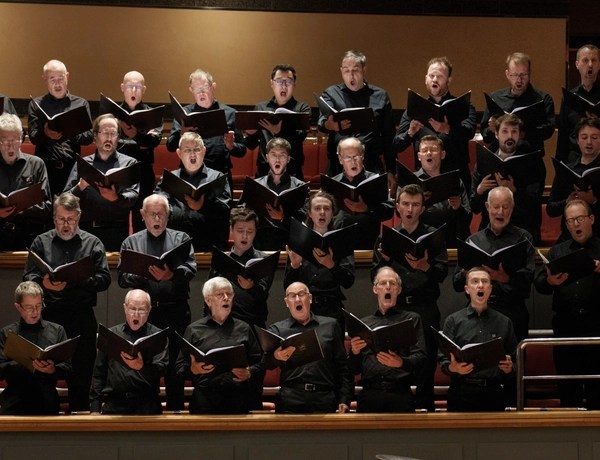
What a lovely idea to bring a concert of Christmas Carols to the last of the BBC Radio 3 Lunchtime Concerts held in the Wigmore Hall in 2025. The Choir of St. John’s College Cambridge, suitably attired, were led in a stirring yet thought-provoking programme by their conductor Christopher Gray, who have just released O Holy Night, an album of Christmas carols, on Signum Classics.

Yet much of the selection here went beyond the album’s component parts, exploring responses old and new to specific parts of the Christmas story. In a curious twist, the oldest music heard proved to be the most adventurous and emotive.

The concert began with an account of Sally Beamish’s In the stillness which was notable for its crystal clear intonation and enunciation, features the choir would display throughout the concert. John Rutter’s There is a flower fared equally well, the anthem he wrote for the choir leading with a touching treble solo, before the complexities of Robert Parsons’ masterful Ave maria were aligned in commendable phrasing. Similar qualities befell the lively exchanges of counterpoint in Hans Leo Hassler’s Verbum caro factum est, before the remarkable invention of the teenage Britten was found in A Hymn to the Virgin, music that looks simultaneously forward and backward.

The choir performed these carols in carefully arranged sequences, ideally programmed for tonality and emotive impact. Walton’s exuberant All this time began the second sequence, the choir enjoying the push-pull rhythms, after which In dulci jubilo switched on its ever-beautiful light in the darkness, casting a spell in spite of a slightly ragged second verse. The clever text setting of Hieronymus Praetorius – not the normally performed Michael! – was especially enjoyable in his Magnificat setting, before the clarity of carols from Canadian composer Eleanor Daley and Brit Elizabeth Poston was beautifully achieved. The latter’s Jesus Christ The Apple Tree was particularly moving in the simplicity with which its paragraphs end.

The mood darkened appreciably for George Kirbye’s lament Vox in Rama, the inconsolable Rachel weeping for the loss of her children in the massacre ordered by King Herod, while the Coventry Carol too sounded sombre in this company. All the more reason to end with a characterful account of Jonathan Dove’s The Three Kings, brilliantly characterised by the trebles especially.

Two encores followed – a breathless and exciting arrangement of Adam lay ybounden by Laura Sheils, then a close-harmony version of We Wish You A Merry Christmas, channelling Cole Porter to show-stopping effect. It was the musical equivalent of a mince pie with extra brandy, the ideal way to send the Wigmore Hall audience humming into the afternoon!

You can listen to the concert on BBC Sounds here, and explore the choir’s recent discography at the Signum Classics website.

Published post no.2,750 – Tuesday 16 December 2025

In concert – The Gesualdo Six & Matilda Lloyd @ Wigmore Hall

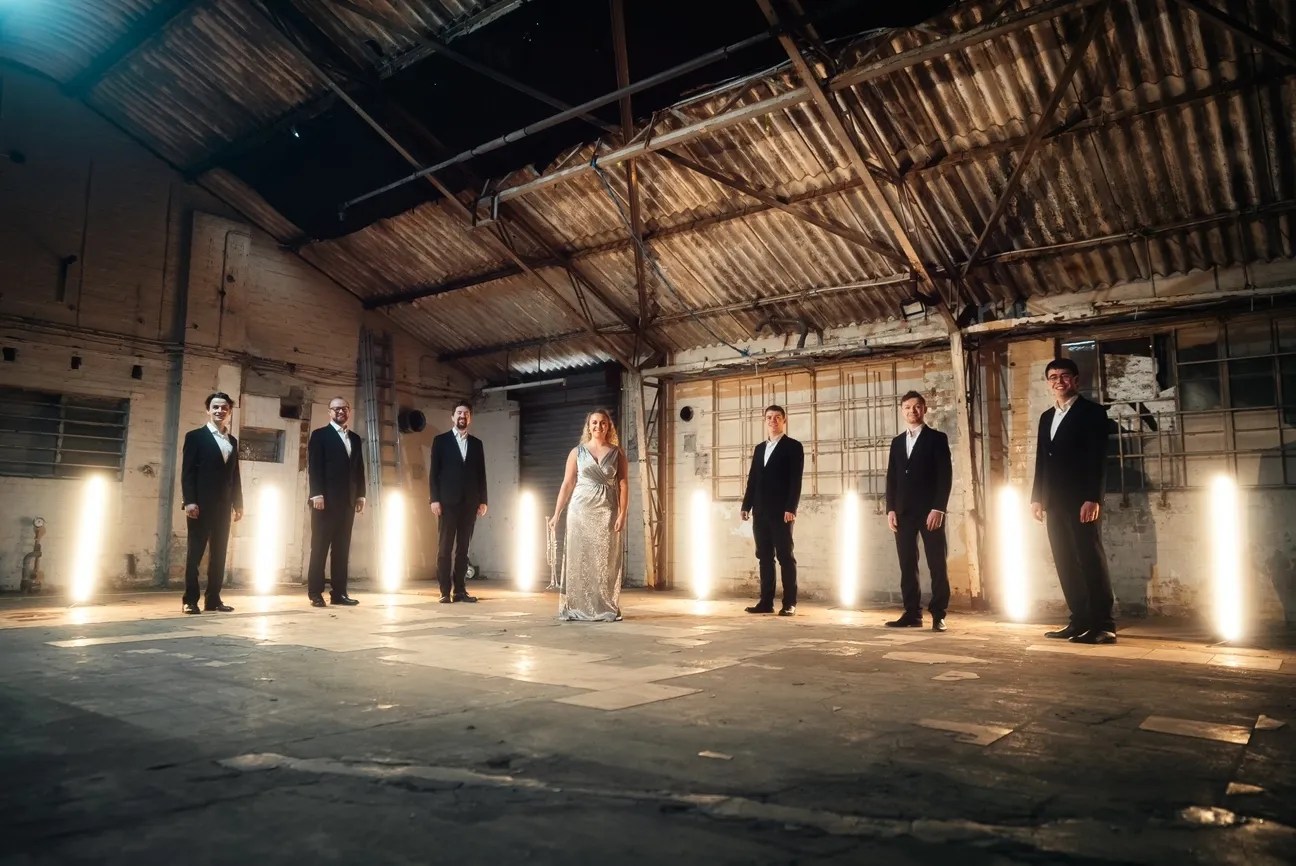
The Gesualdo Six [Guy James (countertenor), Alasdair Austin (countertenor), Joseph Wicks (tenor), Josh Cooter (tenor), Simon Grant (baritone) and director Owain Park (bass)]

Roth Night Prayer (2017)
Tallis O nata lux de lumine (pub. 1575)
Pritchard The Light Thereof (2020)
MacMillan O Radiant Dawn from The Strathclyde Motets (2005)
Tallis Dum transisset Sabbatum (1575)
Hildegard of Bingen O gloriosissimi (с.1163-1175)
Bingham Enter Ghost (2002)
Owain Park Sommernacht (2022)
Rheinberger Abendlied from 3 Geistliche Gesänge Op. 69 (pub.1873)
Barnard Aura (2020)
Roxanna Panufnik O Hearken (2015)
Burgon Nunc dimittis (1979)

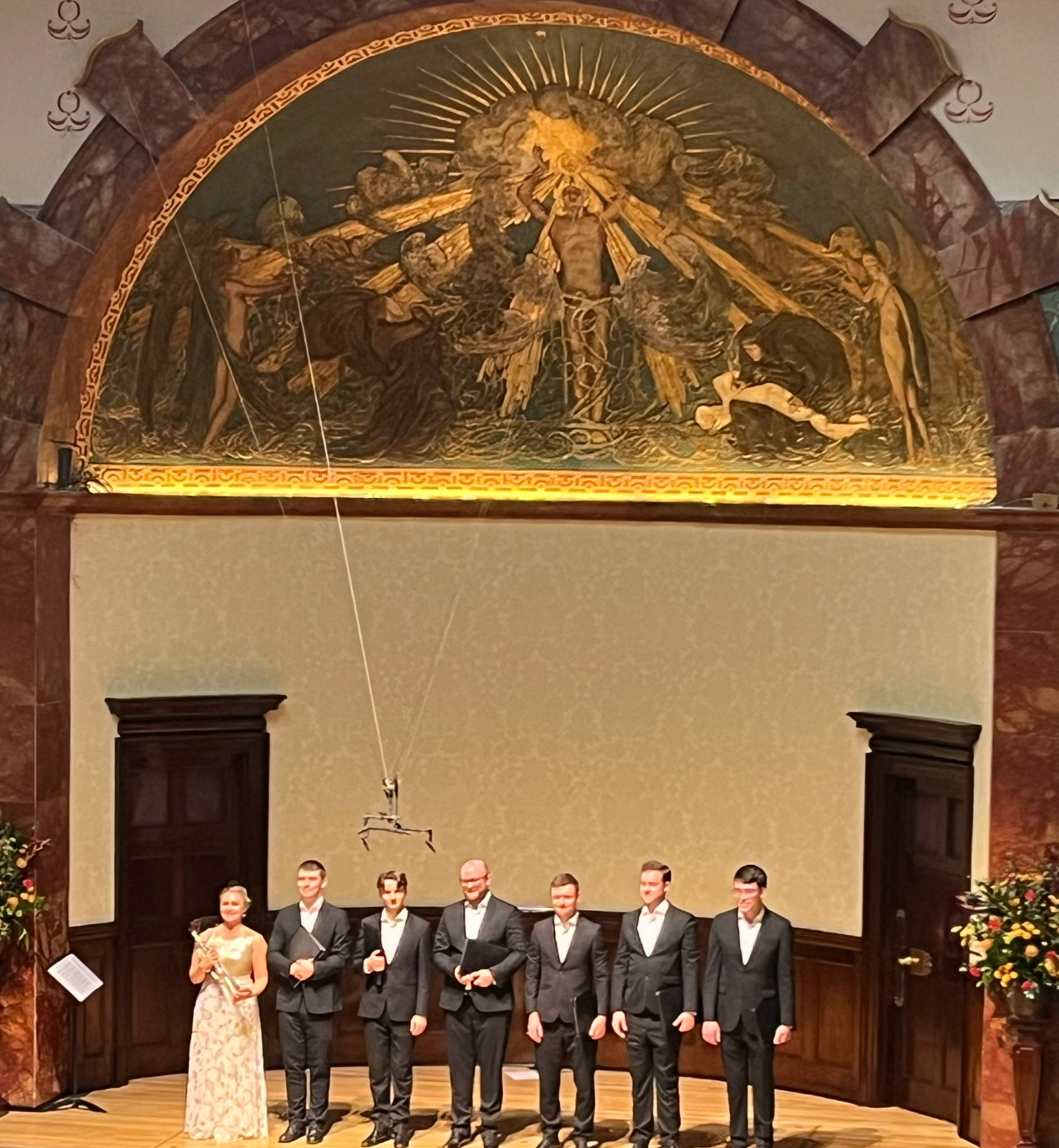
Wigmore Hall, London, 2 October 2025

by John Earls. Photo credits unknown (above), John Earls (below)

The Gesualdo Six have recently released their tenth album (for Hyperion) Radiant Dawn. It finds them combining consistently high standards of choral music with imaginative programming featuring classic and contemporary compositions spanning over 800 years of music. It also sees them introducing a new element to the mix, namely the inclusion of the trumpet for a number of pieces superbly played by Matilda Lloyd.

The new album was the focus for this hour-long lunchtime concert at a packed Wigmore Hall with all pieces performed coming from it (and a few omitted). The theme of the album, as explained by The Gesualdo Six’s director and bass (and recently named new chief conductor of the BBC Singers) Owain Park, is “musical responses to light” in a whole variety of contexts.

First up in the set (and on the album) was Alec Roth’s Night Prayer, an almost dreamy reflection of the Compline hymn Te lucis ante terminum that introduces Lloyd’s trumpet and the remarkable effect it has when married with these magnificent voices.

Next was Thomas Tallis’s O nata lux de lumine, one of two shorter pieces (both just over 2 minutes) along with Roxanna Panufnik’s O Hearken, but their duration made them no less impactful. Both featured just voices, and I loved finding out from the programme that O Hearken started life as a raffle ticket prize. Another Tallis piece Dum transisset Sabbatum saw Matilda Lloyd’s trumpet taking the soprano voice to powerful effect.

There are two of James MacMillan’s Strathclyde Motets on the album. Only one of them, O Radiant Dawn, from which the album gets its title, gets performed here. It’s harmonically inspired by Tallis’s O nata lux de lumine and has a yearning to it befitting of the Advent season it relates to.

Richard Barnard’s Aura (commissioned for the album) sets music to the text of Emily Barry’s poem about the loss of her mother. Credit to the programme editors for faithfully reproducing the poem’s arresting layout – two parallel columns reflecting the emotional fracture involved (Owain Park’s programme notes were also excellent). This fracturing dissipates musically as the piece progresses with the trumpet acting as a bridge between two groups of singers. It was one of the most affecting pieces of the concert with the composer in the audience to hear it.

Another composer in the audience was Deborah Pritchard whose The Light Thereof (also commissioned for the album) sets words from the Book of Revelation and demonstrated deftly the ability of the trumpet (muted at times) to evoke different shades of light.

Matilda Lloyd’s virtuosity on the trumpet was to the fore in Judith Bingham’s Enter Ghost, an interpretation of a passage from Shakespeare’s Hamlet mixing music with spoken word, the drama enhanced by her walking off stage (and returning) whilst playing.

Other pieces sung a cappella included Hildegard of Bingen’s O gloriosissimi (from the back of the hall) and beautiful performances of Owain Park’s own Sommernacht and Joseph Rheinberger’s Abendlied.

The programme ended (as does the album) with Geoffrey Burgon’s Nunc dimittis which some may remember as the closing music from the BBC’s television adaptation of John le Carré’s Tinker Tailor Soldier Spy. It was yet another example of how effective this glorious combination of voices and trumpet is and proved a fitting conclusion to a most illuminating concert.  

John Earls is Director of Research at Unite the Union and posts at @johnearls.bsky.social on Bluesky and @john_earls on X. You can subscribe (free) to his Hanging Out a Window Substack column here: https://johnearls.substack.com/

Published post no.2,677 – Saturday 4 October 2025

In concert – BBC Singers / Martyn Brabbins @ St Paul’s Knightsbridge – Holst, Britten, Garrard, Elgar & Pickard

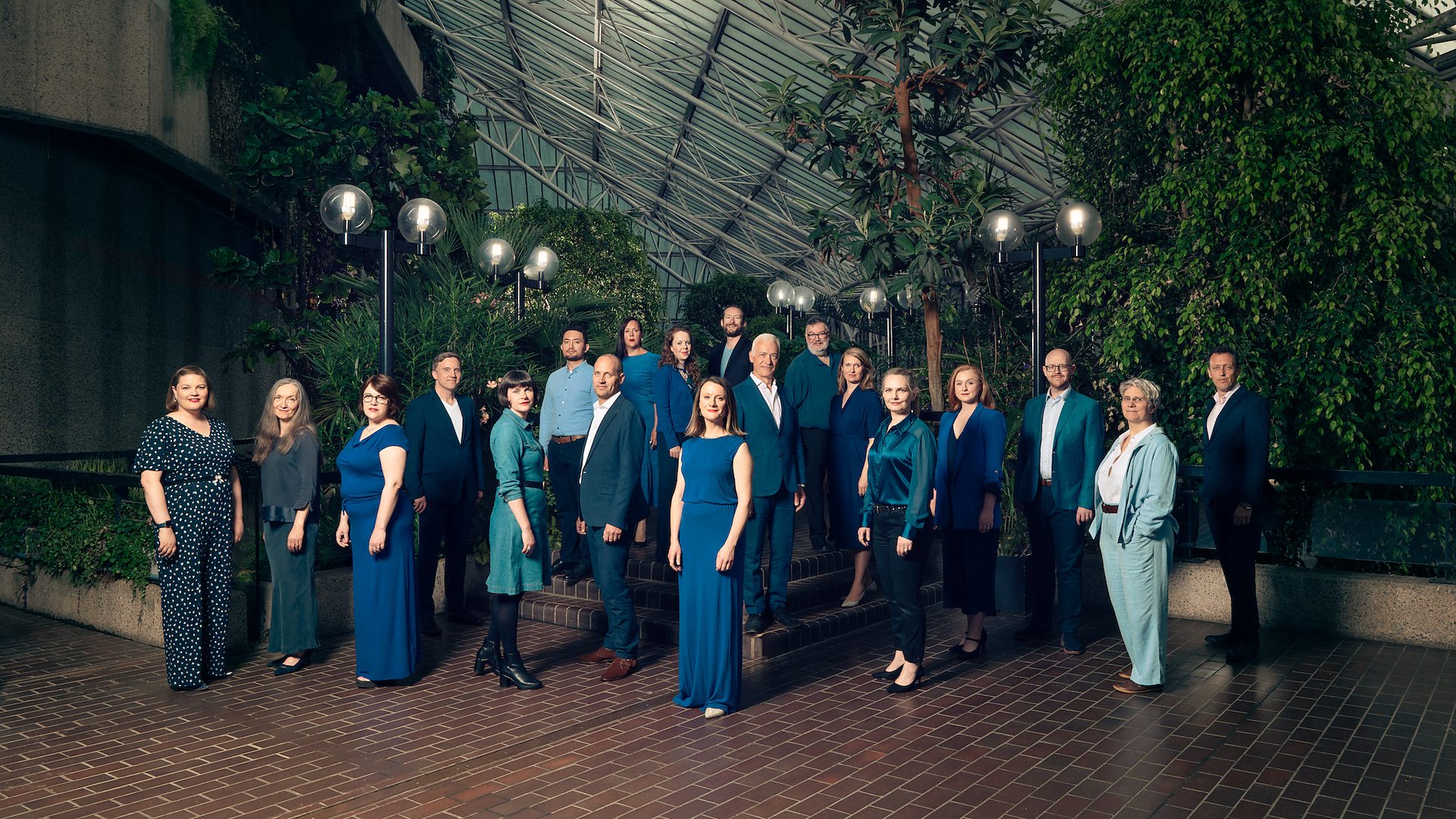
BBC Singers, Elizabeth Bass (harp), Richard Pearce (piano), Andrew Barclay (percussion) / Martyn Brabbins

Holst Choral Hymns from the Rig Veda – Group 3, H90 (1910)
Britten The Ballad of Little Musgrave and Lady Barnard (1943)
Garrard Missa Brevis (2017-18)
Elgar Five Part-Songs from the Greek Anthology Op.45 (1902)
Pickard Elemental (2024-25) (BBC commission: World premiere)

St Paul’s, Knightsbridge, London
Friday 19 September 2025

Reviewed by Richard Whitehouse

The upsurge of interest in and performances by the BBC Singers in the wake of its intended demise shows little sign of abating, and there could be few vocal ensembles able to put on a programme as stylistically inclusive or as technically demanding as that heard this afternoon.

Nowhere more so than Elemental by John Pickard, its first performance occupying the second half. Never absent from the composer’s output, choral music came into own with the powerful Mass in Troubles Times (premiered nearby at St Peter’s, Eaton Square in 2019) and the present work can be heard as a continuation in terms of its underlying concept. A further collaboration with author and theologian Gavin D’Costa, its form is of a journey through the elements such as Pickard had favoured earlier in his output but here with its emphasis firmly on the spiritual arising out of human concerns. Whether individually or collectively, the writing for 18 voices could hardly be more varied and imaginative, while the obbligato roles for harp plus a single percussionist playing across the spectrum of instruments enhances these settings accordingly.

After the evocative Prologue with its Paracelsian take on living matter, Earth draws on the recollections of those in the Tham Luang Cave Rescue – notably teenagers of the Wild Boars football team – in music whose initial bravado gradually assumes a near metaphysical import. Fire integrates its Shakespeare quotations into consideration of this most transformative and cathartic of elements. Air centres on Bessie Coleman with her ambition, racially rather than personally motivated, to become the first professional pilot from African-American ancestry – her combative and ultimately ill-fated career depicted with often graphic immediacy. Water then illustrates the Biblical flood narrative from an oblique and even ambivalent perspective, before Epilogue returns to evocation of the numinous as it builds with a frisson of emotion.

Not that the first half was any mere preparation. Most intimate and alluring of four such sets, the third group of Holst’s Choral Hymns from the Rig Veda traverses the ethereal, the limpid, the hieratic then the questing in the company of female voices and harp. The former were no less attuned to the greater astringency of Sara Garrard’s Missa Brevis – its bracing inclusion of traditional Estonian music offset by the greater introspection elsewhere; these contrasted aspects finding at least a degree of release with the emotional immediacy of the Agnus Dei.

Heard in alternation, the male voices duly came into their own with Britten’s The Ballad of Little Musgrave and Lady Barnard – its folk melody (Matty Groves) stretched through this plangent wartime setting with piano of illicit love, innocent betrayal, desperate revenge and stark lament. Facets that barely feature in Elgar’s Five Part-Songs from the Greek Anthology yet these brief if characterful treatments of translations by Alma Strettell, no less typical than his major choral and orchestral works from this period, were dispatched here with due relish.

Whatever else, this showcase with substance was conducted with unfailing insight by Martyn Brabbins, whose prowess in choral repertoire needs hardly more reiterating than his advocacy of Pickard, and is absolutely worth hearing when broadcast by BBC Radio 3 this Wednesday.

You can hear the BBC Radio 3 broadcast on Wednesday 24 September by clicking here

For more information on the artists, click on the names: BBC Singers, Martyn Brabbins, Elizabeth Bass, Richard Pearce and Andrew Barclay, and composers John Pickard and Sara Garrard

Published post no.2,664 – Sunday 21 September 2025

In concert – Lukas Sternath, BBC Singers, Symphony Chorus & Orchestra / Sakari Oramo @ BBC Proms: Bliss ‘The Beatitudes’, Grieg & Gipps

Lukas Sternath (piano), Elizabeth Watts (soprano), Laurence Kilsby (tenor), BBC Singers, BBC Symphony Chorus, BBC Symphony Orchestra / Sakari Oramo

Gipps Death on the Pale Horse Op.25 (1943) [Proms premiere]
Grieg Piano Concerto in A minor Op.16 (1868 rev.1907)
Bliss The Beatitudes F28 (1961)

Royal Albert Hall, London
Sunday 7 September 2025

Reviewed by Richard Whitehouse Photos (c) BBC / Chris Christodoulou

This evening’s Prom – launching the final week of the present season – was billed as ‘Grieg’s Piano Concerto’, no doubt the reason why many in the audience were attending while hardly being the most interesting aspect of a typically adventurous programme from Sakari Oramo.

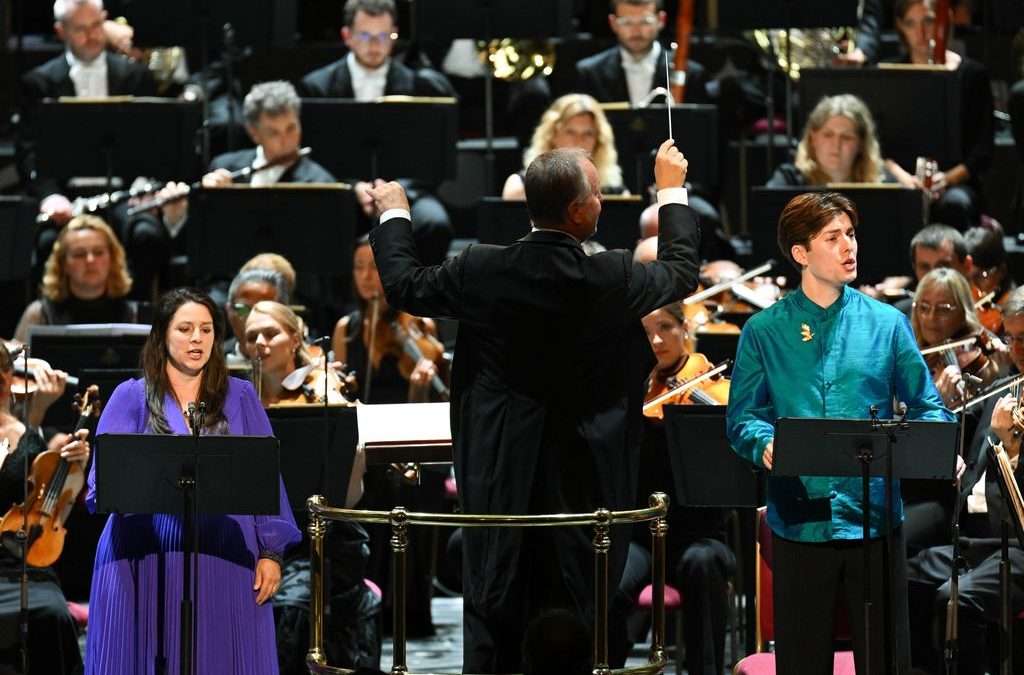
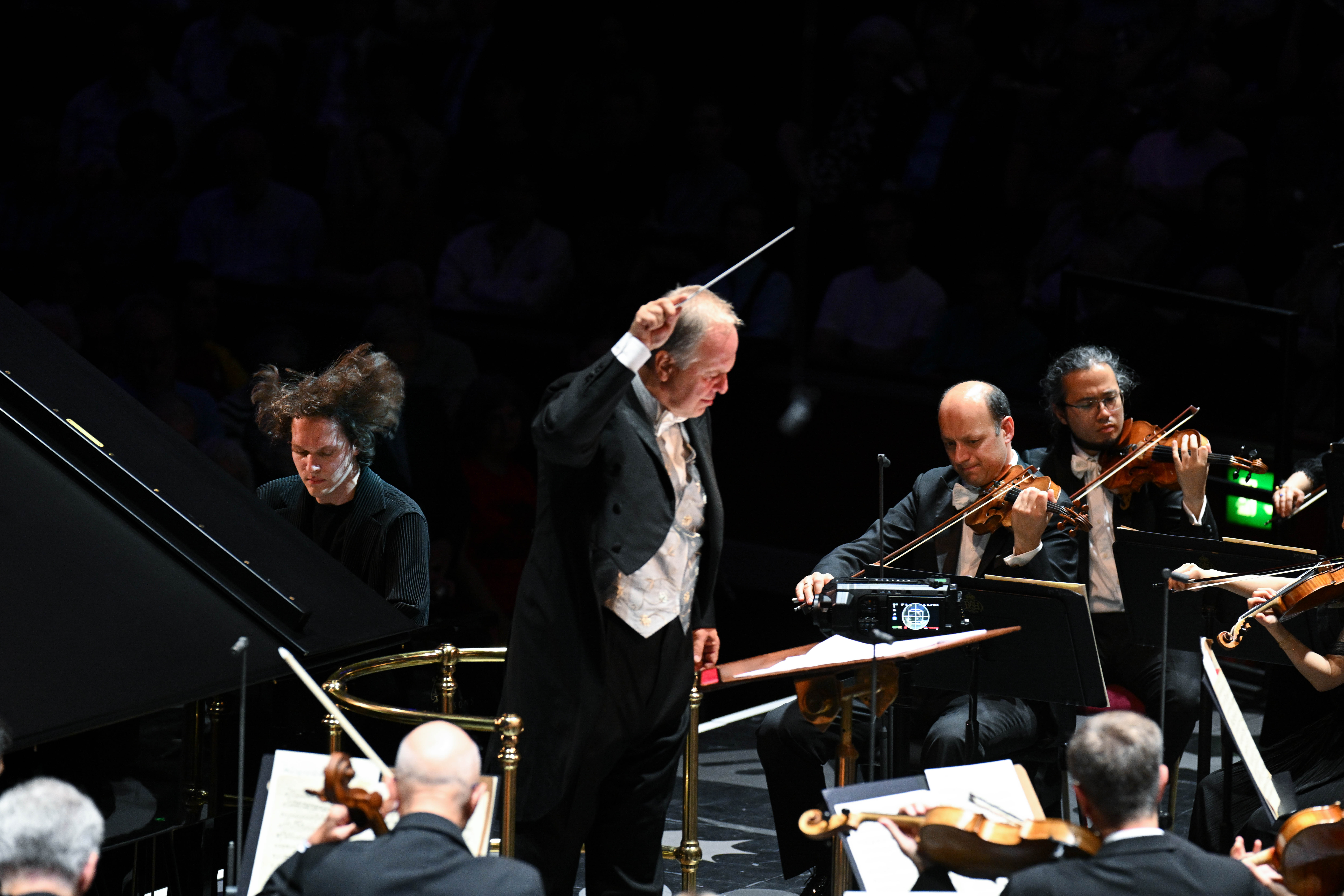
In the event the Grieg received a responsive reading from Lukas Sternath (below, with Oramo), the Viennese pianist who, still in his mid-20s, was most at home in more inward passages. The second theme of the initial Allegro was enticingly taken up after a heartfelt rendering by cellos, as was the Adagio’s eloquent melody and that first emerging in the finale on flute, where it was soulfully rendered by Daniel Pailthorpe. Nor were the more demonstrative aspects underplayed – Sternath having the measure of a cadenza whose mounting rhetoric was pointedly reined-in, while the finale’s outer sections were incisively inflected prior to an apotheosis which felt the more exhilarating through its absence of bathos. A melting take on Richard Strauss’ early song Morgen!, transcribed with enviable poise by Max Reger, served to reinforce Sternath’s formidable pianistic credentials.

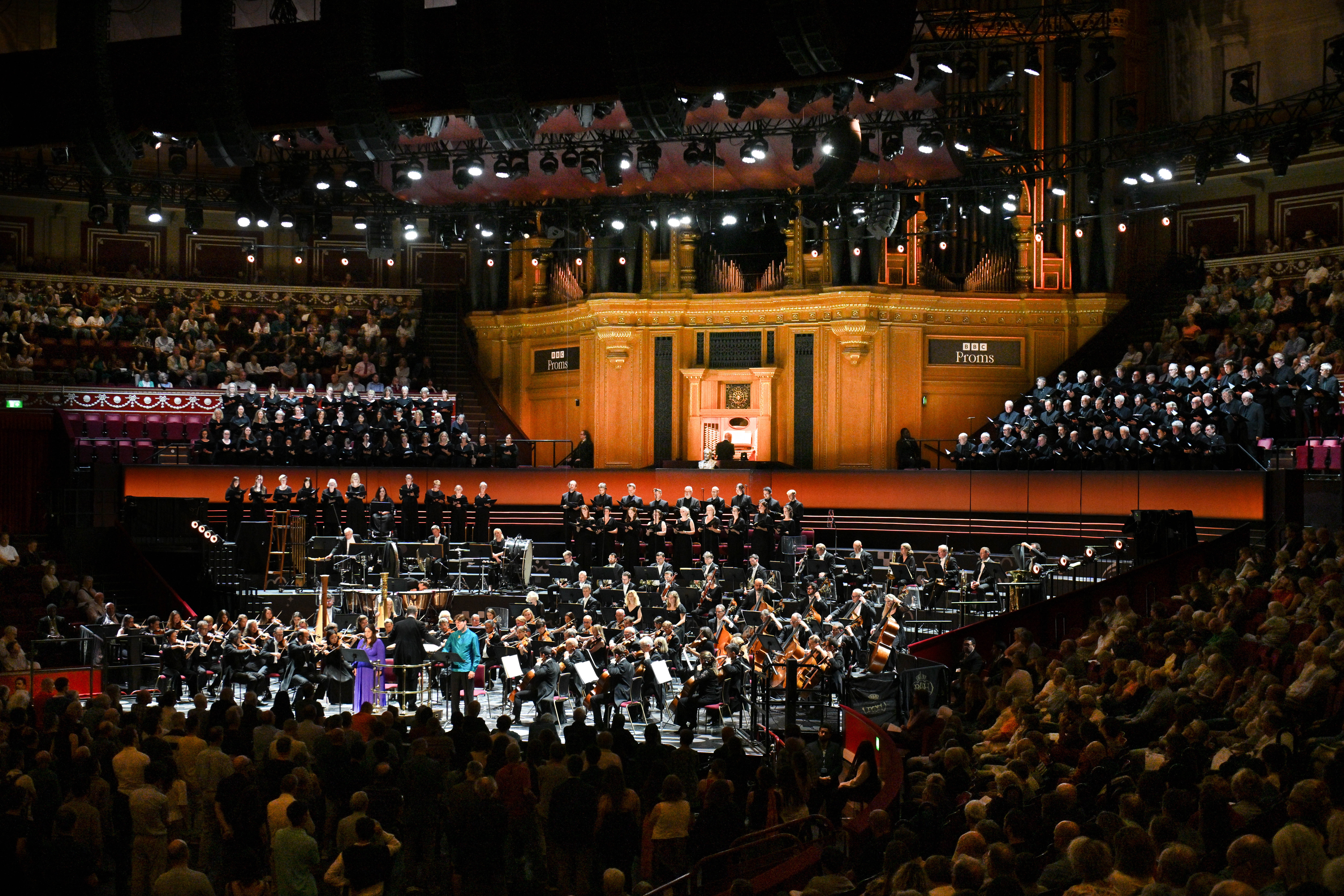
The 50th anniversary year of Sir Arthur Bliss’s death has seen a gratifying number of revivals, few more significant than that of The Beatitudes. The misfortune of its premiere having been moved from Coventry’s new Cathedral to its Belgrade Theatre, thus freeing up rehearsal time for Britten’s War Requiem, rather condemned it as an also-ran from the outset. Yet Bliss had created a piece unerringly suited for the consecration in what, in itself, remains an impressive conception. Unfolding as 14 short sections which can be grouped into six larger movements, this is less a cantata than a choral symphony. Setting all nine Beatitudes, Bliss none the less merged several of these and interspersed them with settings from three 17th-century and one 20th-century ‘metaphysical’ poets to commemorate the past from the vantage of the present.

The texts, drawn from Henry Vaughan, George Herbert and Jeremy Taylor, anticipate a future redemption – as, more ambivalently, does Dylan Thomas in And death shall have dominion which builds implacably to the climactic Ninth Beatitude and Voices of the Mob prior to the hard-won serenity of the Epilogue. That The Beatitudes has enjoyed relatively few revivals is less to do with its intrinsic quality than the demands of its choral writing, to which the BBC Symphony Chorus and BBC Singers did notable justice. Elizabeth Watts responded with real sensitivity and perception to some radiant soprano writing and while Laurence Kilsby was a little effortful in the more demonstrative passages, he brought conviction to a tenor role both fervent and compassionate. Nor did Richard Pearce disappoint with his extensive organ part.

Oramo paced the 50-minute entity superbly as to make one hope he will tackle more works by Bliss – not least the masterly Meditations on a Theme by John Blow, which has inexplicably fallen through the net this year. He had started tonight’s concert with a most welcome revival for Death on the Pale Horse – the succinctly eventful tone poem by Ruth Gipps which, while it might not capture the visceral drama of Blake’s eponymous engraving, distils an evocative atmosphere from pithy initial ideas that audibly reflects the circumstances of its composition.

Click on the artist names to read more about soloists Elizabeth Watts, Laurence Kilsby and Lukas Sternath, the BBC Singers, BBC Symphony Chorus and BBC Symphony Orchestra, and their conductor Sakari Oramo. You can also click to read more about composers Arthur Bliss, Ruth Gipps and the BBC Proms

Published post no.2,652 – Tuesday 9 September 2025

In concert – Soloists, Danish National Concert Choir & Symphony Orchestra / Fabio Luisi @ BBC Proms: Beethoven 9th Symphony, Bent Sørensen & Anna Clyne

Clara Cecile Thomsen (soprano), Jasmin White (contralto), Issachah Savage (tenor), Adam Palka (bass), Danish National Concert Choir, Danish National Symphony Orchestra / Fabio Luisi

Bent Sørensen Evening Land (2017)
Anna Clyne The Years (2021)
Beethoven Symphony no.9 in D minor Op.125 ‘Choral’ (1811-24)

Royal Albert Hall, London
Thursday 21 August 2025

Reviewed by Ben Hogwood Photos (c) BBC / Chris Christodoulou, Ben Hogwood (soloists)

Celebrating their centenary this year, the Danish National Symphony Orchestra and chief conductor Fabio Luisi led us from the quiet of evening to the blazing light of a sunny morning in the course of this concert.

The challenge facing any concert programmer containing Beethoven’s Choral Symphony is how to lead up to it. This Prom approached from a contemporary angle, beginning in near silence with Bent Sørensen’s contemplative Evening Land. The Danish composer’s imaginative orchestration was key to the success of his picture painting, beautifully rendered by Luisi, as was the threadbare violin solo with which leader Christina Åstrand began. Childhood reminiscences of the Danish island Zealand took place in the half-light, contrasting with visions of nocturnal Manhattan that came through in bursts of technicolour, honouring Leonard Bernstein. Making a lasting impression, however, was the beautiful oboe solo from Kristine Vestergaard that marked the illness and subsequent passing of Sørensen’s father.

Having eavesdropped on this intimate opening piece, the Danish National Concert Choir rose for Anna Clyne’s musical account of the Covid pandemic – already consigned to history, it seems. Few people would like to revisit those days in a concert experience, but Clyne’s message – channelling the text of Stephanie Fleischmann – was one of underlying resilience. The choir began in stasis, occupying an added note chord which somehow drew parallels with the Björk song Possibly Maybe for this correspondent, before the piece flourished. A dreamlike mood was enhanced by a pure, almost complete lack of vibrato from both choir and orchestra, while the harmonic language drew strong parallels with the latter stages of Holst’s suite The PlanetsSaturn and Neptune in particular. An autumnal chill was evident in spite of increasingly frenetic activity in the orchestra, and the piece ended in an uneasy acceptance of events passed, rather like our own emergence from lockdown.

Beethoven’s Ninth Symphony is the ultimate hymn to freedom, though it does of course go through a titanic struggle before that release, in the form of Schiller’s Ode To Joy, can be attained. Luisi led us through the dark, pre-twilight moments in an account notable for its poise and guile. Using relatively fast speeds, the first movement took a little while to light the touch paper, but once ignited the music powered forward with increasing determination. The scherzo was quick, quite matter of fact with its timpani interventions, and balanced by a bucolic trio where the wind kept pace heroically with Luisi’s quick baton. Their attractive textures and warm melodic phrasing were a key feature of both this and the Adagio, again on the quick side, but managing its fanfare interventions impeccably.

Left to right: Clara Cecile Thomsen (soprano), Jasmin White (contralto), Issachah Savage (tenor), Adam Palka (bass), beneath the bust of Sir Henry Wood @ BBC Proms

And so to the finale, with a memorable exposition for the Ode to Joy theme from sotto voce cellos and basses, the Royal Albert Hall hushed in anticipation. The choral passages were suitably exultant, the 75-strong choir drilled to perfection if cooler in temperature than the orchestra. The four soloists (above) were led by impressive bass Adam Palka, whose authoritative recitative “O Freunde, nicht diese Töne!” was a highlight, and while the quartet’s ensemble pieces wavered a little in tuning the sense of release and elation was keenly felt and clearly relished. The smile on the face of the music spread to the audience in the exhilarating closing bars as the orchestra took flight, completing an impeccably controlled interpretation on the part of Luisi that came to the boil at just the right time.

You can listen back to this Prom concert on BBC Sounds until Sunday 12 October.

Click to read more about the BBC Proms

Published post no.2,634 – Friday 22 August 2025