Oxford Lieder Festival – Alessandro Fisher & Gary Matthewman: An Italian Songbook

Alessandro Fisher (tenor, above), Gary Matthewman (piano, below)

Bellini Malinconia, ninfa gentile, Per pietà bell’idol mio, Ma rendi pur contento (all 1829)
Donizetti Me voglio fa’ ‘na casa (1837), Lu trademiento (1842)
Verdi Il poveretto (1847), Il tramonto (1845), Brindisi (1845)
Tosti ‘A vucchella (1907), Sogno (1886)
Hahn Venezia (1901)

Sheldonian Theatre, Oxford
Wednesday 17 October 2018

Written by Ben Hogwood

The spectacular round of the Sheldonian Theatre proved the ideal setting for tenor Alessandro Fisher and pianist Gary Matthewman, with an attractive Italian recital continuing the Grand Tour theme of the Oxford Lieder Festival.

Fisher proved a consummate storyteller, and his asides to the audience between songs were ideally judged and set the music of the concert in context. There was deep, romantic love, humour and much merrymaking to be had over the course of the hour!

Photo (c) Johan Persson

Fisher and the ever-attentive pianist Matthewman filled the first half of their recital with songs from Italian composers known primarily for their opera – and indeed it did feel as though the tenor was singing excerpts from bigger, stage-bound works. The Bellini songs were straight and to the point – melodic and responsive to their text. Donizetti showed off the voice in Me voglio fa’ ‘na casa (I want to build a house) but cut straight to the heart in Lu trademiento (The treachery).

Three songs by Verdi were of rich variety – the downtrodden Il poveretto (The poor man) led to the rather moving Il tramonto (Twilight) before Fisher and Matthewman cast all cares aside for Brindisi (A toast). Sporting a different musical response to the famous aria of the same name from La Traviata, this was a riotous celebration of wine.

The songs of Tosti are highly respected but still quite rare in concert hall recitals, so it was good to hear a consummate master of the form at work in ‘A vucchella (A sweet mouth) and Sogno (Dream), passionately sung.

The concert’s second part told the story of Hahn’s Venezia, where Matthewman painted the watery settings of the opening song Sopra l’acqua indormenzada (Upon the sleeping waters), the undulations of La barcheta (The little boat) and the heady atmosphere of La biondina in gondoleta (The fair maiden in a gondoleta). Fisher was a very entertaining guide to the ups and downs of love in Venice for the subject, no more so than in Che peca! (What a shame!) where he had all the requisite mannerisms to cast off his ‘only thought’ Nina, to the amusement of the audience – but perhaps the best was left for last, a celebration of La primavera (The springtime) to round off the cycle in some style.

Fisher’s bright tenor sound was also ideally suited to the encore, Leoncavallo’s Mattinata, which provided further evidence of the strength of his partnership with Matthewman. With such colourful song set under the equally bright roof of the Sheldonian, it was a match to remember.

Further listening

You can hear the repertoire from this concert on the Spotify playlist below. Alessandro Fisher has yet to record any of the Italian songs, so leading alternative versions have been used:

Meanwhile Fisher himself appears in a new recording from Classical Opera and Ian Page of Mozart’s Grabmusik and Bastien Und Bastienne:

The Oxford Lieder Festival – why you should go and see it!

written by Ben Hogwood

Sometimes judging a book by its cover can bring the best possible results. For a few years now the immaculate publicity and tempting programmes of the Oxford Lieder Festival have been beckoning me in – and 2018 was at last the year I travelled to Oxford for the day to experience a day in the company of song enthusiasts.

If you had told me 15 years ago that I would be attending a concert of classical song, let alone travelling for three hours to see a couple, I would have politely asked you to leave the room. Yet thanks to the Wigmore Hall I have gradually come to know and in some cases love the ‘Lieder’ repertoire, all the way through from Mozart to the present day.

I attended the festival on Wednesday, where the focus was on Italy, Russia and the Baltic countries, notably Estonia. As you will read in the following three reviews, to be published on Arcana later today, I could not praise the Oxford Lieder Festival highly enough for its ability to appeal to all concertgoers, regardless of what stage in their audience life they are at. A combination of slick organisation, a relaxed approach to concert going and a clear love of their cause shone through at all times. The performers clearly loved to be there too – in each of the three concerts smiles were frequent, long-lasting and genuine.

The ’fringe’ activities excelled too – the Language Labs, where people can get to know the characteristics of the language they will hear in song later in the day, are invaluable. A talk about The Grand Tour from the Ashmolean Museum’s Matthew Winterbottom was entertaining and informative, throwing the Italian vocal compositions of the time into a fresh context. The integration of restaurants and bars into a mix already containing some striking venues was a great plus too, showing the city of Oxford at its best.

The festival, then, is greater than the sum of its many parts – and there really is something for everyone in the twists and turns of its Grand Journey this year. If you are within striking distance of Oxford, I heartily recommend it.

Live review – Kensington SO / Russell Keable: William Schuman 3rd Symphony, Adams, Bernstein & Tower

Kensington Symphony OrchestraRussell Keable (above)

St. John’s, Smith Square, London. Monday October 15, 2018

Tower Fanfare for the Uncommon Woman No. 1 (1986)
Bernstein Divertimento (1980)
Adams Doctor Atomic Symphony (2007, rev 2008)
Schuman Symphony No. 3 (1941)

Written by Richard Whitehouse

The Kensington Symphony Orchestra‘s 63rd season got off to a most impressive start with tonight’s concert of American music (simultaneously continuing the Americana ’18 festival taking place at St John’s during this year), opening with the Fanfare for the Common Woman with which Joan Tower launched her wider reputation over three decades ago. Rhythmically bracing while not without harmonic subtlety, it provided a fitting showcase for the KSO brass and percussion as well as a pertinent tribute to this composer in the year of her 70th birthday.

Leonard Bernstein‘s centenary was marked with his Divertimento, seven succinct movements that touch upon most of his salient traits and a reminder that his latter-day creativity was one where less equals more. Highlights include a delectable Waltz (enjoying frequent exposure on Classic FM), wistful Mazurka, evocative Blues then a rousing March: The BSO Forever whose Johann Strauss take-off duly makes for an uproarious close. Suffice to add the KSO was not found wanting in a piece written for the Boston Symphony’s own 100th birthday.

As Russell Keable‘s opening remarks made plain, John Adams’s Doctor Atomic Symphony was an altogether more serious proposition. First heard at the 2007 Proms, the rather diffuse 45-minute work in four movements was duly streamlined into a continuous structure lasting barely half an hour. Surprising, then, that the result seems less than cohesive – its reworking of material from the composer’s third opera one of cinematic contrast than symphonic unity. Some of his most virtuoso orchestral writing, which the KSO tackled with relish, is hampered by the recourse to post-minimalist gestures that remain Adams’s (unwitting?) stock-in-trade. Even the final section, a setting of John Donne‘s sonnet Batter my heart with its baritone part taken by trumpet (here the mellifluous Stephen Willcox), felt less than truly affecting.

After the interval, a welcome revival (likely the first in London for two decades) for William Schuman‘s Third Symphony. One of a triumvirate of such pieces by American composers to emerge either side of the Second World War, it evinces a formal integration and expressive panache that its composer never surpassed – not least in the way its four movements are arranged in two larger parts such as complement each other unerringly, and with a steadily accumulating momentum which emerges across the whole in what is itself a marvel of tensile dynamism.

Keable delineated the variations of the initial Passacaglia with assurance, ensuring textural clarity here and in the ensuing Fugue while underlining how the numerous woodwind and brass solos emerge naturally from the string polyphony rather than sounding laminated onto it. Nor was there any lack of emotional poise with the Chorale, its understated eloquence in contrast to the inexorably mounting impetus of the closing Toccata whose final pages are as visceral as any in the symphonic literature – not least when rendered with such verve as here.

A memorable reading of a seminal though under-appreciated piece such as the KSO has long championed. Hopefully future seasons will see revivals of comparable American works – the Second Symphony of Roger Sessions and Seventh (Variation) Symphony of Peter Mennin.

For further information on the Kensington Symphony Orchestra you can visit the orchestra’s website

Wigmore Mondays: Nicholas Daniel & Charles Owen – J.S. Bach, Pavel Haas, York Bowen & Julian Anderson

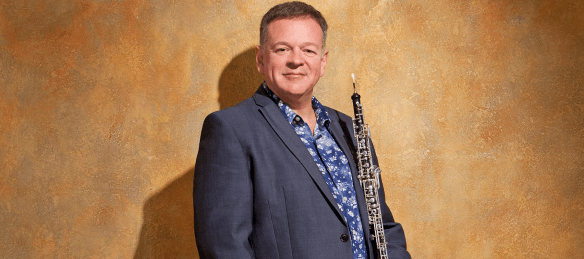
Nicholas Daniel (oboe, above), Charles Owen (piano, below)

J.S. Bach Sinfonia from Easter Oratorio Kommt, eilet und laufet, BWV249 (1725, rev.1938) (1:33-5:40)
Pavel Haas Oboe Suite Op.17 (1939) (5:42-22:12)
Julian Anderson The Bearded Lady (1994) (24:20-31:33)
Stravinsky Russian Maiden’s Song (arr. for oboe and piano) (32:49-36:24)
York Bowen Oboe Sonata Op.85 (37:02-54:22)

Wigmore Hall, London; Monday 15 October 2018

You can listen to the BBC Radio 3 broadcast by clicking here

Written by Ben Hogwood

The common link to the inventive programme for this BBC Radio 3 Lunchtime Recital was the oboist Leon Goossens, whose instrument Nicholas Daniel still plays. Goossens, who died in 1988, was a legendary artist. Arguably the most influential exponent of the oboe in the 20th century, he helped secure a good deal of modern repertoire for the instrument. He also loved to play arrangements of existing works, such as the Bach movement with which Nicholas Daniel and Charles Owen began this concert (from 1:33 on the broadcast link)

This was beautifully phrased and ornamented by Daniel, with exemplary control and beauty of tone, complemented by subtle prompting from Owen. It led without a break into the curious but deeply affecting three-movement Suite from Pavel Haas. The Czech composer’s music is slowly making itself better known after a revival in the 1990s. Prior to then, Haas – along with fellow Jewish composers Erwin Schulhoff, Hans Krása and Gideon Klein, had suffered considerable neglect, due partly to the tragic events of 1941-1942. All were taken to concentration camps during the Second World War, and tragically none returned.

This piece was unpredictable in places, and even confrontational between the instruments, but it left quite an emotional trail, writing directly to the soul in the manner of Haas’s teacher Janáček. Its music contained some of the blunt economy of expression for which his teacher was renowned, but also a slightly more whimsical quality. The first movement Furioso (5:42) began sternly but soon became more introspective, Owen’s considered interpretation bringing characterisation to the twists and turns of the piano part. The second movement, marked Con fuoco (10:08) began with an outburst from the piano, which was then calmed a little by the lyrical oboe line – and the two plotted very different paths during the course of the movement, which finished with another impassioned statement from the piano. The final movement Moderato (15:38) was calmer and found greater alignment between the two. A lovely, much more intimate moment from 19:57 led by the oboe but with an evocative loop from the piano, growing to an impressive climax.

For his comedic piece The Bearded Lady, commissioned by Daniel and based on a scene in Stravinsky’s Rake’s Progress, Julian Anderson used the extremities of the range of both instruments, the oboe jumping and swooping between high and low pitches, before we heard a tumbling figure down the piano. Then both instruments descended together, and while the piano hammered away at the low register Daniel left the stage. This was all part of the theatre, for soon we heard in the distance the mournful tones of the cor anglais (30:31), The Bearded Lady lamenting her fate at the end of an entertaining piece.

Stravinsky himself followed, an arrangement of the Russian Maiden’s Song from the 1921 comic opera Mavra. This had the classic Stravinsky combination of spiky rhythms but more tender melodic asides, the affecting and slightly humorous melody complemented by spicy harmonies from the piano.

York Bowen is often viewed as an English equivalent to Saint-Saëns or Rachmaninov – which gives a good idea of where his strengths lie. A melodic composer, he also makes quite heavy virtuoso demands on the performer – demands that Nicholas Daniel and Charles Owen met head on. They enjoyed the light hearted and sweet first movement, with its winsome melody, presenting it as part of a graceful dance.

The slow movement (44:15), marked Andantino espressivo by the composer, featured a long-breathed melody that Daniel played and phrased beautifully, lightly prompted by Owen. As the music got more intense we heard more of the lower range of Daniel’s oboe, a full-bodied sound, before the melancholy theme reappeared.

The shackles were confidently thrown off for the finale (50:23, marked Allegro giocoso) with a cheeky and memorable theme, which led to some fun sparring between the instruments and a bright signing-off.

As a bonus Daniel brought the recital full circle, returning to a Bach arrangement – on this occasion the Siciliano from the Flute Sonata in E flat major BWV1031. Unfortunately the radio broadcast cut away before this was played – a shame, as they would have had room for it. It certainly capped a very fine recital which showed a much greater depth to the oboe repertoire than one might expect!

Further listening

Nicholas Daniel has not recorded any of the material in this concert, but it can be tracked in this Spotify playlist:

Five years ago Daniel and a number of colleagues released this disc of chamber works by the Scottish Thea Musgrave, who turned 90 this year:

Live review – Nash Ensemble: War’s Embers – Elgar Piano Quintet & John Ireland Piano Trio no.2

Nash Ensemble (above) [Ian Brown (piano), Stephanie Gonley, Michael Gurevich (violins), David Adams (viola), Adrian Brendel (cello) (N.B. the line-up pictured above is not the same as the one appearing at this concert)

LSO St Luke’s, Friday 12 October 2018 (lunchtime concert)

Ireland Piano Trio no.2 (1917)
Elgar Piano Quintet in A minor Op.84 (1918)

Written by Ben Hogwood

The First World War had a profound effect on composers of classical music. Many of them served or were closely involved with the conflict, and even those who weren’t used their music as a vehicle for the shock and dismay felt at the turn of events.

John Ireland expressed his horror through two chamber works completed in 1917, the Violin Sonata no.2 and the Piano Trio no.2. The latter work began this concert from the Nash Ensemble, part of their War’s Embers series focusing on music written around the War in England. Set in one compact movement, it is a powerfully expressive utterance, even when the music is quiet – as it was when the first cello melody began – to when it reaches peaks of intensity in the march sections, depicting the war itself. Ian Brown, Stephanie Gonley and Adrian Brendel were united in voice, their three instruments often linked in melody, while Brendel’s eloquent solo at the start set the solemn tone.

Stylistically the work draws part of its inspiration from Debussy and Ravel, and these links were nicely played up by the trio, but the opening music dominated to the point of obsession, sweeping all before it. As evidenced in an interview with BBC Radio 3 host Fiona Talkington after the performance, the players had a clear understanding of Ireland’s writing, and his still underrated status in chamber music form.

Ireland’s trio was first heard at the Wigmore Hall in June 1917, and at the same venue nearly two years later audiences heard the premiere of Sir Edward Elgar’s Piano Quintet. Composed in Sussex, this autumnal work, written just prior to the Cello Concerto, reflects a fascination the Elgars held with a group of dead trees in Flexham Park, their branches twisted ‘in an eerie manner’.

The spidery tendrils of the first few bars reflected this eerie vision, and refused to release their grip on the piece despite a first movement that really got into top gear in this performance, passionately played and majestically poised. There was an affecting second theme before we heard for the first time some Spanish rhythms, also inspired by legend around the dead trees and refracted through a prism in Elgar’s mind, strangely sketched but never fully coloured-in.

The relative serenity of the slow movement, was countered by an emotional distance, as though here Elgar was conscious of the War, itself audible to him through the use of artillery just across the Channel. Perhaps because of this the trees made themselves known in closer proximity as the finale began, though here Elgar – and the Nash Ensemble – threw off the shackles to power through to an upward looking conclusion.

This was a fine performance of a work the Nash – and certainly Ian Brown – have had in their repertoire for more than 25 years. Brown displayed a natural instinct with the tricker phrases and was helped by a lovely string tone from the quartet in a performance that made sense of some of Elgar’s more distorted rhythms.

War’s Embers will come to BBC Radio 3 on Tuesday 13 November and I urge you to hear it, placing this elusive work in the context of a fine performance.

Further listening

You will be able to listen to this concert on BBC Radio 3 on Tuesday 13 November. In the meantime recordings of the works heard are on the Spotify playlist below:

For further information on the Nash Ensemble’s War’s Embers series, visit the diary section on the ensemble’s website