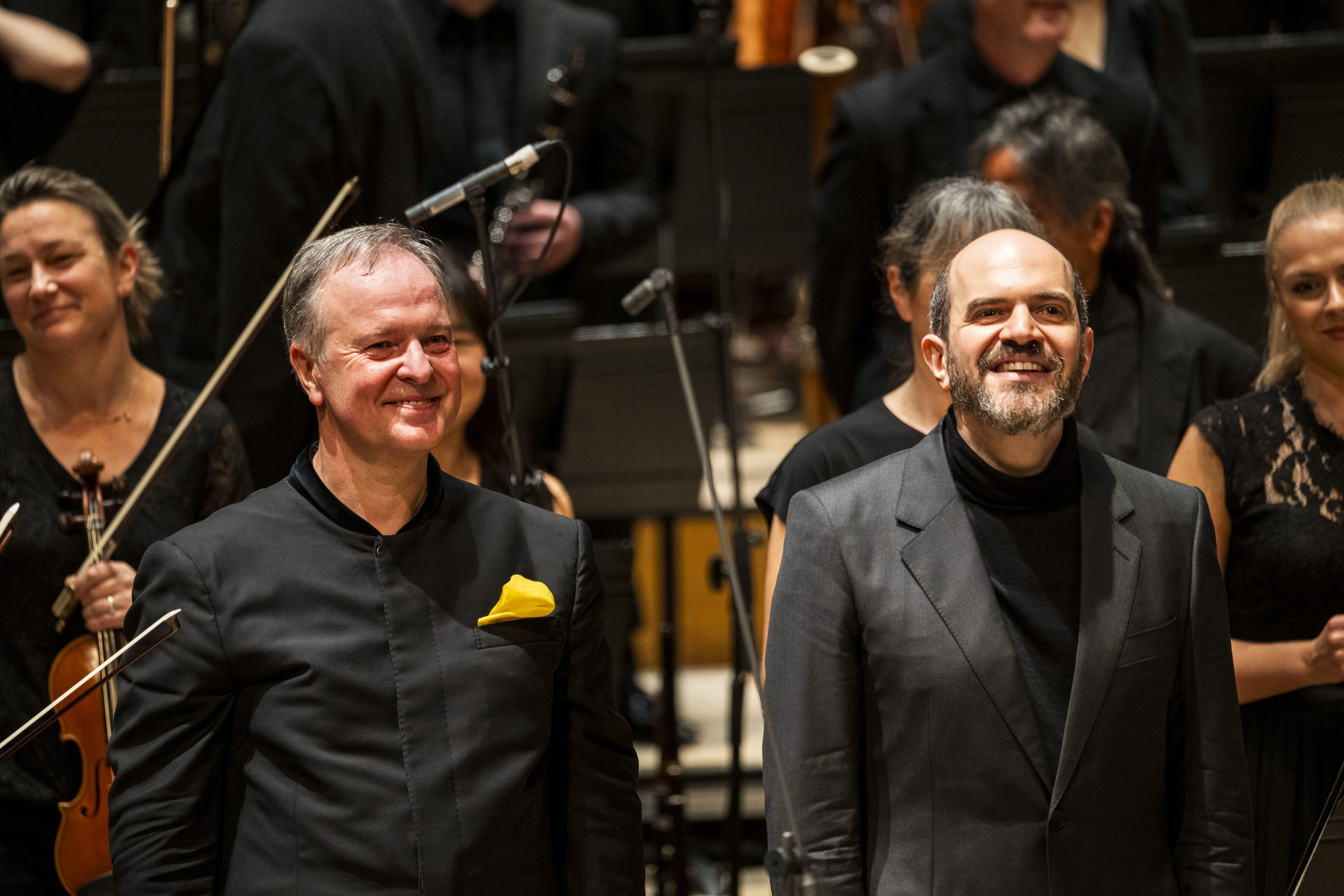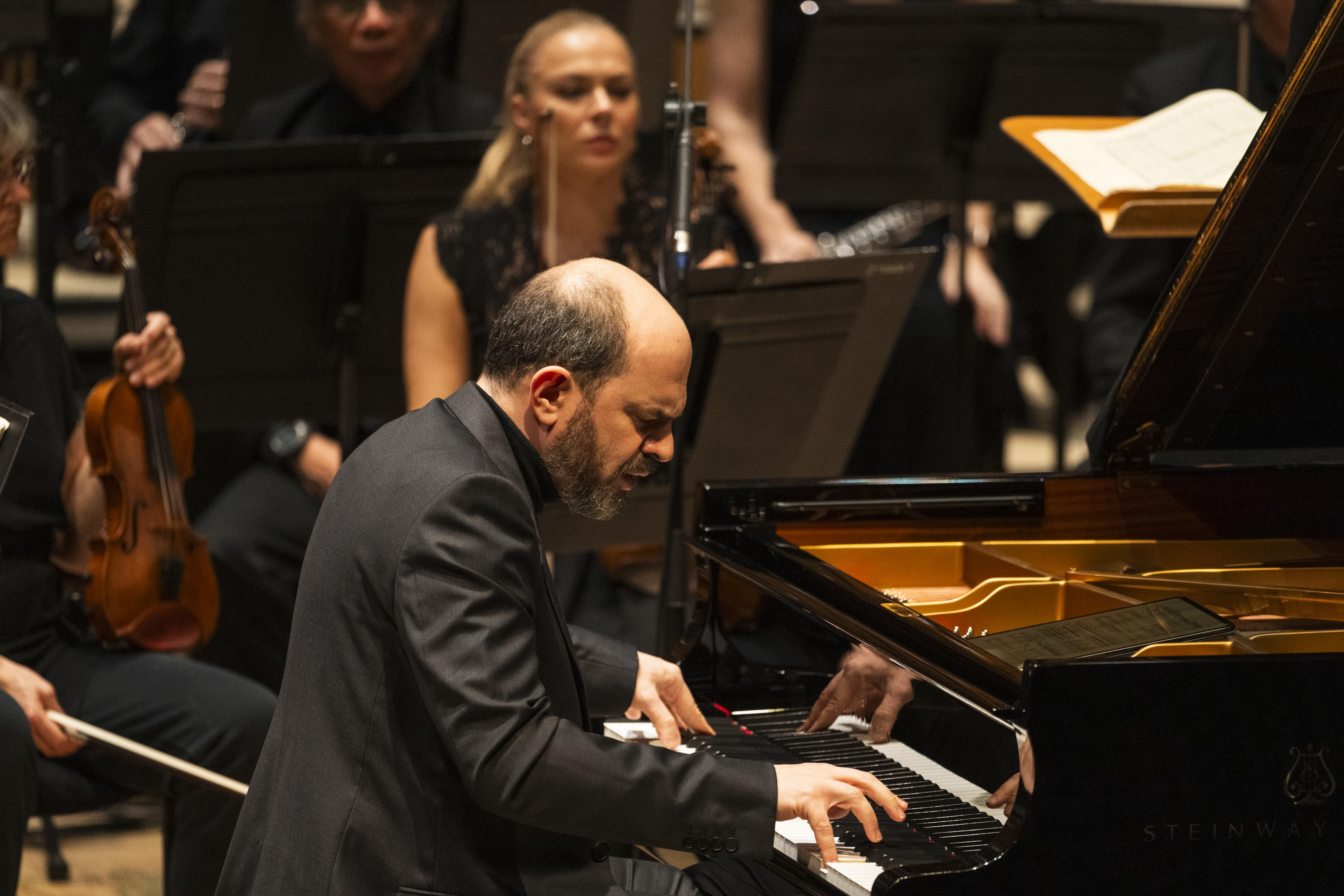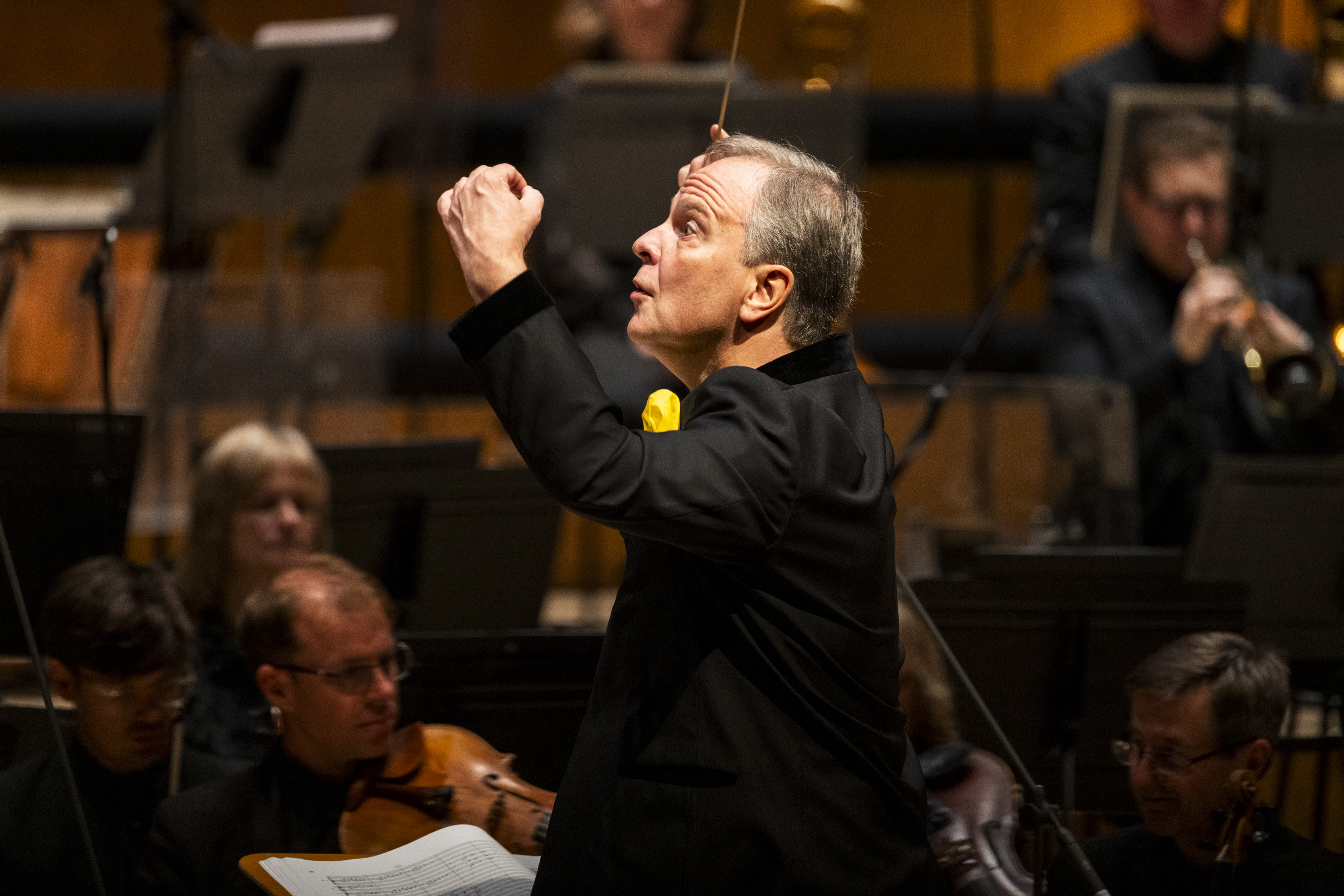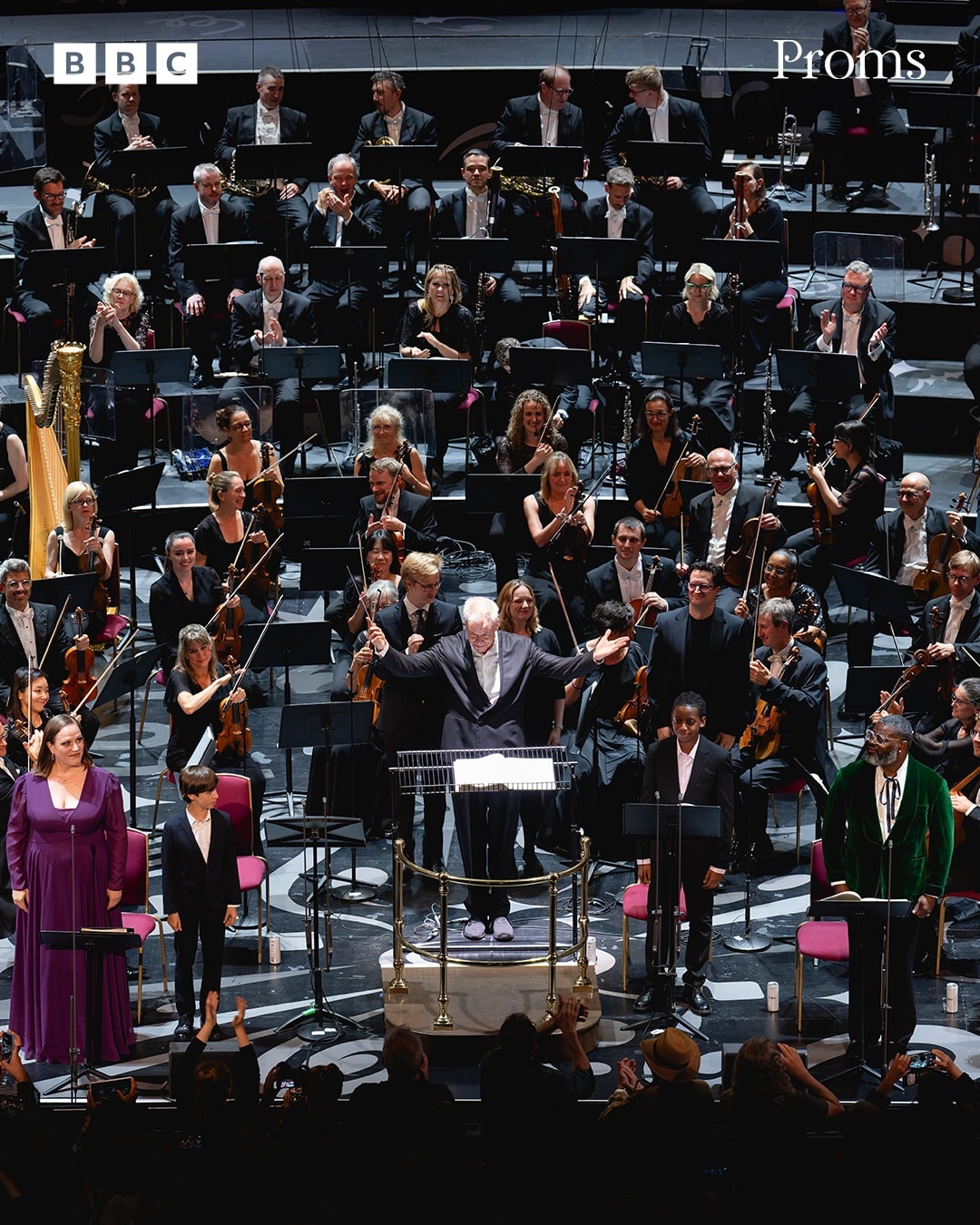
In concert – Soloists, BBC Symphony Chorus & Orchestra / Hannu Lintu @ BBC Proms: Mahler Das klagende Lied & Boulez Rituel in memoriam Bruno Maderna

Natalya Romaniw (soprano), Jennifer Johnston (mezzo-soprano), Russell Thomas (tenor), James Newby (baritone) Carlos González Nápoles (treble), Malakai Bayoh (alto), Constanza Chorus, BBC Symphony Chorus, BBC Symphony Orchestra / Hannu Lintu

Boulez Rituel in memoriam Bruno Maderna (1974-75)
Mahler Das klagende Lied (1878-80)

Royal Albert Hall, London
Tuesday 4 August 2025

Reviewed by Richard Whitehouse Photos (c) BBC Proms (from the festival’s uncredited Facebook upload)

Boulez and Mahler may not seem an obvious coupling, until one recalls the would have-been centenarian regularly conducted all the latter’s major works including that heard tonight – as well having made the first recording of its original three-part version more than 55 years ago.

When it appeared in 1975, Rituel in memoriam Bruno Maderna was thought something of an anomaly in Boulez’s output – its hieratic aura and structural (if never literal) use of repetition a homage more to his teacher Messiaen than his late colleague who, revealingly perhaps, had grown disenchanted in the avant-garde project of the post-war era. To which this work might seem an envoi – one eschewing any trace of nostalgia as it pursues its inevitable course from the response of the individual to that of the collective then (almost) returning to the singular.

Outwardly Rituel unfolds a series of litanies from one to seven players and refrains for a 14-piece brass ensemble, but such distinctions increasingly merge towards its mid-point so that its latter half is an intricate mesh of overlaid textures, moving around those groups arrayed on stage. Maintaining audible balance is crucial – in which respect, Hannu Lintu succeeded admirably, as in pacing the overall sequence (memory recalls Boulez as opting for a discreet acceleration across the later stages) so its ending conveyed arrival though hardly fulfilment.

What marked a crucial juncture for Boulez was no less evident, almost a century before, for Mahler. The virtual absence of any previous music only makes Das klagende Lied the more remarkable for conveying the essence of what its composer, barely out of his teens, went on to achieve. At this time, he aspired to opera and though this cantata was never envisaged for staging, its scenic evocation and its dramatic immediacy suggest that, had he been awarded the 1881 Beethoven Prize for his entry, his creative priorities could have been very different.

The work has fared well at the Proms, this being its seventh hearing and the third to use the edition of the original version that restores the first of its three parts and enables the latter to be heard as conceived, thereby making musical as well as dramatic sense. A leisurely course through Waldmärchen enabled Lintu to highlight the motivic richness of its prelude, and if the alternation of solo verses with choral refrains felt a little stolid, the latter stages with the discovery of the flower, the fratricide and a desolate postlude were consummately rendered.
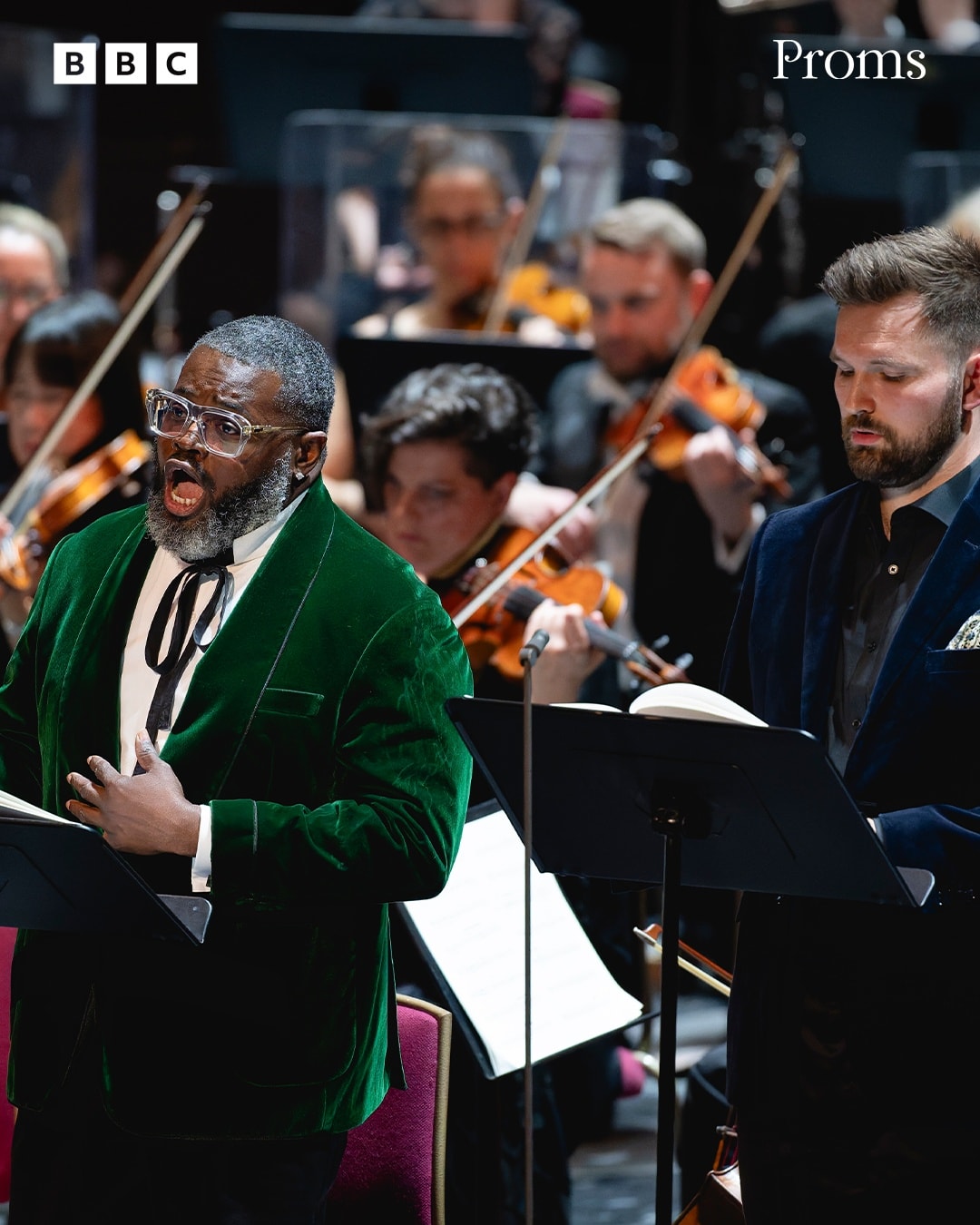
With its anticipations of later Mahler (via Wagner and Bruckner), Der Spielmann is the most characteristic part as it pivots deftly yet pointedly between genial whimsy and ominous dread. That this latter gains the upper hand with discovery of the ‘singing bone’ is offset by the blaze of glory with which Hochzeitstück begins; the offstage orchestra – head to advantage in the gallery – underpinning an increasingly desperate course of events as the fratricide is revealed and the wedding descends into mayhem, with deathly stillness pervading those final minutes.

There was some persuasive solo singing, notably Jennifer Johnston who carries the primary narrative thread; Russell Thomas was fervent if slightly strained and James Newby warmly eloquent, with Natalya Romaniw conveying real dramatic acuity. Treble and alto roles were poignantly taken, while Lintu drew an assured response from sizable choral and orchestral forces – the latter’s quartet of harps assuming a concertante role in an orchestration whose encompassing of dramatic impetus and intimate reflection is already that of Mahler alone.

Playing for around 70 minutes, Das klagende Lied seems as rich in incident as any Mahler symphony; not all of which, whatever their greater stylistic assurance or maturity, feature a conclusion as spine-tingling as this – and one which certainly drove its point across tonight.

You can listen back to this Prom concert on BBC Sounds until Sunday 12 October – or listen to recordings of the two works conducted by Pierre Boulez on Tidal here

Click on the artist names to read more about the Constanza Chorus, BBC Symphony Chorus and BBC Symphony Orchestra, conductor Hannu Lintu and soloists Natalya Romaniw, Jennifer Johnston, Russell Thomas and James Newby. Click also for more on the BBC Proms

Published post no.2,617 – Tuesday 5 August 2025
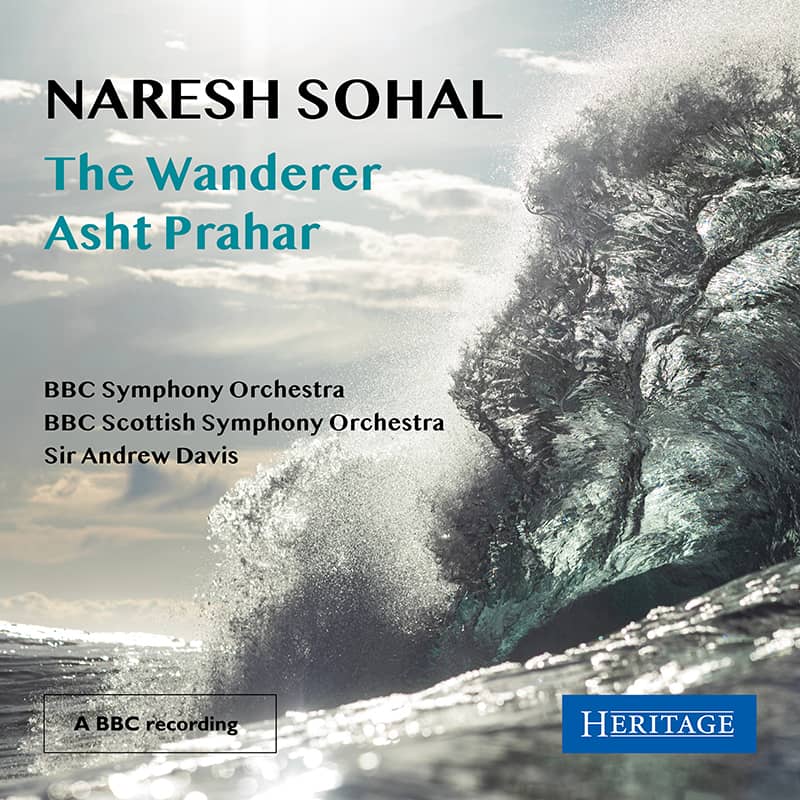
On Record – BBC SSO & BBC SO / Sir Andrew Davis – Naresh Sohal: The Wanderer & Asht Prahar (Heritage)

Naresh Sohal
Asht Pradar (1965)
The Wanderer (1982)

Jane Manning (soprano), BBC Scottish Symphony Orchestra (Asht Pradar), David Wilson-Johnson (baritone), BBC Symphony Chorus and Orchestra (The Wanderer) / Sir Andrew Davis

Heritage HTGCD135 [77’36”] English text included
Remastering Engineer Paul Arden-Taylor

Broadcast performance from BBC Studios, Glasgow on 6 January 1973 (Asht Pradar); live performance from Royal Albert Hall, London on 23 August 1982 (The Wanderer)

Reviewed by Richard Whitehouse

What’s the story?

Heritage issues what will evidently be an ongoing series of archival releases devoted to the music of Naresh Sohal, taken from BBC sources and featuring performers who championed his work over a career whose achievement is not reflected in the availability of recordings.

What’s the music like?

Although he came belatedly to the UK, Sohal (1939-2018) rapidly made up for any lost time when arriving in London in 1962 (further biographical detail can be found in the booklet note for this release and on the composer’s website). Within three years, he had produced his first major (and latterly his first acknowledged) work. Asht Prahar then had to wait until 1970 for its premiere (at the Royal Festival Hall conducted by Norman Del Mar), but it attracted much favourable attention and led to another hearing three years on – the performance featured here.

Taking its cue from the Indian sub-division of the day into eight temporal units (four each for day and night), Asht Prahar unfolds its eight sections as an unbroken continuity. The sizable forces are, for the most part, used sparingly yet resourcefully; as too the deployment of such devices as quarter-tones, along with influences of Ravel and Stravinsky, in music that makes a virtue of its pivoting between East and West. Cyclical if not necessarily cumulative, its final and longest ‘prahar’ brings wordless soprano and orchestra into tangible and haunting accord.

By the time that The Wanderer received its premiere, Sohal had a number of major works to his credit and rationalized his musical idiom accordingly. Setting an anonymous Anglo-Saxon poem in which the male protagonist speaks movingly and often despairingly of his isolation – both physical and spiritual – after the death of his lord, the work divides into two large parts that expand on the narrative’s emotional import. Such ‘‘existential bleakness’’ is intensified by omission of the poem’s last lines with their invoking a specifically Christian consolation. Despite its more than 50-minute duration, there is nothing discursive or unfocussed about The Wanderer’s content. Much of its text is understandably allotted to the baritone, whose austere character is complemented by darkly rhetorical choral passages while offset by an orchestral component with much soloistic writing (notably for flute) in a texture the more involving for its restraint and its strategic use of colour to define specific incidents or emotional responses. Nor is this an opera-manqué, the work succeeding admirably on its inherently abstract terms.

Does it all work?

It does, allowing for the fact that Sohal is not seeking any overt fusion between Occident and Orient, but rather attempting to forge a personal idiom influenced by both while beholden to neither. Both these performances bear out his convictions, Jane Manning adding her ethereal presence to Asht Prahar and David Wilson-Johnson bringing evident compassion to his more substantial role in The Wanderer. Both works benefit from the insightful presence of the late Sir Andrew Davis, whom one regrets never had an opportunity to record them commercially.

Is it recommended?

It is. The sound of these broadcasts has come up decently in remastering, lacking only the last degree of clarity or definition, and Suddhaseel Sen contributes informative annotations. Those looking for a way into Sohal’s distinctive and alluring sound-world need no further incentive.

Listen & Buy

For purchase options, you can visit the Heritage Records website

Published post no.2,451 – Thursday 20 February 2025

In concert – Kirill Gerstein, BBCSO / Sakari Oramo: Bacewicz & Busoni @ Barbican Hall

Kirill Gerstein (piano), BBC Symphony Chorus (lower voices), BBC Symphony Orchestra / Sakari Oramo

Bacewicz Symphony no.2 (1951)
Busoni Piano Concerto in C major Op. 39 (1901-04)

Barbican Hall, London
Friday 1 November 2024

Reviewed by Richard Whitehouse Pictures (c) BBC / Sarah-Louise Bennett

Wait years for a performance of Busoni’s Piano Concerto then (at least) two come (almost) at once. As 2024 sees the centenary of the composer’s death and it is much his largest work for the concert hall, this was doubtless to be expected though a welcome occurrence all the same.

Having first played it in Boston seven years ago (later released on Myrios), Kirill Gerstein (below) and Sakari Oramo were intent on utilizing an experience unusual in the context of this work. This was evident at the outset of its Prologo e introito – the long orchestral introduction having a cumulative impetus that carried into the soloist’s imposing entry, with this physicality finding contrast in the delicacy of passagework and the sensitivity of dialogue later in this movement. Nor was there any lack of capriciousness in a Pezzo giocoso whose more ambivalent asides pointedly underlined, and its more populist elements always integrated into the ongoing flow.

Centrepiece in every respect, Pezzo serioso made a memorable impression. The sombreness of its introduction complemented by the undulating poise of Gerstein’s playing in the ensuing barcarolle section, before a remorseless build up of intensity towards its central climax found piano and orchestra in true accord; the re-emergence of earlier themes of a pathos abetted by a conclusion whose gently insistent rhythmic undertow led to an ending of exquisite finesse.

Rarely can the All’italiana have conveyed such scintillating appeal at this headlong a tempo, making for a tarantella of infectious wit but one whose ever more daring flights of fancy never threatened to lose focus – the BBC Symphony Orchestra responded with unfailing conviction, while the climactic cadenza made for a seamless link into the Cantico. Here male voices, placed at the rear of the platform instead of offstage, assumed the musical foreground as this finale built in a rising arc of tension to an apotheosis of a triumph the more cathartic for its sense of release.

How Busoni’s epic work comes over in performance is in part determined by what has been heard earlier in the programme. Tonight’s concert got it just right with a rare hearing (at least in the UK) for the Second Symphony from Polish composer and violinist Grażyna Bacewicz.

Oramo (above) had previously given notice of his sympathy for her music via recordings of the Third and Fourth Symphonies (Chandos), and this performance did not disappoint. Playing for just over 20 minutes, the Second has a variety of incident and overall impact out of all proportion to its length – whether in the opening movement as this alternates between equivocation and resolve, the eloquence of a Lento in which Bacewicz’s orchestration is at its most resourceful, a Scherzo whose poetic asides never threatened to offset its prevailing vivacity, then a Finale that (as with Roussel’s Fourth Symphony which may have provided the model) ended almost too soon yet whose incisiveness always felt apposite to the whole. Throughout, Bacewicz was conscious of the implications of Socialist Realism while steering clear decisively of its values.

Hopefully this and Bacewicz’s First Symphony will be appearing in due course as a follow-up volume. For now, it gave ready enhancement to a concert whose enterprise and conviction are further proof, is such were needed, of that continued rapport between Oramo and the BBCSO.

For details on their 2024-25 season, head to the BBC Symphony Orchestra website. Click on the names to read more about pianist Kirill Gerstein, conductor Sakari Oramo and composer Grażyna Bacewicz

Published post no.2,351 – Sunday 3 November 2024

Arcana at the Proms – Prom 19: Jess Dandy, Senja Rummukainen, BBC SO & Sakari Oramo – Holst ‘Cloud Messenger’, Harvey & Elgar

Harvey Tranquil Abiding (1998) [Proms Premiere]
Elgar Cello Concerto in E minor, Op. 85 (1918-19)
Holst The Cloud Messenger, H111 (1909-10, rev. 1912) [Proms Premiere]

Jess Dandy (contralto), Senja Rummukainen (cello), BBC Symphony Chorus, BBC Symphony Orchestra / Sakari Oramo

Royal Albert Hall, London
Saturday 3 August 2024

reviewed by Richard Whitehouse Photos (c) Chris Christoudoulou

Now approaching his 12th season as chief conductor of the BBC Symphony Orchestra, Sakari Oramo tonight gave his first Prom of the season with this typically well-balanced programme of British music framing unfamiliar pieces past or (relative) present with a classic of its genre.

First came a welcome revival for Tranquil Abiding – doubtless one of Jonathan Harvey’s most immediately appealing works and one where the rhythm of ‘breathing’ central to so much of his later output is afforded lucid expression. The degree to which its melodic content emerges out of then returns into the surrounding texture was duly conveyed by Oramo, who ensured a real sense of expectation as this music took on an almost tangible impetus towards its climax. A pity that some restless and inattentive listeners robbed the final stage of its ‘ultimate calm’.

Long before it had the eminence it now enjoys, Elgar’s Cello Concerto was a regular Proms item through advocacy from Beatrice Harrison, Anthony Pini and, latterly, Jacqueline du Pré. Senja Rummukainen (above) thus joined a distinguished roster of soloists and, in the first movement at least, seemed a little inhibited in this context. Her arresting lead-in to the scherzo brought playing of greater involvement, both here and in an Adagio whose autumnal eloquence never risked sentimentality. The relatively lengthy finale was securely rendered, its themes incisive then genial, and if the development culminated a little portentously, the reprise was tellingly subdued before a moving apotheosis and curtly inevitable coda. Rummukainen can be heard again in London in the Dvořák concerto, with the BBC Concert Orchestra, this October 4th.

In the 150th anniversary of his birth, and the 90th anniversary of his death, a major revival by Gustav Holst was almost mandatory. Setting his translation from the Sanskrit of a poem by Kālidāsa, The Cloud Messenger never quite recovered from its evidently disastrous premiere such that revivals have been occasional. At almost 45 minutes, it is a demonstrable statement of intent whose expansive choral gestures are assured but almost anachronistic given Holst’s chamber opera Sāvitri redefined his conceptual approach and musical idiom barely a year before. Yet the present work amply foreshadows much of what was achieved over the next two decades, notably a freely evolving melisma mostly unimpeded by rhythmic precedent and a harmonic subtlety such as only needed greater refinement in its handling to realize its fullest potential.

That much of this latter aspect was already in place is clear from those intimate passages for semi-chorus to the fore during its later stages, while the third of its five continuous section brought a confiding soliloquy that Jess Dandy (above) – contralto in the truest sense – realized with distinction. A pity she was not heard again, but the BBC Symphony Chorus was not found wanting beforehand or in that ethereal leave-taking with which the work evanesces, ‘Venus’-like, to its close. Whatever the stylistic inconsistencies, the best of it is Holstian to its core.

Now it is available in an expert reduction for chamber orchestra by Joseph Fort, The Cloud Messenger should attract more frequent hearings, but the Royal Albert Hall proved a fitting venue for this expansive original while Oramo’s perceptive performance did not disappoint.

For more on this year’s festival, visit the BBC Proms website – and for more on the artists involved, click on the names to read more about Jess Dandy, Senja Rummukainen, the BBC Symphony Chorus, BBC Symphony Orchestra and chief conductor Sakari Oramo

Published post no.2,261 – Monday 5 August 2024

BBC Proms 2023 – Jon Hopkins with the BBC Symphony Orchestra and Jules Buckley

Prom 58

Hopkins
ATHOS (arr. Jules Buckley) (BBC Commission, world premiere)
Feel First Life (arr. Peter Riley & Leo Abrahams)
The Wider Sun (arr. Sam Gale)
Singularity (arr. Simon Dobson)
Music for Psychedelic Therapy – excerpt (arr. Peter Riley)
Form by Firelight (arr. Peter Riley)
Luna Moth (arr. Sam Gale)
Collider (arr. Simon Dobson)
Abandon Window (arr. Tom Trapp)
Recovery

Jon Hopkins (piano, programming), Leo Abrahams (guitar), BBC Singers, BBC Symphony Chorus (chorus master David Young), BBC Symphony Orchestra / Jules Buckley

Royal Albert Hall, London
Tuesday 29 August 2023

by Ben Hogwood photos by Mark Allan / BBC

Electronic and orchestral music are more closely related than you might think, with Jon Hopkins a classic case in point. For 15 years, the pianist and producer has been carefully sculpting his music either as a contributor for other artists (King Creosote, Coldplay and Brian Eno to name just three) or making his own, weather-beaten albums. Starting with Opalescent and Insides, these have developed into immersive meditations (Singularity and the most recent long player Music for Psychedelic Therapy) by way of more full-bodied rave music (2013’s Immunity). How, then, does this music hold up in a packed and expectant Royal Albert Hall?

Extremely well as it turns out. In order to achieve what he described beforehand as ‘a meditation for 5,000 people’, Hopkins has to temporarily turn his back on beat-driven, post-rave landmarks such as Collider or Form By Firelight. When such material appears, its percussive impact is modified so that the main job is done by the timeless, meditative chorale echoing around the hall.

Hopkins’ music is repetitive, but as with the best exponents of minimalism – Steve Reich, Philip Glass and John Adams, for instance – the material under repetition rewards the investment made. The mind is eased, enjoying the upfront melodies but also taking up the option of picking out new threads beneath the surface, like examining a tartan pattern under a magnifying glass.

The tartan analogy is purposeful, for Hopkins’ earlier music has a distinctive Celtic edge furthered by his work with King Creosote. The Wider Sun, from 2009 album Insides, has an authentic left of centre tuning, is slow but packs emotional heft, beautifully arranged by Sam Gale and masterfully weighted by Jules Buckley and the BBC Symphony Orchestra strings.

Before that we hear a new piece, the 25-minute ATHOS demonstrating Hopkins’ control of larger structures. This is a natural direction for his music to be taking after Music for Psychedelic Therapy, for it is effectively an album ‘A’ side of several interwoven tracks. The profile and material of ATHOS sits closely to composers such as Arvo Pärt, and in particular his Credo, but Hopkins has up his sleeve a number of heart-shifting modulations. Accentuated by the Royal Albert Hall organ, these are once heard, never forgotten moments.

So, too, are the choral passages, thanks to pinpoint interpretations from the BBC Singers and BBC Symphony Chorus, whose lines float effortlessly above the orchestral forces. Their vocal control is masterful and effortless, ensuring the sustained notes keep their emotional impact without wavering. Lesser singers would have tailed off long before these ones even think of blinking!

The sequence of music, running for approximately 75 minutes, is well chosen. Only on occasion does the source material become oversimplified, and as it turns out these moments serve as natural pauses for breath in the musical tapestry.

Guitarist Leo Abrahams, appearing for the last two numbers, makes a critical contribution (above). A good friend and established collaborator with Hopkins and Eno, he brings a sharper timbre to the shredded distortion of Recovery, which is – as throughout – complemented by imaginative and sympathetic lighting.

This was a multisensory Prom, containing a different sort of symphony to which the Royal Albert Hall is normally accustomed. Hopkins has proved his credentials in mastering larger structures, and his development in this field will be worth watching for sure. For now, the afterglow remains.

For more on the 2023 BBC Proms, visit the festival’s website at the BBC. For more on the artists, click here to read about Jon Hopkins, Leo Abrahams, Jules Buckley and the BBC Symphony Orchestra