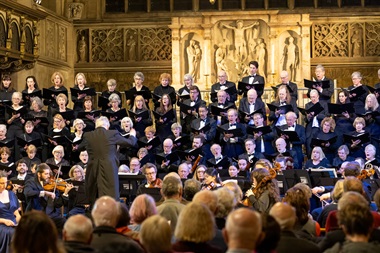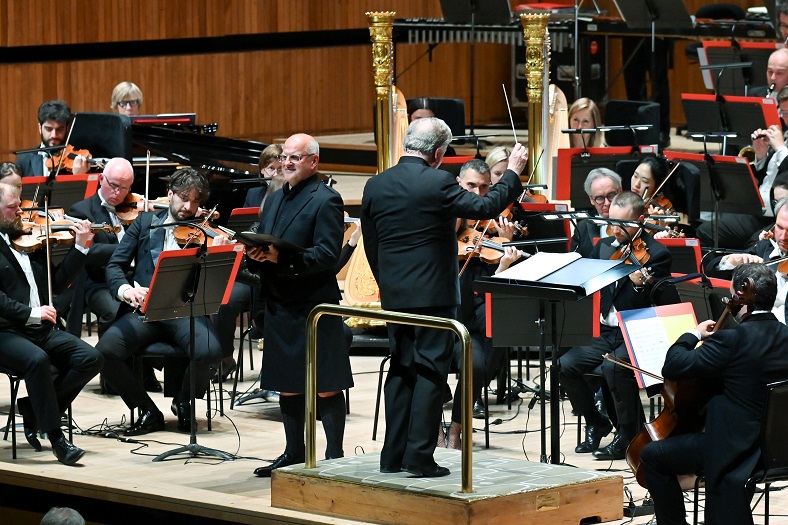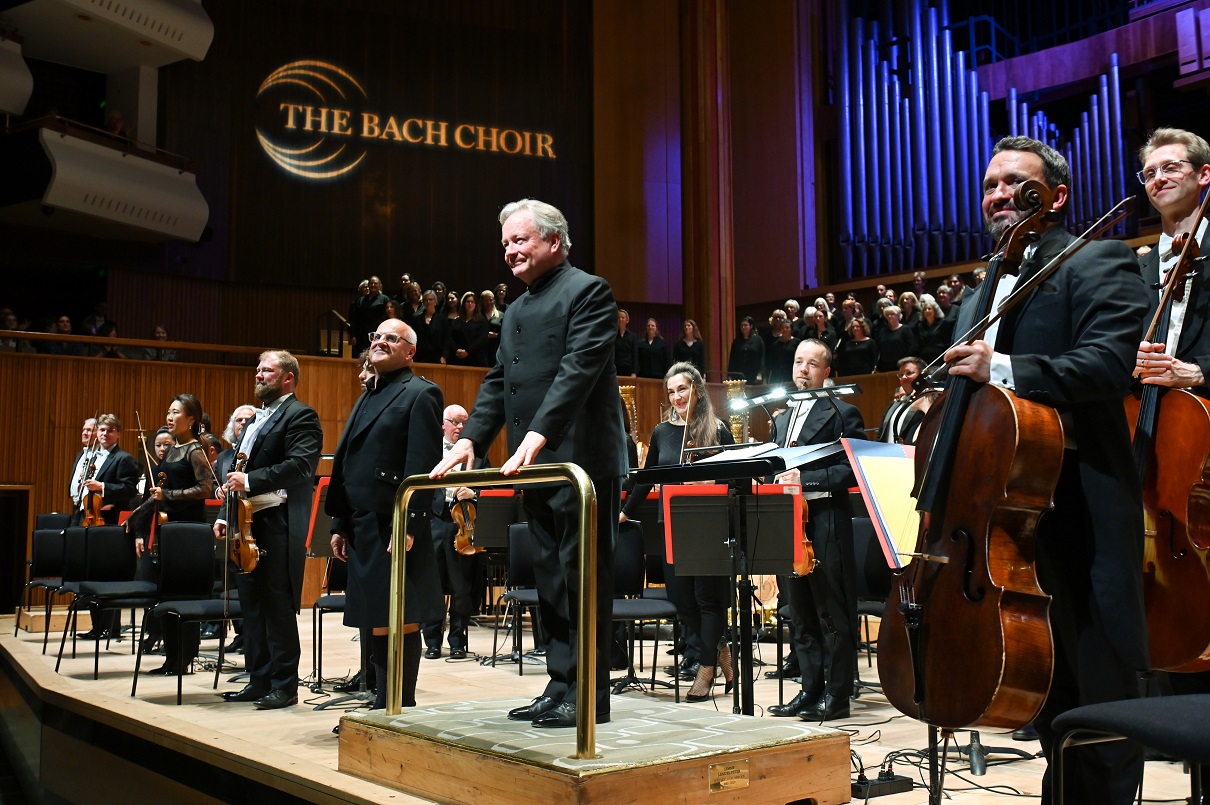
In concert – The Bach Choir, Philharmonia Orchestra / David Hill: Delius, Blackford & Walton

Amy Carson (soprano), Harry Jacques (tenor), Christopher Purves (baritone), The Bach Choir, Philharmonia Orchestra / David Hill

Delius The Song Of The High Hills (1911)
Blackford La Sagrada Familia Symphony (2022, world premiere)
Walton Belshazzar’s Feast (1931)

Royal Festival Hall, London
Thursday 8 May 2025

Reviewed by Ben Hogwood Pictures (c) Chris Christodoulou

This imaginative concert presented three British works telling stories from overseas, their reach extending to Norway, Spain and Babylon respectively.

Although born in Bradford, Frederick Delius spent much of his life abroad, living in America and then France – from where he would visit Norway for many a summer holiday with his wife. One such vacation in 1911 inspired him to write The Song Of The High Hills, a continuous sequence in three sections for wordless choir and orchestra capturing the mountain plateau, or ‘vidda’, that they found on their walks. Images from the plateau were shown on a screen behind the chorus as they performed.

Musically the work draws from Grieg and Debussy (his Nocturnes in especially) but inhabits a world all of its own, Delius achieving an unusual, rapt stillness when describing the high plains. David Hill, a long time exponent of his music, marshalled a strong performance, albeit one that didn’t quite sustain the rarefied atmosphere of the central section. It did cast quite a spell, mind, thanks to a beautiful oboe solo from Timothy Rundle on the approach, and some superbly controlled singing from The Bach Choir, headed by soloists Amy Carson (soprano) and Harry Jacques (tenor). The climax of the middle section was bolstered by three timpani, before the orchestra returned us to base camp. Speeds were on the fast side, but the Philharmonia Orchestra gave consistently luminous textures.

London-born composer Richard Blackford has shown considerable flair when writing for orchestra, and this was immediately evident in the world premiere of his La Sagrada Famila Symphony. Completed in 2022 and already recorded on the Lyrita label, it is a musical response to a 2019 encounter with Gaudí’s vision, concentrating on three great facades of the building – Nativity, Passion and Glory.

Blackford’s symphony was rich in colour but also vividly descriptive, his responses matched by an accompanying film, directed by the composer. Nativity began with awe-inspiring salvos from the brass but grew into a more intimate study, with elements of Hindemith and Berg in the orchestral writing, before a propulsive passage threw off the shackles. Passion was the emotional centrepiece, a vivid study in the brutality of the Good Friday story. Grotesque elements were emphasised by sudden closeups of Josep Maria Subirachs’s sculptures, their drawn expressions reflected in the music. The death of Christ was especially notable, marked by a solo of moving eloquence from cellist Martin Smith, then a sharp cry of dismay from Mark van de Wiel’s clarinet.

Glory was less obviously jubilant than might have been expected, mystical and reverent, but again it was an accurate response to the imagery as the film briefly went inside the massive structure. Blackford’s imagery danced in the listener’s mind on its own merits, with the thrilling surge at the end, bolstered by the organ, reminiscent of Messiaen or Scriabin. David Hill secured a fine performance from the Philharmonia, bringing the splendour of Gaudí’s cathedral to the concert hall. The emphatic finish brought with it a reminder of the building’s likely completion in 2026, a mere 144 years after construction began!

A British choral classic followed in the second half. Belshazzar’s Feast was initially denounced by Sir Thomas Beecham (a Delius fan, coincidentally) but Walton’s cantata has become a popular occasion piece. It is a vivid account of Babylonian decadence, before a human hand appears, writing on the wall of the banqueting hall to prophesy Belshazzar’s downfall. David Hill applied expert pacing to the storytelling, the Bach Choir on top form as the tension grew, spilling over into the exultant Praise Ye section. The paeans to the Babylonian Gods were starkly thrilling, contrasted by the terrifying unison shout of “Slain!” at Belshazzar’s death. The Philharmonia were superb, too, offstage brass bringing widescreen sound from either side of the stage and the percussion giving brilliant descriptions of the elements – iron and wood especially.

When the writing on the wall began, an ominous hush descended on the choir, the orchestra spreading a macabre chill through the hall – before the triumph of the closing pages, the Israelites free at last. Baritone Christopher Purves was a fine soloist, narrating the events and capturing the mood throughout. With 220+ in the choir, our ears were ringing long after the concert had finished, a timely reminder of a ruler whose inflated ego had brought about his downfall. Could there be any parallels in today’s world, I wonder?

For details on the their 2024-25 season, head to the Philharmonia Orchestra website

Published post no.2,529 – Saturday 10 May 2025

In appreciation: Coralie Hogwood

by Ben Hogwood

A personal post for today, which marks the 10th anniversary of the passing of my mother Coralie. If you’ve been reading Arcana for a while you might know that I have a lot to thank my mum for, not least in terms of musical inspiration! Here is a post I wrote nearly ten years ago, detailing her influence.

Here, though, I would like to leave one of her favourite classical pieces, Dvořák‘s Symphony no.8 in G major – not least because it’s a beautiful spring day in the UK, which she would have loved! Keep resting peacefully, Mum.

Published post no.2,520 – Friday 2 May 2025

Orchestral Music That’s Right Up Your Street: The CBSO announces its 2025-26 season

From the press release:

The City of Birmingham Symphony Orchestra (CBSO) today announces its 2025-26 season, presenting a compelling programme of concerts deeply connected to the city’s vibrant cultural identity.

Findings from the orchestra’s new “Listening Project” – a West Midlands focused research initiative reveals Birmingham’s strong cultural confidence. The new research shows 60% of Birmingham residents consider attending arts and cultural events to be a vital aspect of their free time. In addition, public support for Birmingham’s music venues is strong: 79% of people say they have attended a Birmingham venue in the last year – and 57% say they haven’t felt the need to travel beyond the city for music concerts.

In line with this, the CBSO has crafted a season that brings together world-class classical performances, diverse cultural collaborations, and accessible community events that reflect what Birmingham audiences value most.

CBSO Music Director, Kazuki Yamada, comments: “Our 2025-26 season celebrates both our classical heritage and Birmingham’s diverse cultural voices. We’re bringing orchestral music directly to communities across the city – honouring traditional masterworks while creating experiences that reflect what Birmingham audiences have told us they value most.”

The CBSO’s 2025-26 season at a glance

Classical tradition at its finest

The 2025-26 season offers ambitious classical programming:

· Kazuki Yamada enters his second year as Music Director by beginning a full Mahler Symphony Cycle with Symphony No.1, and leading more than 10 concerts in Birmingham, including as part of CBSO in the City.

· Elgar’s The Dream of Gerontius opens the season with the full CBSO Chorus.

· Puccini’s Tosca in concert featuring Natalya Romaniw, Gwyn Hughes Jones and Sir Bryn Terfel.

· The CBSO season has drawn top international soloists, including; Isata Kanneh-Mason, Benjamin Grosvenor, and Lisa Batiashvili.

Celebrating Birmingham’s cultural diversity

Building on successful past collaborations, the CBSO continues to champion the city’s rich cultural tapestry:

· Black Lives in Music brings a taste of their celebrated classical music festival to Birmingham with the return of award-winning singer-songwriter Laura Mvula to her hometown.

· The CBSO & The Orchestral Qawwali Project, a glorious blend of Sufi poetry, Indian Classical dance and symphony orchestra returns to Birmingham.

· Rushil Ranjan leads an evening that celebrates the musical and spiritual connections between western and eastern classical music.

· Satnam Rana presents Bringing the Light, an evening dedicated to celebrating light and winter festivals, including new commissions from contemporary voices including Cassie Kinoshi, Joan Armatrading and Roxanna Panufnik.

Taking music to Birmingham’s communities

The CBSO continues its commitment to bringing music directly to communities across the city:

· CBSO in the City week (23-28 July 2025) will return – as the CBSO delivers free music in public spaces throughout Birmingham.

Music for everyone

The season includes accessible programming designed to welcome new audiences:

· The complete Star Wars Original Trilogy performed over a full weekend, with live orchestra (24-26 October 2025).
· Symphonic Queen celebrating one of the UK’s greatest-ever rock bands.
· Charlie Chaplin’s The Gold Rush with live orchestra.

Inspiring music experiences for children and students

The CBSO’s 2025-26 season will also feature a strong focus on young people, giving more than 20,000 young people enriching music experiences through 36 concerts specifically designed for young people:

· Targeted Schools’ Concerts for different key stages, reaching thousands of children who might otherwise never experience live orchestral music.
· Notelets performances specifically designed for toddlers and young children’s first music experiences – these fun-filled interactive concerts give children the freedom to dance, sing and learn about musical instruments for the first time.
· Relaxed Concerts created for pupils attending Special Schools to enable pupils to experience live music in a supported, accessible and engaging environment.
· Four dedicated family concerts including “Music from the Movies”, “CBSO Family Christmas”, “Tunes & Tales” and “Dance Across America.”

“Our new season is a magnificent celebration of music” says Emma Stenning, CBSO Chief Executive, who promises that 2025-26 will deliver “joy filled concerts for everyone, whether you find us at Symphony Hall, across Birmingham and the West Midlands, or on national and international tour led by our incredible Music Director, Kazuki Yamada”.

She adds: “Birmingham is our inspiration. Our home city is fantastically musical, and full of diversity and creative adventure. This new season is drawn from exactly that spirit, and presents us to the world as a truly future facing orchestra, that both celebrates the great classical repertoire, and dares to try something new”.

“As you delve into what’s on offer, we hope that you will discover music that moves you, uplifts you and offers you moments of celebration and reflection. We very much look forward to welcoming you to a concert soon”.

Catherine Arlidge, Director of Artistic Planning and former CBSO violinist, added: “Our season marries the global with the local. Whilst the diversity of our season programming is informed by understanding our wide-ranging audiences locally, we are also delighted that so many top international artists are joining us for the new season – Sir Bryn Terfel, Lisa Batiashvili, Osmo Vänskä, Vilde Frang and the Jussen brothers to name but a few. At a time of international geo-political tensions, our concerts celebrate different geographies and cultures – and remind us all about music’s power to unite people. Through our research, we have a strong sense of the musical experiences that speak for the city today – yet in terms of repertoire, guest artists and composers, the season is richly international in flavour. It is a season about celebrating home – but on the world stage.”

To explore the 2025-26 CBSO season in full visit the CBSO website. Tickets for the new season go on sale from Wednesday 21 May 2025, 10am.

Published post no.2,519 – Thursday 1 May 2025

On Record – Hallé / Kahchun Wong: Bruckner: Symphony no.9 (fourth movement revised by Dr. John A. Phillips) (Hallé)

Bruckner, ed. Kito Sakaya Symphony no.9 in D minor WAB109 (1887-96)
with performing edition of finale by Nicole Samale, John A. Phillips, Benjamin-Gunnar Cohrs and Giuseppe Mazzuca (1983-2012) as revised by John A. Phillips (2021-22)

Hallé / Kahchun Wong

Hallé CDHLD7566 [two discs 88’24’’]
Producer Steve Portnoi Engineers Tony Wass, Edward Cittanova

Recorded 26 October 2024 at Bridgewater Hall, Manchester

Reviewed by Richard Whitehouse

What’s the story?

The Hallé furthers its association with principal conductor and artistic advisor Kahchun Wong in this recording of Bruckner’s Ninth Symphony, the finale heard in a new edition prepared by John A. Phillips as the ostensible culmination of a process extending back across four decades.

What’s the music like?

Although his introductory note leaves no doubt as to his advocacy for Bruckner Nine, Wong’s approach is not an unqualified success overall. Doubts such as they are centre on the opening two movements, the first of which lacks that sustained inevitability and cumulative intensity necessary to make its extensive span cohere. Aptly contrasted in themselves, its three themes follow on each other without establishing any greater continuity and while the approach to its development yields tangible ominousness, the ensuing climax conveys less than the ultimate terror, though its coda does attain a fearsome majesty. Wong’s take on the second movement succeeds best in its trio’s speculative flights of fancy, which only makes the relative stolidity and emotional disengagement of its Scherzo sections the more surprising and disappointing.

The highlight is undoubtedly the Adagio. Without intervening unduly in its evolution, Wong ensures cohesion over a movement manifestly riven if not outright fractured by the starkness of its thematic contrasts. The journey towards its seismic culmination feels as eventful as it is absorbing and while that climax is less shattering than it can be, the clarity afforded its dense harmonies could not be bettered. Wong is mindful, moreover, not to allow its coda to broaden into an extended postlude but instead to keep this moving in anticipation of what is to follow.

This is hardly the place to go into the whys or wherefores of the ‘SPCM’ edition of the Finale. Given his intensive research into the issues of what is extant and what Bruckner intended for the crowning movement of his grandest symphonic design, Phillips is ideally placed in making his revisions to a completion which renders some striking yet often disparate material from a focussed and convincing perspective. The main alterations are those made to its latter stages, more streamlined and with less overt rhetoric than in the 2011 revision as recorded by Simon Rattle (Warner) though, to this listener at least, the 2008 revision as recorded by Friedemann Layer (Musikalische Akademie) still remains the most convincing in context. Whatever else, Wong conveys the extent of this gripping torso right through to the elation of its apotheosis.

Does it all work?

How well this performance succeeds depends on how one judges the necessity of that closing movement and the persuasiveness of Wong’s interpretation as a whole. Pertinent comparison might be made with the Hallé’s previous recording (also on its own label) – Cristian Mandeal drawing a response that, in the first two movements, has a power and intensity in advance of this newcomer. Interesting he should eschew the finale while instilling into those three earlier movements a sense of completion which, whether or not intentionally, is its own justification.

Is it recommended?

It is, whatever the reservations here expressed. This is not the final word on a four-movement Bruckner Nine any more than on Wong’s evolving interpretation though, with realistic sound alongside Phillips’s detailed while informative annotations, it is evidently a mandatory listen.

Listen / Buy

You can read more about this release and explore purchase options at the Hallé website

Published post no.2,518 – Wednesday 30 April 2025

In concert – Anne Queffélec @ Wigmore Hall: Mozart and a French ‘musical garden’

Anne Queffélec (piano)

Mozart Piano Sonata no.13 in B flat major K333 (1783-4)
Debussy Images Set 1: Reflets dans l’eau (1901-5); Suite Bergamasque: Clair de lune (c1890, rev. 1905)
Dupont Les heures dolentes: Après-midi de Dimanche (1905)
Hahn Le Rossignol éperdu: Hivernale; Le banc songeur (1902-10)
Koechlin Paysages et marines Op.63: Chant de pêcheurs (1915-6)
Schmitt Musiques intimes Book 2 Op.29: Glas (1889-1904)

Wigmore Hall, London
Monday 28 April 2025 (1pm)

by Ben Hogwood picture of Anne Queffélec (c) Jean-Baptiste Millot

The celebrated French pianist Anne Queffélec is elegantly moving through her eighth decade, and her musical inspiration is as fresh as ever. The temptation for this recital may have been to play anniversary composer Ravel, but instead she chose to look beneath the surface, emerging with a captivating sequence of lesser-known French piano gems from the Belle Époque, successfully debuted on CD in 2013 and described by the pianist herself as “a walk in the musical garden à la Française.”

Before the guided tour, we had Mozart at this most inquisitive and chromatic. The Piano Sonata no.13 in B flat major, K.333, was written in transit between Salzburg and Vienna, and the restlessness of travel runs through its syncopation and wandering melodic lines. Queffélec phrased these stylishly, giving a little more emphasis to the left hand in order to bring out Mozart’s imaginative counterpoint. She enjoyed the ornamental flourishes of the first movement, the singing right hand following Mozart’s Andante cantabile marking for the second movement, and the attractive earworm theme of the finale, developed in virtuosic keystrokes while making perfect sense formally.

The sequence of French piano music began with two of Debussy’s best known evocations. An expansive take on the first of Debussy’s Images Book 1, Reflets dans l’eau led directly into an enchanting account Clair de Lune, magically held in suspense and not played too loud at its climactic point, heightening the emotional impact.

The move to the music of the seldom heard and short lived Gabriel Dupont was surprisingly smooth, his evocative Après-midi de Dimanche given as a reverie punctuated by more urgent bells. Hahn’s Hivernale was a mysterious counterpart, its modal tune evoking memories long past that looked far beyond the hall. Le banc songeur floated softly, its watery profile evident in the outwardly rippling piano lines. The music of Charles Koechlin is all too rarely heard these days, yet the brief Le Chant des Pêcheur left a mark, its folksy melody remarkably similar to that heard in the second (Fêtes) of Debussy’s orchestral Nocturnes.

Yet the most striking of these piano pieces was left until last, Florent Schmitt’s Glas including unusual and rather haunting overtones to the ringing of the bells in the right hand. Queffélec’s playing was descriptive and exquisitely balanced in the quieter passages, so much so that the largely restless Wigmore Hall audience was rapt, fully in the moment. Even the persistent hammering of the neighbouring builders, a threat to concert halls London-wide, at last fell silent.

Queffélec had an encore to add to her expertly curated playlist, a French dance by way of Germany and England. Handel’s Minuet in G minor, arranged by Wilhelm Kempff, was appropriately bittersweet and played with rare beauty, completing a memorable hour of music from one of the finest pianists alive today.

Listen

You can listen to this concert as the first hour of BBC Radio 3’s Classical Live, which can be found on BBC Sounds. The Spotify playlist below has collected Anne Queffélec’s available recordings of the repertoire played:

Published post no.2,517 – Tuesday 29 April 2025