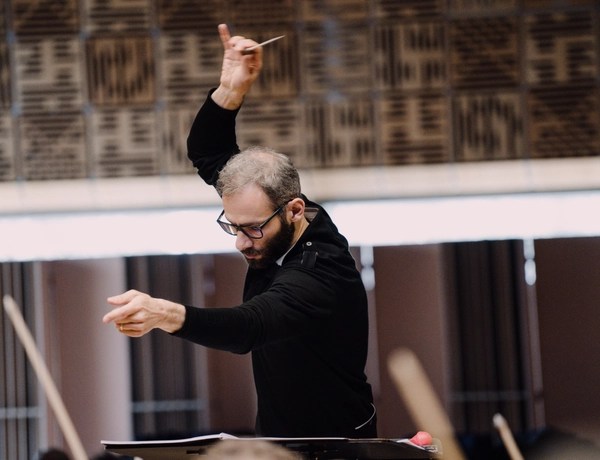
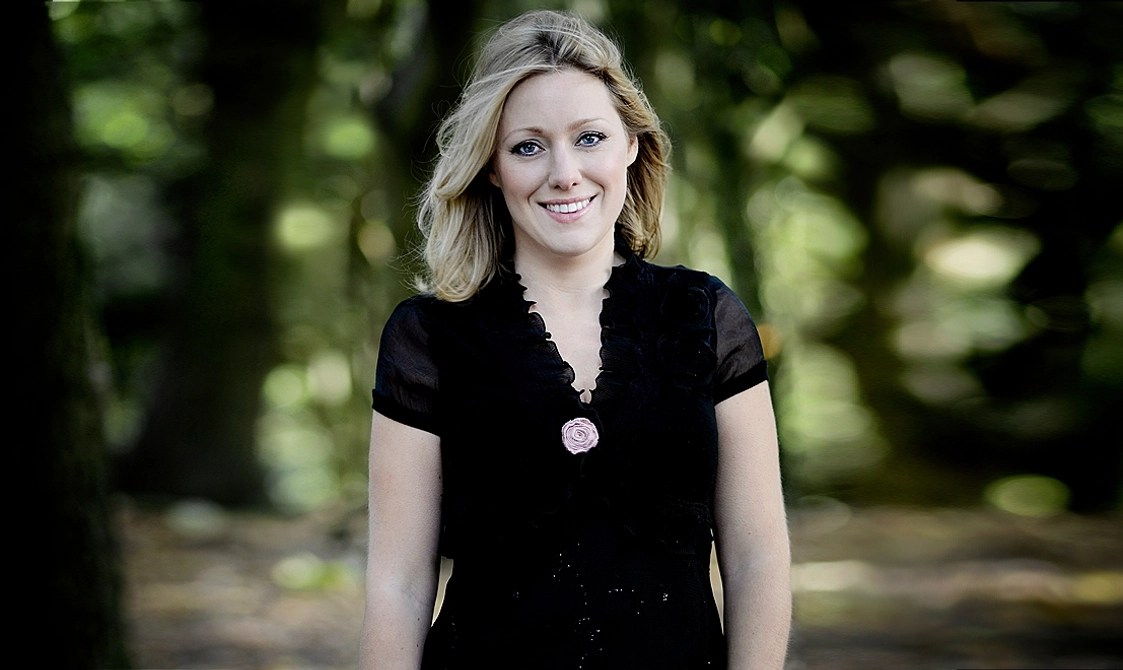
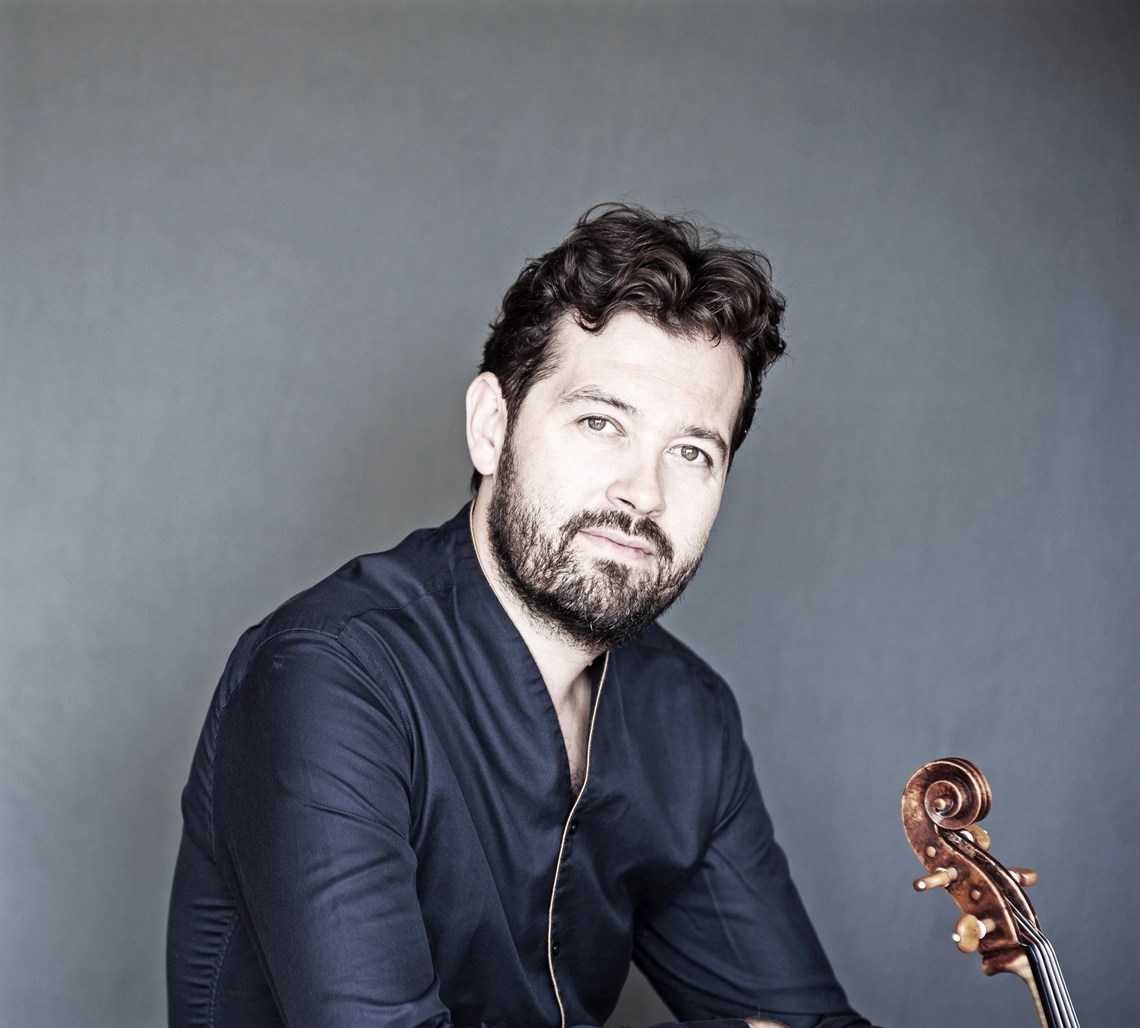
Inmo Yang (violin), City of Birmingham Symphony Orchestra / Dima Slobodeniouk (above)
Martinů Memorial to Lidice H296 (1943) Tchaikovsky Violin Concerto in D, Op. 35 (1878) Prokofiev Symphony no.6 in E flat minor Op.111 (1945-47)
Symphony Hall, Birmingham Thursday 18 June 2026 2:15pm
Reviewed by Richard Whitehouse Picture of Dima Slobodeniouk (c) Marco Borggreve
If not quite an all-Russian sequence or, indeed, one centred on the Second World War, this was still a cohesive and satisfying programme that played to the collective strengths of the City of Birmingham Symphony Orchestra along with this afternoon’s conductor Dima Slobodeniouk.
Just over eight decades since a first hearing in Prague (83 years following its premiere in New York), Memorial to Lidice has lost little of its fervency and pathos – qualities often present in the music of Martinů’s maturity yet seldom so graphically as here. The CBSO’s playing duly ensured a performance of sustained eloquence, with Slobodeniouk lightening the mood in its central section so that the return of the opening music – with its allusions to the St Wenceslas Chorale and the motto of Beethoven’s Fifth Symphony – left a tangibly cathartic impression.
Tchaikovsky’s Violin Concerto received a far less cordial reception at its premiere in Vienna, but soon afterwards established a place in the repertoire as has never been challenged. Early audience may have found its first movement protracted, but Immo Yang ensured a seamless follow-though with due characterization of its subtly contrasted main themes. Imaginatively articulated, the cadenza was pointedly developmental as to make the wistful reappearance of the first theme the more affecting. Nor was there any lack of emotional depth in the ensuing Canzonetta – its musing uncertainty the counterweight to a finale which, after its (rightly) jarring introduction, found the right balance between impetuosity and plaintiveness on route to a coda no less uproarious for all its knife-edge coordination between soloist and orchestra.
Acclaimed at its Leningrad premiere, Prokofiev’s Sixth Symphony was a victim of political intrigues such as hampered any wider dissemination (its first hearing in Birmingham came as late as 1980) or recognition as its composer’s finest and most finely achieved such piece. Slobodeniouk undoubtedly had its measure, not least that opening Allegro moderato whose diverse and even disparate ideas – which might be described as speculative, mesmeric then desperate – melded with an assured sense of where this disquieting movement was headed. In particular, the lengthy development proceeded with truly remorseless intensity toward a pulverizing climax – one whose bitter after-tones persisted through a summary reprise then on to a conclusion whose embrace of the major key could hardly have felt less affirmative.
If this movement finds Prokofiev at his most questing, then the Largo finds him at his most empathetic such as its searing introductory bars then heartfelt main theme are drawn into a powerfully focussed design leaving no doubt as to its composer’s awareness of the ‘human cost’ or this conductor’s conveying of what was at stake. Not that the final Vivace was at all pre-empted, the forced jocularity of its main theme offset by ambivalent episodes prior to a coda whose teetering on catastrophe seemed hardly allayed by those fateful closing gestures.
Taken as a whole, this proved an impressive conceived and realized performance that, having occurred ‘‘many years since my last visit’’ (to quote the conductor), was such as to make one hope that Slobodeniouk’s next appearance with this orchestra might not be so long in coming.
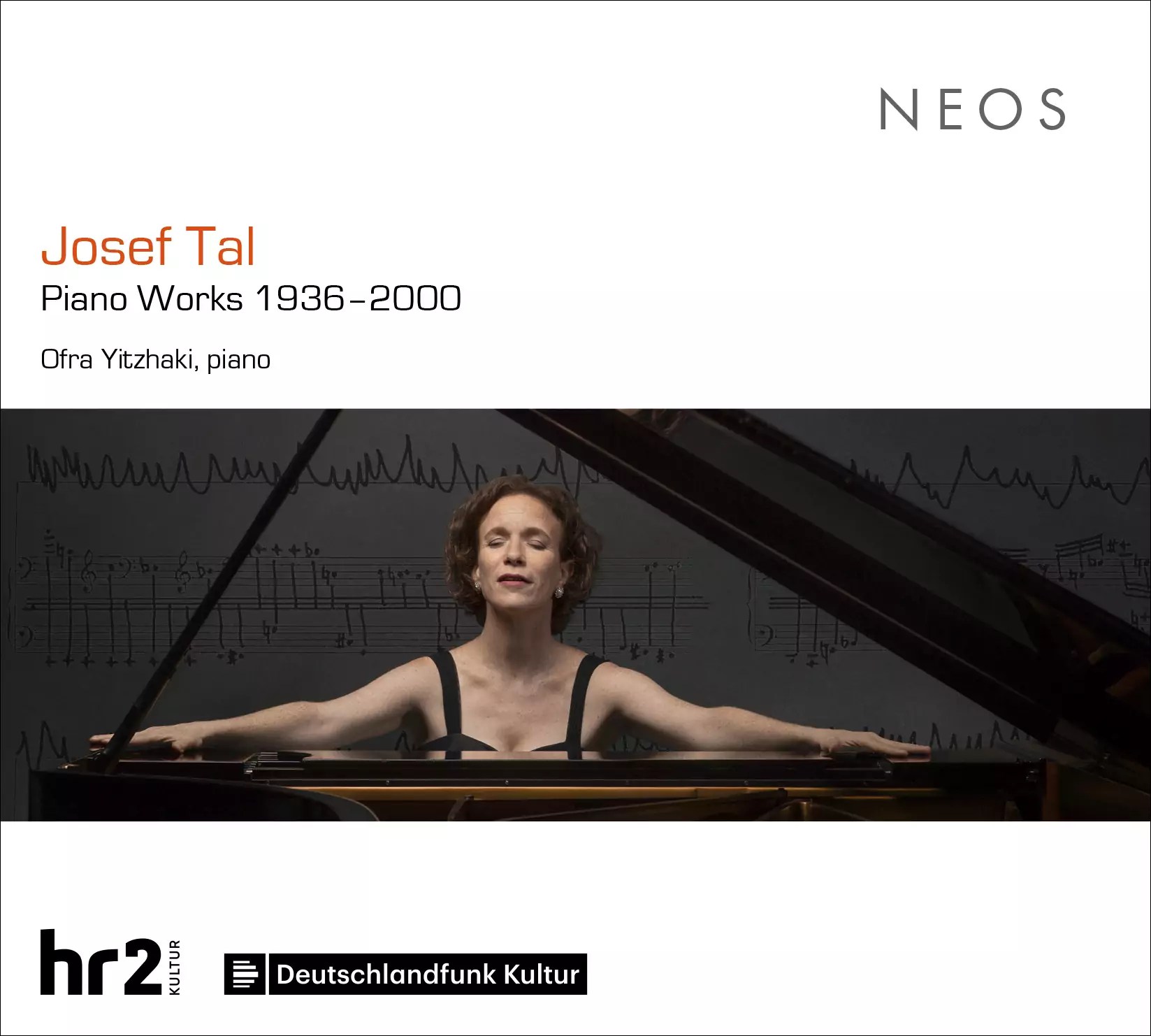
Josef Tal Sonata for Piano (1949) Five Densities (1975) Three Pieces (1937) Concerto no.5 for Piano and Magnetic Tape (1964) By the Rivers of Babylon (1951) Six Sonnets (1946) Essay IV (1997) Essay V (2000) Chaconne (1936)
NEOS Music 12520 [82’04”] Producers Alexander Hainz and Dominik Weinmann Engineer Robin Bös
Recorded 1-3 September 2022 at Hessian Radio Studio, Frankfurt am Main
Reviewed by Richard Whitehouse
What’s the story?
The enterprising NEOS Music label releases an anthology of piano music by Josef Tal (2010-2008), the German-born Israeli composer who did much to advance the cause of new music in Israel during the post-war era and whose varied output confirms him as a significant creative figure.
What’s the music like?
Little heard in the UK (his Third Symphony featured at the 1979 Proms and his chamber opera The Garden at South Bank Centre in 1998), Tal wrote in all the main genres. His piano music, moving from overt Expressionism to innate Atonalism, is accorded focus by its motivic rigour.
This is evident from the earliest piece here – Chaconne being a consummate study in ‘less is more’ such that its variations on an austerely rhetorical theme merge into an intensifying and cumulative whole, capped by an epiphanic calm prior to the inevitability of a final onslaught. Elements of this language are further explored by the Three Pieces which, in their respective volatility, impetuousness or introspection, denote the influence of Schoenberg’s piano pieces -albeit less those emotional extremes of his Op. 11 than that fastidious subtlety of his Op. 23.
A subtlety duly refined in the Six Sonnets, miniatures of a formal ingenuity and expressive poise out of all proportion to their brevity. From there to the Sonata is to emerge at a crucial stylistic juncture in Tal’s output: again, the modest dimensions (each of its three movements lasting around four minutes) only makes more acute that growing ominousness of its initial movement, the plangency of its central Basso Ostinato (a favoured device throughout Tal’s career) then the mounting impetus of its final Rondo toward a viscerally unequivocal close.
Arranged from a theatrical work, By the Rivers of Babylon conveys a measure of eloquence prior to what became the most radical phase of Tal’s composing. Hence the Concerto No. 5 as replaces orchestra with electronics in a substantial single movement which, whatever the timbral limitations of its magnetic tape, ensures a tense while often combative interplay of mutually opposing forces. This intensity is channelled into the Five Densities, such that its starkly contrasted first four pieces find unlikely yet convincing rapprochement in the fifth.
The remaining works form part of a sequence that extends across Tal’s final creative decades. Essay IV moves stealthily between sharply distinct ideas to an ending which does not resolve but simply cease, and Essay V is more demonstrative as it heads to its terse yet forceful close.
Does it all work?
Indeed it does. A figure nowadays admired more for what his music represents than for what it achieves, Tal left a legacy which is highly significant in or of itself (and one which, unlike almost all Israeli composers of his generation, audibly transcends the idiom of Ernest Bloch). His piano output exemplifies that technical precision, underpinning a creative spontaneity, as are hallmarks of his maturity and which help make this music as relevant to our day as to his own. It also makes for an engrossing and sometimes even entertaining listen in its own right.
Is it recommended?
Indeed it is. Only the Sonata has previously been recorded, and Ofra Yitzhaki’s empathy with this music cannot be denied. Superbly recorded and informatively annotated, this deserves an enthusiastic recommendation, with hopefully a follow-up of Tal’s other piano works to come.
Listen / Buy
You can hear excerpts from the album and explore purchase options at the NEOS Music website. Click on the names to read more about pianist Ofra Yitzhaki and composer Josef Tal
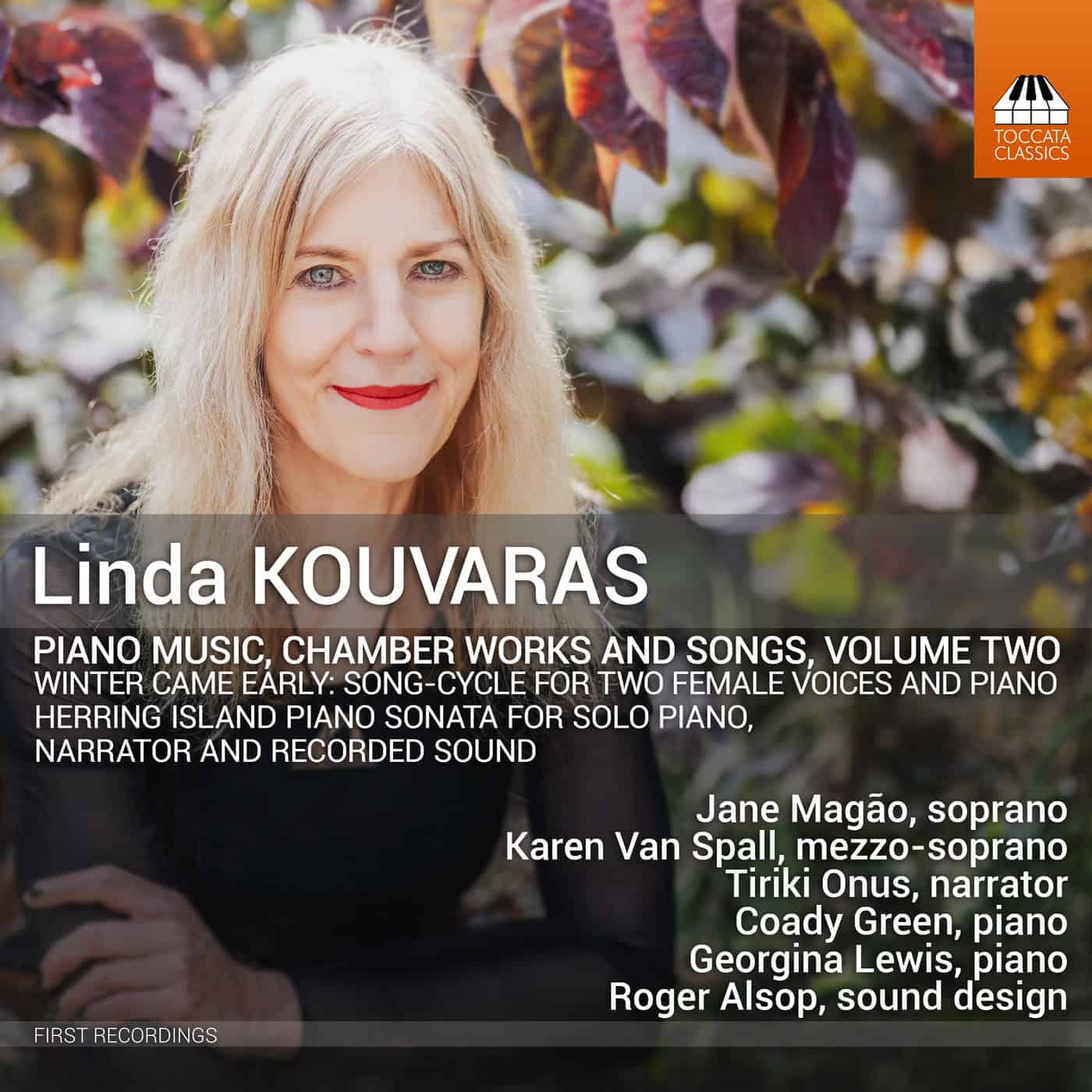
Tiriki Onus (narrator), Coady Green (piano), Roger Alsop (sound design) – Herring Island Piano Sonata; Jane Magão (soprano), Karen Van Spall (mezzo-soprano), Georgia Lewis (piano) – Winter Came Early
Linda Kouvaras Herring Island Piano Sonata Winter Came Early
Toccata Classics TOCC0734 [78’33”] English text included Producer / Engineer Haig Burnell
Recorded 16 & 24 November 2023 (Herring Island Piano Sonata), February 2024 (Winter Came Early)
Reviewed by Richard Whitehouse
What’s the story?
Toccata Classics issues the second volume in its ongoing survey of chamber and vocal works by Linda Kouvaras (b.1960), comprising two sizable pieces that examine those genres of the piano sonata and the song-cycle from unlikely while always thought-provoking perspectives.
What’s the music like?
A veteran of the New Wave scene from the early 1980s, Kouvaras studied in London and her native Melbourne where she has pursued her career as an academic and composer. Especially notable is her output for ensemble, with or without voices, which is currently being recorded by Toccata. Its second instalment demonstrates a keen sense of how to broaden and diversify genres that could all too easily be taken for granted as regards precedent then, in the process, making these relevant to the artistic and the cultural concerns of those having inspired them.
Inspired then dedicated to the physical and historical facets of an artificial islet in Melbourne, Herring Island Piano Sonata amalgamates an abstract entity with a text by N’arweet Carolyn Briggs and spoken by Tiriki Onus in the context of an environmental soundscape from Roger Alsop – though the piano component can also be performed independently (and can be heard here by selecting tracks 2, 3, 5 and 7). Musically it typifies Kouvaras’ predilection for modal harmonies and vibrant textures, allied to a determined if never excessive virtuosity. Just how far this three-way interplay comes together is for each listener to decide, though there can be no doubt as to the ambition of the whole. To which end, a visual (not necessarily illustrative) component might have helped with integrating these already interrelated aspects further still.
Written immediately before, Winter Came Early is a song-cycle to poems by Melbourne poet Catherine Lewis whose untimely death and her posthumous legacy is directly commemorated. The presence, indeed frequent concurrence, of two female voices represents a mother and her daughter – the latter being pianist Georgina Lewis who also contributes the central poem that gives the work its title – heard alternately and in dialogue, though this could be considered too much of a good thing given the overlap in vocal lines and consequent blurring of words such as makes it difficult (if not impossible) to discern what is being sung. Musically, the sequence alternates between knowledge of encroaching death and recollection of earlier but not always happier times, rounded off by an ‘Epilogue’ that sets the poet’s final love-note to her husband.
Does it all work?
For the most part. Kouvaras is evidently a composer with an inquiring mind and the means to realize her intentions, though the element of mixed media sometimes works to the detriment of her music by drawing attention away from its intrinsic content. All the performers provide contributions of unfailing sincerity, but there remains a feeling of sensory overload or merely reluctance to let this music speak on its own terms. Try those sonata tracks detailed above, or the final four tracks (11-14) of the song-cycle, to hear her music at its most communicative.
Is it recommended?
Yes, with these reservations in mind. Those who are unfamiliar with this composer would be best advised to start with the first volume in this survey (TOCC0729) with its works for solo piano or saxophone and piano that, in their different ways, find her music at its most potent.
In the first of two interviews themed around the Aldeburgh Festival, Featured Artist Ryan Wigglesworth talks to Ben Hogwood about the influence of his mentor, Oliver Knussen, and the inspiration he takes from the music of Britten, Debussy and Bruckner.
Picture credits: Benjamin Ealovega (Ryan Wigglesworth, Steven Osborne), Mark Allan (Oliver Knussen), Sussie Ahlberg (Sophie Bevan), Lawrence Power (Giorgia Bertazzi)
Ryan Wigglesworth is a musician of many disciplines – and for half an hour he has joined us to talk about his work as a composer, conductor and pianist, specifically within the rarefied world of the Aldeburgh Festival, where he is a Featured Artist for 2026.
The festival has played a key part in his career, as I ask him to cast his mind back to the first time he visited. “My first contact with Aldeburgh was through the young artists programme, which is where I first met Ollie Knussen – that would have been 2000 or 2001. I had forced my parents, when I was much younger, to take me to Aldeburgh. It must have been the time when the Humphrey Carpenter biography of Britten came out. I read that biography and begged my parents to drive from Sheffield so I could see the place and go on a pilgrimage. It’s been a very special place to me for such a long time, and since the turn of the century, when I met Ollie, that became the most important musical friendship and mentorship of my life. I spent so much time there and was virtually living at his house for a period. It’s a home to me.”
It is striking in conversations with artists that worked with Knussen, the speed with which his name comes up, and the affection it provokes. In this case, Wigglesworth met his mentor through the soprano Claire Booth. “Claire and I were undergraduates together”, he says, “and she was on the course at Snape. I tagged along, because I wasn’t officially there as a student that first year. Claire and I had already learned his Whitman Settings, and we kept asking if we could sing it to him. He was dreading it was going to be awful, but he finally caved in, and we performed it. I think he was very touched, and I think that was the beginning of him thinking, “Maybe they’re not so bad, these two!”
As with fellow-students, Knussen (above) left a lasting musical and personal footprint. “It was my education. I must have sat in hundreds of hours of rehearsals with the London Sinfonietta and the BBC Symphony Orchestra. I could never understand why no-one else was there, and it was the same when I used to go to Boulez’s rehearsals. That was my education, because Ollie’s rehearsals were masterclasses in time management, efficiently sorting our problems, and that pristine conducting technique. I’m so grateful to have had that as my starting point, and with such a dominant creative force in your life, it takes a while to free yourself from their way of doing it, and finding your own way, but it still informs everything I do. When it comes down to it, it’s still about respect for the text, and that the composer is the most important thing – not the performer’s ego!”
He considers further. “You couldn’t not be learning, just spending time with him, sitting at the kitchen table. As everyone knew him understood, he had obsessions at a particular moment in time. He would be gorging on the music of Busoni, or whatever it happened to be that week, so we’d go through tonnes of his music – and that’s an incredible education, going through those scores together – and learning how he marked up scores. It was my starting point, and I’ve developed it in how to learn a score thoroughly, especially when I’ve had to learn something quite quickly, stepping in for a cancellation. I remember having to learn Elgar’s The Dream of Gerontius in two days, and it was incredible to fall back on that technique of inhabiting a score.”
The influence of Knussen spreads to the programming for the 2026 Aldeburgh Festival, where his innovations can be felt in Wigglesworth’s repertoire choices – such as the pairing of his own Piano Concerto and that by Ravel, both to be performed with Steven Osborne (above) as soloist. “It’s a bit of a risk, that one!” laughs Ryan, “putting your piece alongside one of the greatest concertos ever written. That was something I began to think about much more deeply spending time with him, the way pieces resonate together. It’s a very subtle and complex business, and of course you get it wrong sometimes, but that’s fine because you don’t know until you do it, very often. It’s one of the great pleasures to have the freedom you have at Aldeburgh where your wings aren’t clipped. It’s worrying that so much of concert life is becoming so narrow, reduced in its scope and imaginative adventure.”
We reflect on his role as Featured Artist at Aldeburgh this year – a chance to spread musical wings? “It’s very special to be able to think about bringing the different aspects of what I do under one roof, because they’re all sides of the same business of making music. Of course they feature in different ways. Playing chamber music is so important because it’s my only direct contact with producing the sound, and I need that. Yet at the same time, if I’m conducting Pelléas et Mélisande, I hope I’m becoming a better composer as a result!”
His reference is to Debussy’s only opera, with which the festival opens on Friday 12 June. “You can’t not learn from every page of a score like that”, he says, “about how to be a better composer and holding the mystery. I don’t think I’ve ever met a composer for whom that’s not the greatest opera ever written, because it’s so difficult to fathom how he did it! It is so elusive, you can’t see how he put it together. The more time you spend in the orbit of masterpieces like that, it’s stimulating for me as a composer, and to spend time with the orchestra. It’s such an organism, this group of individual musicians with a collective personality, sound and ethos – it’s extremely mysterious! That was the great thing about spending all those hours in rehearsal with Ollie”, he reflects, “that’s what you’re soaking up, how these groups function, and how you balance the double basses and harps – what needs to be done on the most basic practical level.”
The orchestra to which he refers in Pelléas is the BBC Scottish Symphony Orchestra, of whom he has been chief conductor since September 2022. “They are uniquely versatile”, he says, “When you think of what they do in the Tectonics festival, with Ilan Volkov, from the most experimental new music – from that to Bruckner’s Seventh Symphony – and they approach it with care and flair. City Halls is so good for classical repertoire, too, and they are incredibly stylish in Mozart, which is such a difficult thing. It’s incredible what they can do, and in such short spaces of time. To be able to flick the switch is amazing, with something like Birtwistle’s Earth Dances, which we performed with Beethoven’s Eroica Symphony at the BBC Proms last year. To achieve that in such little rehearsal time would have been almost unimaginable in the mid-1980s. The speed with which things are inhabited is incredible.”
On a much smaller scale is The Poet’s Echo, a concert where Wigglesworth will take to the piano, joining soprano Sophie Bevan – his wife – in a programme marking the centenary of the birth of Russian powerhouse Galina Vishnevskaya. Along with her own husband, Mstislav Rostropovich, Galina played an important role in the career and life of Benjamin Britten. Britten’s song cycle The Poet’s Echo was completed in 1965 for Vishnevskaya, and will feature alongside Wigglesworth’s own settings of George Herbert, Till Dawning – written for Sophie (above). “The Poet’s Echo is new for both of us”, he says, “and it is wonderful to have a major work of Britten’s to come to fresh and learn together. We’ve done selections of the folksongs for a good few years, now.”
He has great affection for them. “I love them so much – and those accompaniments in the Britten folk song arrangements, each one is a sort of bull’s eye! There are one or two very focused, simple ideas, and it comes back to Britten’s economy.” A quality Britten and Knussen shared? “Exactly – a supremely practical approach. I learned from Ollie, and almost at Britten’s feet. Ollie’s Dad was so involved with Britten as a conductor, taking part in the premiere of works like Curlew River, and Ollie was there as a kid, taking all this up. He always said about Britten that he could have been a grandmaster chess player, or even an army general. The ability to move things in the abstract, in his head, was so strong, and that extends to planning the entire act of an opera in his mind before committing it to paper. He had an extraordinary ability to manipulate things in space and knowing, in the operas, when to introduce a colour, treating the instruments of the orchestra like individual characters, and knowing when to hold one back for dramatic purposes.”
He reflects further. “It’s about finding the off-kilter but logical solution. A great example is the ‘interview chords’ in Billy Budd – they’re every way of harmonising the F major triad. He’s working through a secret, and it’s absolutely right, a key emotional part of the opera.”
Returning to Wigglesworth’s own music, there is a significant premiere with the Knussen Chamber Orchestra on Saturday 27 June, in the form of his Viola Concerto, written for Lawrence Power (above). “It’s quite difficult to talk about, because I’ve not long finished it!” he confesses. “I’m still too close to the process of having written it, but I haven’t heard it yet. Like all of my recent pieces, and I hope my pieces in the future – they’re all my reactions to who is performing, and who I’m writing for. I think I would struggle now if I were commissioned by a musician or orchestra I don’t know, I’d struggle to have ideas. I’m so lucky with Sophie, or Steven Osborne, who’s playing my piano concerto at the beginning of the festival, to have these long term, meaningful relationships. With Laurence, we first worked together years ago. I wrote these Five Little Waltzes for him during lockdown. He’s such a one-off, and his artistic personality is so strong. He has this incredible sound, and variety of colour, and the piece came from my reaction to that.”
He describes the work. “It’s slightly unusual – in three movements, which sounds very standard, but it’s slow-fast-slow. It was a deliberate attempt to try to achieve something a bit more spacious than anything I’ve attempted before. I suppose it allows the viola to occupy a lyrical space. It’s not a battle between soloist and orchestra, more a fluid relationship. It comes back to the music that becomes more meaningful as a performer. Like Bruckner – I love this music so much, and what can I learn from it? Bruckner’s vision is so personal, but there are things to be learned – how to create a long wave, a big paragraph. It’s finding the things that challenge you, because in the past I’ve struggled to create a genuinely long line. You could say Britten concentrated on little cells of ideas, but it’s nice to think about how to achieve something that doesn’t come naturally, that can become more a part of your make-up.”
Debussy comes to mind as a composer capable of uniting the two ways of working, which returns us to the festival’s opening night. “To have created Pelléas as his first dramatic work, and to have got it that right… it was a long gestation process written it a long time before it was premiered, but it’s unlike anything else!” he says, under Debussy’s spell. “As he admitted himself there is a lot of Mussorgsky’s Boris Godunov in it, but these scenes tend to be conversations between two characters, with the function of these orchestral interludes, which seem so necessary. To think they were added so late on in the process, just to cover the stage move time, is remarkable – but you need them because of the intensity of each scene. You need the space afterwards to process what you’ve just heard, for the brain to catch up. It’s an incredible living organism, when you’re in it – and it really does grip you! This score is just as much like a drug as Wagner is said to be. The more you spend time with it, the more you need it!”
You can read more about this year’s Aldeburgh Festival at the Britten Pears Arts website, with full concert information and details. For biographical information on Ryan Wigglesworth himself, you can visit his artist page
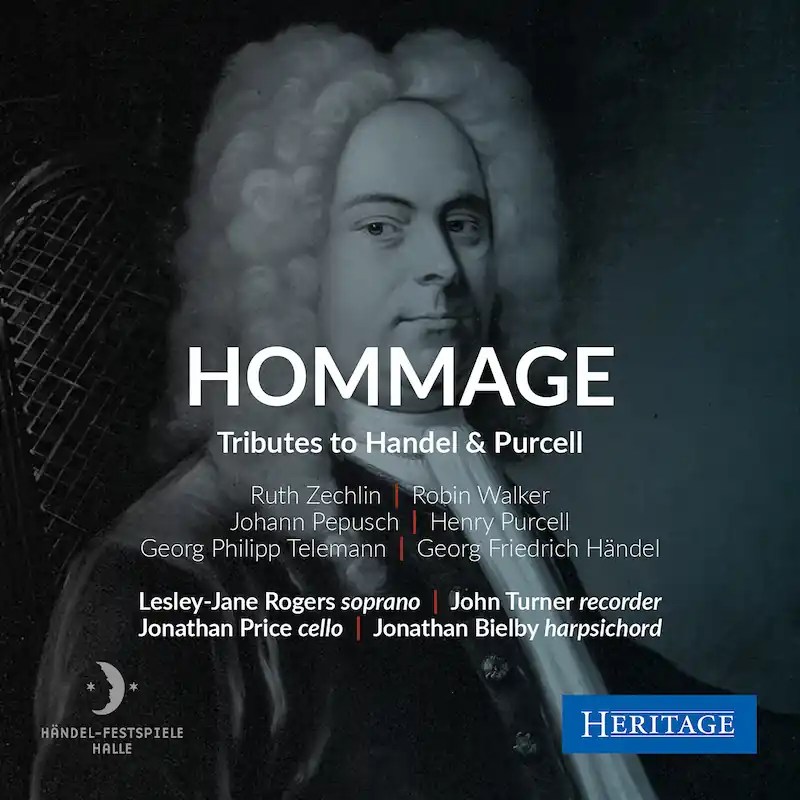
Lesley-Jane Rogers (soprano), John Turner (recorder), Jonathan Price (cello), Jonathan Bielby (harpsichord)
Ruth Zechlin Hommage á Henry Purcell (1997); Hommage á Handel (2004) Robin Walker Handel to his Soul (2006) Pepusch When Love’s Soft Passion (pub. 1720) Purcell The Blessed Virgin’s Expostulation, Z196; Oedipus, Z583 (1678) – Music for a while; The Indian Queen, Z630 (1695) – I attempt from love’s sickness to fly Telemann Cello Sonata in D major TWV41: D6 (pub. 1728-9) Handel Nel Dolce del’Oblio, HWV134 (1709)
Heritage Records HTGCD118 [73’06”] Texts and translations included Remastering Engineer Paul Arden-Taylor
Live performance on 14 June 2006 at Händel-Haus, Halle an der Saale
Reviewed by Richard Whitehouse
What’s the story?
Heritage releases what was actually a live performance, given at the original ‘Handel House’ in the composer’s hometown of Halle while featuring an imaginative miscellany of Baroque and Contemporary works, all expertly realized by soprano, recorder, cello and harpsichord.
What’s the music like?
The sub-title says it all – tributes to Handel and Purcell that range from pieces by both these composers to works which wear their ‘hommage’ credentials not a little obliquely. Purcell is heard in evergreen extracts from his incidental music to Oedipus and semi-opera The Indian Queen elegantly sung by Lesley-Jane Rogers, who renders the interplay of recitative and aria in The Blessed Virgin’s Expostulation with real eloquence. Handel rounds off this programme with Nel Dolce del’Oblio (In the Sweetness of Oblivion), one of several Italian cantatas that helped establish his reputation prior to his arrival in England. Again, a fine performance that respects this music’s expressive deftness and understatement though without making it seem trite or lightweight; failings which are not so uncommon in latter-day accounts of this music.
Also featured is a cello sonata drawn from Telemann’s collection Der Getreue Musikmeister (The Faithful Music-Master), its simple alternation of Largo and Allegro movements belying the piece’s overall motivic subtlety. Interest naturally attaches to the cantata When Love’s Soft Passion by Johann Pepusch, remembered for his musical contribution to The Beggar’s Opera by John Gay (and lesser-known sequel Polly) but who wrote extensively for various genres – among them the secular cantata, hence the poise and sensuous appeal of the present example.
Two of the contemporary works are by Ruth Zechlin (1926-2007), among the most prominent composers in what was East Germany, whose expertise as harpsichordist or organist informed her own works. Hommage á Henry Purcell juxtaposes recorder and harpsichord with pointed humour redolent of Mauricio Kagel, whereas Hommage á Handel comprises settings of three Shakespeare sonnets (Nos. 36, 78 and 46) with their music derived from three Handel arias to verses by Barthold Brockes. Even more engrossing is Handel to his Soul, a cantata setting his own text by Robin Walker (b.1953) who, known primarily for some seismic orchestral works (Toccata Classics TOCC0283), brings comparable insight to this thought-provoking trialogue between the composer, his soul and the goddess Proserpina – its music being witty and ironic.
Does it all work?
Yes, not least as collated into a programme which elides nimbly if meaningfully between the musical past and present. All credit to the musicians that these performances are so idiomatic across the board, thereby bringing works separated by over three centuries into enlightening accord. Whether the present release is taken from a radio broadcast or an archive recording, its sound lacks nothing in spaciousness or focus; enabling Rogers’s excellent annunciation to come through unimpeded. An occasion which was decidedly making available commercially.
Is it recommended?
It is. The booklet has decent notes and full texts (if not all English translations) – making for a worthy tribute to Percy M. Young (1912-2004), renowned music scholar and soccer historian, in whose memory this concert was sponsored by the British Professional Football Association.