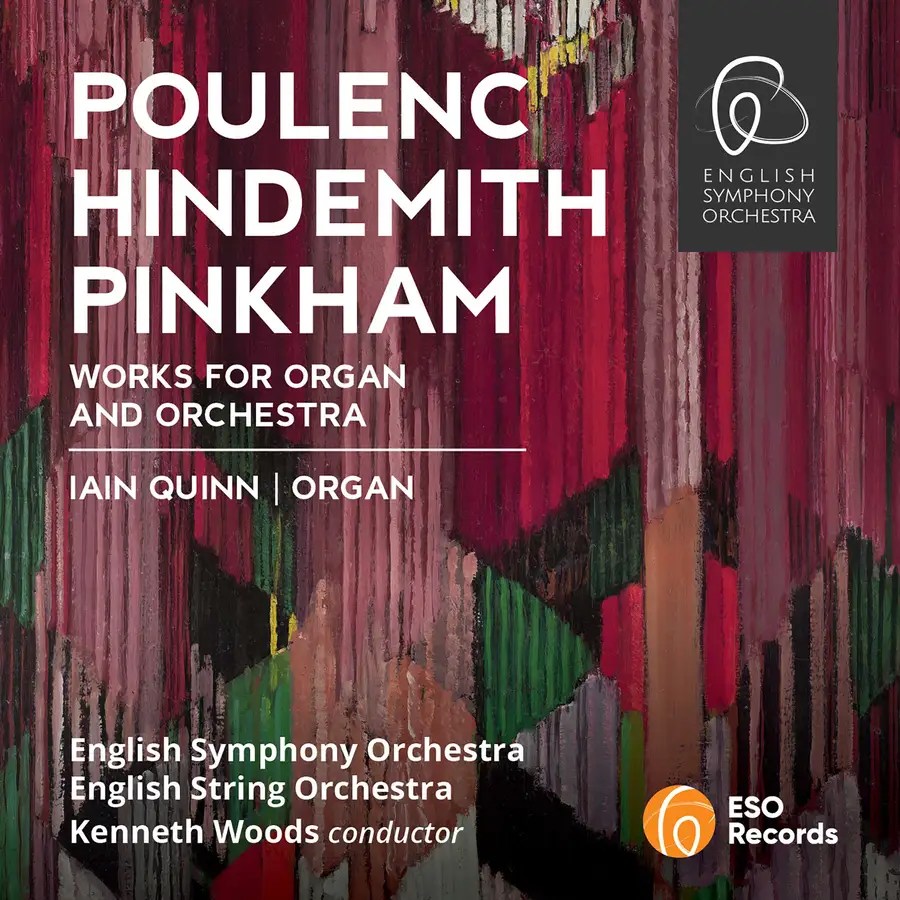
On Record – Iain Quinn, English Symphony & String Orchestras / Kenneth Woods: Works for Organ and Orchestra (ESO Records)

Iain Quinn (organ), English Symphony Orchestra (Hindemith), English String Orchestra / Kenneth Woods

Hindemith Kammermusik no.7 Op.46/2 (1927)
Pinkham Sonatas for Organ and Strings: no.1 (1966); no.2 (1966); no.3 (1987)
Poulenc Concerto in G minor for Organ, Strings and Timpani FP93 (1934-8)

ESO Records ESO2601 [62’44”]
Producer Phil Rowlands Engineer James Walsh

Recorded 1-3 April 2025 at Merton College Chapel, Oxford

Reviewed by Richard Whitehouse

What’s the story?

The English Symphony Orchestra (and its ‘String Orchestra’ incarnation) continues releases on its ESO Records label with a collection of works for organ and orchestra featuring the industrious Iain Quinn, and which includes the first recordings of two organ sonatas by Daniel Pinkham.

What’s the music like?

Much the most often heard organ concerto (as opposed to organ symphony), that by Poulenc never fails to entertain and provoke: a judicious synthesis of musical past and present, high- and low-art, the serious and skittish – all given focus by its composer’s tendentious sense of style. It certainly sounds cohesive on this persuasive recording, Quinn alive to those reckless expressive contrasts and Kenneth Woods shaping its seven continuous sections into a logical yet purposeful whole. The relatively lengthy third section emerges as a ‘slow movement’ of encroaching pathos, and only the sixth disappoints with its ‘music-hall’ aspect rather muted. What is never in doubt is the seriousness of Poulenc’s response to tragic circumstances and his aspiring towards a transcendence that is cursorily denied by those fateful final gestures.

Interestingly, the seventh and final of Hindemith’s Kammermusik itself finds its composer at something of an aesthetic crossroads as regards that trenchant objectivity of the music from his early maturity then the greater emotional range of what followed. Certainly, its opening movement has a vigour but also self-containment duly leavened in the slow movement with its eloquent enfolding of the soloist into the orchestral texture; the finale fusing elements of the preceding on route to a peroration whose expressive force is a sure marker for the future.

Interest naturally alights on music by Daniel Pinkham (1923-2006), the American composer and organist who, based largely in Boston, wrote extensively in most genres while being best known for his choral and organ music. The three works heard here are ‘Church Sonatas’ akin to those from the Baroque and Classical eras, notably the 17 such pieces Mozart wrote in the 1770s. While the First Sonata is an appealing Andante, the Second Sonata contrasts its more inward Andante with a capering Allegro; the Third Sonata duly extended to four movements with its ingratiating Allegro and animated final Vivace framing a quizzical Allegretto and an Andante whose wistful poignancy makes it the highlight from among these pieces. Music for which Quinn evidently feels real affinity, rendered here with the necessary poise and finesse.

Does it all work?

Almost always. Among the most inclusive of present-day organists in terms of his repertoire, Quinn is an assured exponent throughout while receiving steadfast support from Woods and the ESO. Sound does full justice to the Dobson Organ of Merton College Chapel, even if the reverberant acoustic is not ideally suited to the Hindemith as this affects the music’s textural pungency or its overall assertiveness. Even so, both this and the Poulenc can hold their own with earlier recordings, while that of the Pinkham should prove difficult to surpass in future.

Is it recommended?

Indeed so. The booklet features detailed notes about each work by Guy Rickards, along with pertinent observations about this organ in the context of those ‘Neoclassic Instruments’ built in quantity, most notably North America, following the Second World War. Fascinating stuff!

Listen / Buy

You can listen to excerpts and explore purchase options at the Presto Music website. Click on the names to read more about organist Iain Quinn, conductor Kenneth Woods, the English String / Symphony Orchestra and composer Daniel Pinkham

Published post no.2,890 – Sunday 17 May 2026

On Record – The Peter Jacobs Anthology: Twentieth Century British Piano Music (Heritage Records)

Peter Jacobs (piano)

Bax Winter Waters (1915)
Baines Preludes nos.1,3 & 6 (1919)
Benjamin Scherzino (1936)
Bliss Suite: Polonaise (1926)
Britten Sonatina Romantica: Moderato (1940)
Hold Tango (1975)
Howells Procession (1920)
Leigh Eclogue (1940)
Mayer Three Pieces from Calcutta-Nagar (1993)
Parry Scherzo in F major (pub 1922)
Quilter Summer Evening (1916)
Scott Egyptian Boat Song (1913)
Searle Vigil: France 1940-1944 (1944)
Seiber Scherzando Capriccioso (1953)
Shaw Roundabouts (1925)
Sterndale Bennett Presto agitato in F# minor Op.24/5
Stevenson A Wheen Tunes for Bairns Tae Spiel (1967)
Warren Second Sonata: Monody (1977)
Woodferne-Finden Kashmiri Song (1903)

Heritage Records HTGCD159 [76’40”]
Producer / Engineer Paul Arden-Taylor

Recorded 25 May 2021 at Wyastone Concert Hall, Wyastone Leys, Monmouth

Reviewed by Richard Whitehouse

What’s the story?

Besides reissuing his already extensive catalogue for other labels, Heritage has also made a number of new recordings by Peter Jacobs, with this album the first in what so far amounts to three volumes of miniatures and standalone pieces as drawn from his extensive repertoire.

Regular readers of Arcana will have come across reviews of the second and third volumes in this series, to which is now added this first instalment that ranges across the extent of Jacobs’ interest in and inclination towards unfamiliar though rewarding music by British composers.

What’s the music like?

Launched by Martin Shaw’s ebullient encore alighting on all two-dozen keys, this anthology continues with the harmonically acerbic second movement (of four) from Arthur Bliss’ early Suite, followed by music of elegant poignancy by Walter Leigh. John Mayer is heard in three from his 18 vignettes evoking sights and sounds of Calcutta (sic), with that by Roger Quilter a minor masterpiece of serenity infused with regret.

Màtyás Seiber contributes music whose liveliness and recalcitrance are entirely characteristic, with something ‘completely different’ in Amy Woodforde-Finden’s appealingly descriptive and once-ubiquitous number. Few are likely to recognize Herbert Howells as composer of a rhythmically combative piece that is (relatively) better known in its orchestral guise, while that from Arthur Benjamin could be no-one else given its playful insouciance. Dedicated ‘‘To my friends of the Fighting French Forces’’, Humphrey Searle’s evocation of war is the more powerful for its overall restraint and could well be considered the single-most impressive piece featured on this collection.

Hubert Parry is heard at his most vivacious and uninhibited; an ideal foil to Cyril Scott who, though he associated Egypt with (his own) past existences, focusses on melody of the most poetic. Much the earliest piece here, that by William Sterndale Bennett is the fifth in a six-movement suite – its deftness and agility in telling contrast to the incremental display of the opening movement from Raymond Warren’s Second Sonata. Three out of a larger sequence of preludes by William Baines constitute an object-lesson in making more out of less, while the first movement of Benjamin Britten’s never-quite-completed Sonata Romantica evinces ingenuity and didacticism in equal measure. Ronald Stevenson often aspired to the lofty or profound in his music, but the four pieces in the suite recorded here are epigrams as laconic as they are engaging. The longest single item here, Arnold Bax’s piece is at once a visceral seascape, revealing psychological study or resourceful passacaglia – the climax of an album that ends in a disarming item by Trevor Hold such as ought to win its composer new friends.

Does it all work?

As an overall sequence, undoubtedly. Jacobs is as inclusive in his interpretative acumen as   in the breadth of his musical sympathies – thereby making for a collection that plays to his strengths as convincingly as it does to those of the 19 composers who are featured herein.

Is it recommended?

Very much so, not least in the knowledge this release was merely the first in an ongoing and most valuable series bringing unfamiliar music to the attention of inquiring listeners. Sound of clarity and definition, along with Jacobs’ detailed booklet notes, are further enhancements.

Listen / Buy

You can explore purchase options at the Heritage Records website. Click on the name to read more about pianist Peter Jacobs

Published post no.2,889 – Saturday 16 May 2026

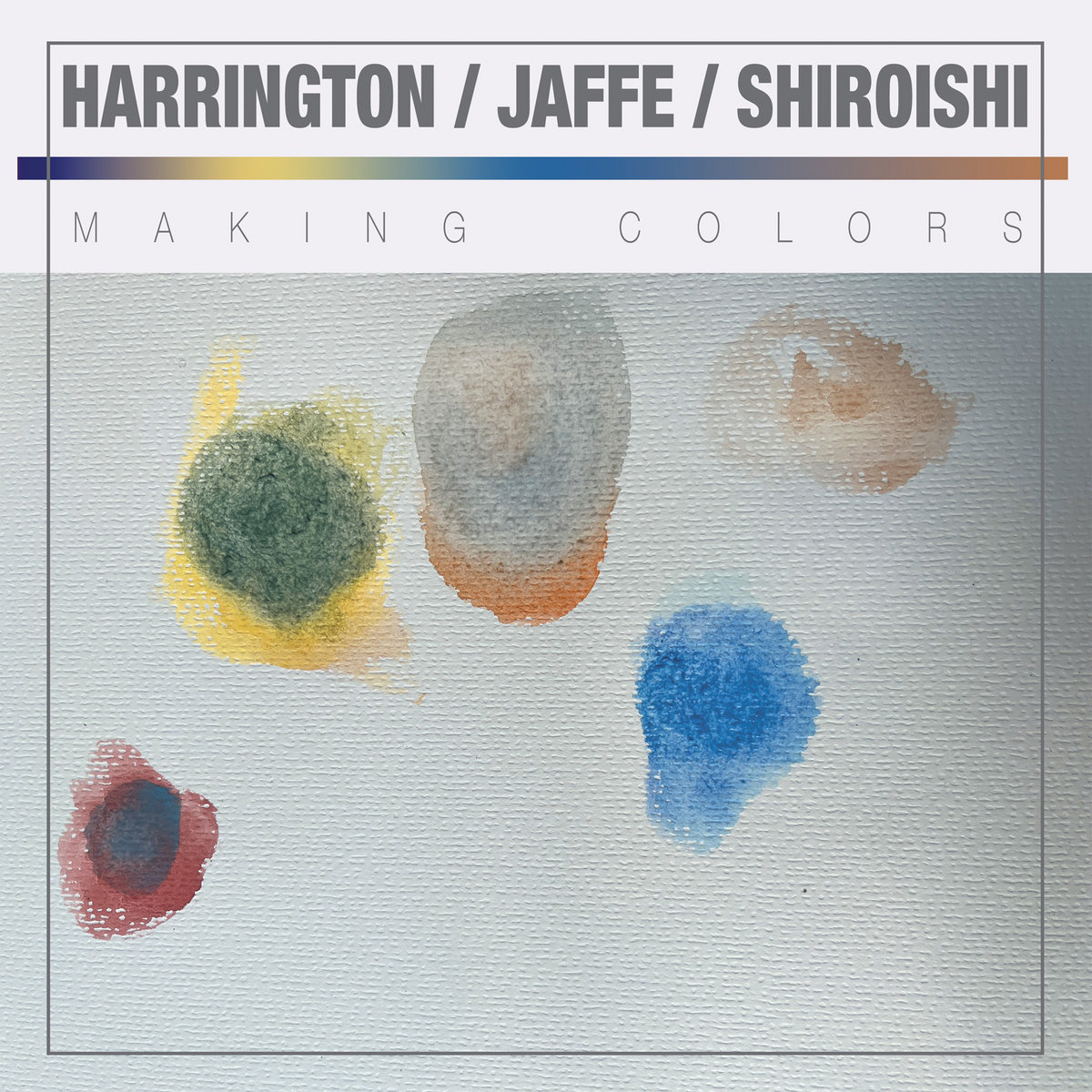
On Record – Harrington/Jaffe/Shiroishi: Making Colors (AKP Recordings)

Reviewed by Ben Hogwood

What’s the story?

Guitarist Dave Harrington, drummer Max Jaffe and saxophonist Patrick Shiroishi return for a sequel to their first musical meeting Speak, Moment, recorded and released by Los Angeles label AKP Recordings in 2024.

For the sequel, they go deeper, with a record whose A-side is essentially a suite of four distinct movements. On the B-side the three tracks reflect “a growing embrace of the sonic vacuum that electronic music depends on…a heaviness that the trio’s 2024 live record Zebulon! unlocked…and an outstretched and unhurried melodic ambience”.

What’s the music like?

There is a fascinating variety of styles and textures at play on this album, rooted in avant-garde jazz but exploring musical territories of great interest to those who love ambient electronica and upfront improvisation.

The four-movement suite with which the album begins moves between ambience and ear-shredding intensity, carefully controlled and yet with the opportunity for each of the three performers to cut loose, which they do on the extended sweat street 7-QS:ZBN9_. The second half finds Shiroishi assertive on Fractal Hash, while Harrington’s studied guitar leads the long form trackerKeeper under spacious California skies, a compelling track of ambience and yet powered by a curious tension.

The frisson of live performance crackles throughout this compelling trip, and at times it is possible if not too far-fetched to sense the wide open plains of the Mojave desert.

Does it all work?

Yes. The musical chemistry between the three is compelling, as are the sound pictures they create.

Is it recommended?

It is. Making Colors is a natural progression for the trio, whose musical acumen and communication is leading them to greater heights. Making Colors is a fascinating album, and a rewarding one to follow.

Listen / Buy

Published post no.2,867 – Friday 24 April 2026

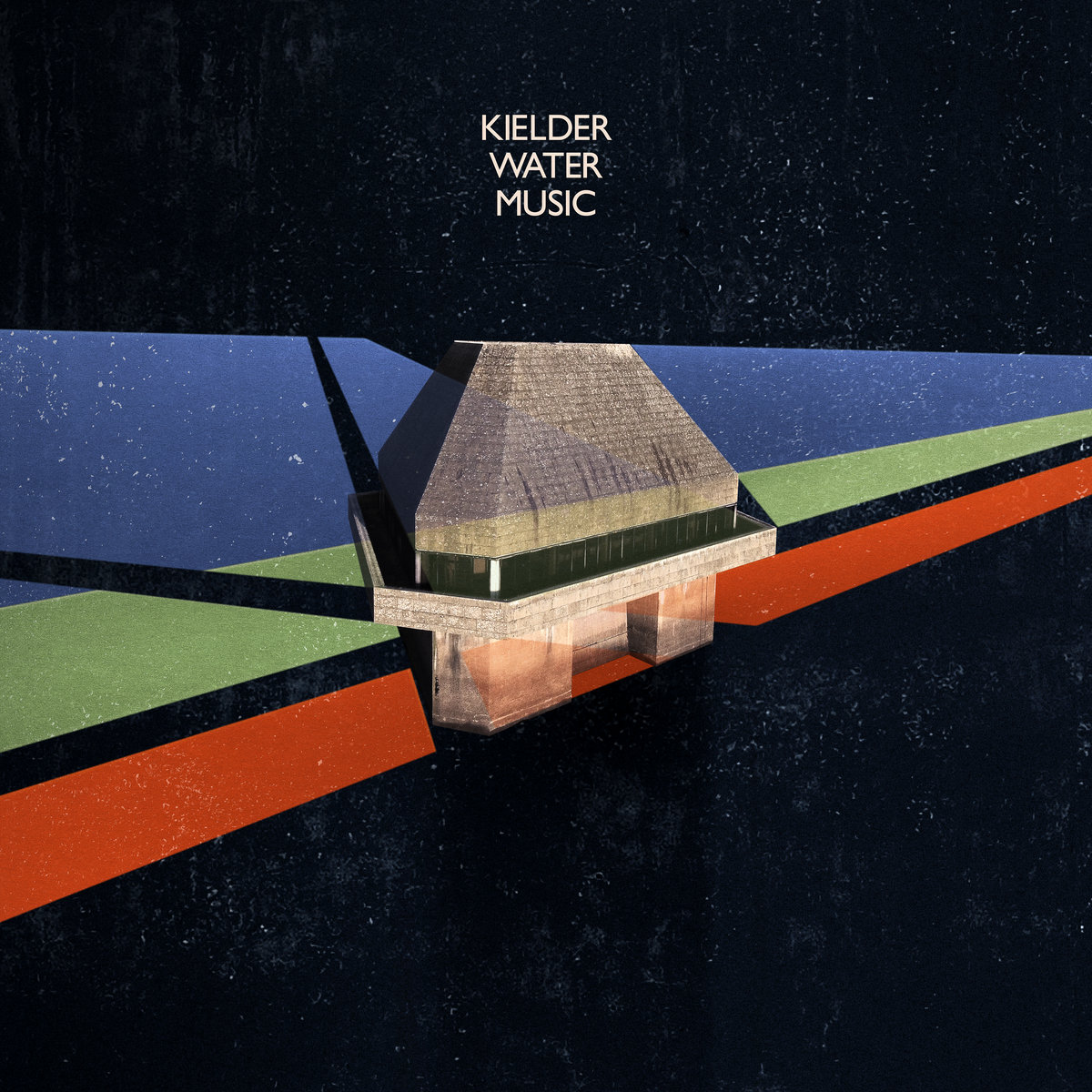
On Record – Dan Moore: Kielder Water Music (Bandcamp)

Reviewed by Ben Hogwood

What’s the story?

Bristol-based composer Dan Moore made a three-day field trip to Kielder Water in 2022, having completed some extensive work into the history of the site.

This EP reflects on what he found, both from first-hand experience and from sonic material gathered from the site, which is Britain’s biggest man-made reservoir, a controversial redevelopment plan dating back to the 1960s. Dan’s music blends electronics with field recordings, interview samples and more analogue writing for strings.

Throughout the project he was mentored by film composer Dan Jones.

What’s the music like?

Consistently engaging, and pictorial.

As you might expect, the textures are wide open, but Moore approaches his audio descriptions in a number of different ways. The Architect is busy, its riffs playing backwards and forwards over a spacious backdrop, but the speed drops completely as the music pans out for VT-15, a piece of luxurious ambient textures but uncertain harmonies, using field recordings made from the tunnel underneath the valve tower. It has both depth and a glistening surface, richly coloured.

A Shift In The Land is initially uncertain of its direction, wavering uncertainly, until an emphatic string motif weighs in powerfully, dropping anchor over a distorted backing. The lapping of water is the restful backing to Mike, though the string figures above – often beautiful – are wary, too, and when dropping away in pitch leave the listener feeling uncertain.

Does it all work?

It does – and the only regret is the music isn’t longer, for there are some vivid stories here.

Is it recommended?

Yes. Kielder Water is an ambient experience but is tinged with unease, sitting on the edge of reality. Its music has the same appeal as the breathtaking scenes you encounter on a visit, and have an equally mysterious allure, too.

Listen / Buy

Published post no.2,864 – Tuesday 21 April 2026

On Record – MF Robots: III (Part One) (Good People Records)

Reviewed by Ben Hogwood

What’s the story?

MF Robots is proving to be an unstoppable train of feelgood music. The project was begun by Brand New Heavies founder Jan Kincaid together with former band vocalist Dawn Joseph, with the idea of achieving musical liberation without any ties to genre.

Despite that, soul, funk and jazz inevitably feature high in the mix, with the two linking on a series of carefree club-based songs.

What’s the music like?

Summer was invented for bands like MF Robots! Their music takes you into the sunshine with immediate effect, as soon as the opening strains of That’s The Way kick in. This breezy first song is backed up by the call to arms that is Children Of The World, a classic soul number.

Cares are well and truly thrown to the side as the album unfolds, with a style rooted somewhere in the late 1970s of Earth, Wind & Fire but with Brazilian, jazz and soul thrown in to the melting pot in liberal measure. Through The Pain is the pick of these freer numbers, a persuasive sway to its rhythms and heat-soaked keyboards.

The Pressure offers a sultry complement to the quicker tracks, while Glide, a love story, and Hello Sunshine offer up radio-friendly choruses. Lay It Back, meanwhile, harks back to the best, communal numbers of the Brand New Heavies.

Does it all work?

The best indication of the effectiveness of this album is that once it finishes you’ll want to hear it all over again. It may be short, but III delivers!

Is it recommended?

Yes, enthusiastically. Dawn Joseph has a great voice, and the band deliver summery funk in abundance. If you have an acre of sunshine to fill, use MF Robots as your soundtrack!

Listen / Buy

Published post no.2,853 – Friday 10 April 2026