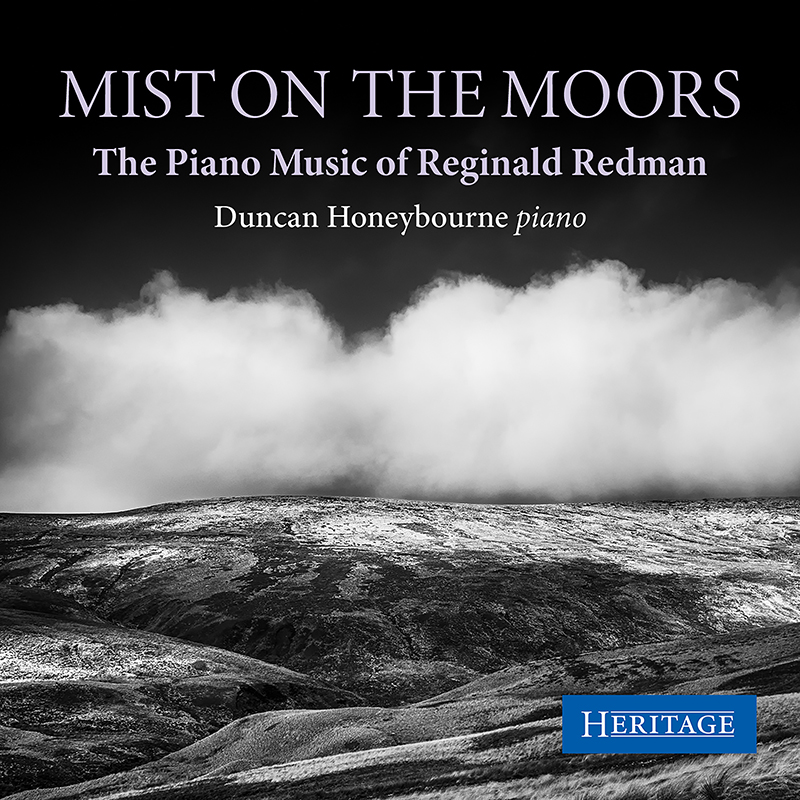
On Record – The Peter Jacobs Anthology: Twentieth Century British Piano Music (Heritage Records)

Peter Jacobs (piano)

Bax Winter Waters (1915)
Baines Preludes nos.1,3 & 6 (1919)
Benjamin Scherzino (1936)
Bliss Suite: Polonaise (1926)
Britten Sonatina Romantica: Moderato (1940)
Hold Tango (1975)
Howells Procession (1920)
Leigh Eclogue (1940)
Mayer Three Pieces from Calcutta-Nagar (1993)
Parry Scherzo in F major (pub 1922)
Quilter Summer Evening (1916)
Scott Egyptian Boat Song (1913)
Searle Vigil: France 1940-1944 (1944)
Seiber Scherzando Capriccioso (1953)
Shaw Roundabouts (1925)
Sterndale Bennett Presto agitato in F# minor Op.24/5
Stevenson A Wheen Tunes for Bairns Tae Spiel (1967)
Warren Second Sonata: Monody (1977)
Woodferne-Finden Kashmiri Song (1903)

Heritage Records HTGCD159 [76’40”]
Producer / Engineer Paul Arden-Taylor

Recorded 25 May 2021 at Wyastone Concert Hall, Wyastone Leys, Monmouth

Reviewed by Richard Whitehouse

What’s the story?

Besides reissuing his already extensive catalogue for other labels, Heritage has also made a number of new recordings by Peter Jacobs, with this album the first in what so far amounts to three volumes of miniatures and standalone pieces as drawn from his extensive repertoire.

Regular readers of Arcana will have come across reviews of the second and third volumes in this series, to which is now added this first instalment that ranges across the extent of Jacobs’ interest in and inclination towards unfamiliar though rewarding music by British composers.

What’s the music like?

Launched by Martin Shaw’s ebullient encore alighting on all two-dozen keys, this anthology continues with the harmonically acerbic second movement (of four) from Arthur Bliss’ early Suite, followed by music of elegant poignancy by Walter Leigh. John Mayer is heard in three from his 18 vignettes evoking sights and sounds of Calcutta (sic), with that by Roger Quilter a minor masterpiece of serenity infused with regret.

Màtyás Seiber contributes music whose liveliness and recalcitrance are entirely characteristic, with something ‘completely different’ in Amy Woodforde-Finden’s appealingly descriptive and once-ubiquitous number. Few are likely to recognize Herbert Howells as composer of a rhythmically combative piece that is (relatively) better known in its orchestral guise, while that from Arthur Benjamin could be no-one else given its playful insouciance. Dedicated ‘‘To my friends of the Fighting French Forces’’, Humphrey Searle’s evocation of war is the more powerful for its overall restraint and could well be considered the single-most impressive piece featured on this collection.

Hubert Parry is heard at his most vivacious and uninhibited; an ideal foil to Cyril Scott who, though he associated Egypt with (his own) past existences, focusses on melody of the most poetic. Much the earliest piece here, that by William Sterndale Bennett is the fifth in a six-movement suite – its deftness and agility in telling contrast to the incremental display of the opening movement from Raymond Warren’s Second Sonata. Three out of a larger sequence of preludes by William Baines constitute an object-lesson in making more out of less, while the first movement of Benjamin Britten’s never-quite-completed Sonata Romantica evinces ingenuity and didacticism in equal measure. Ronald Stevenson often aspired to the lofty or profound in his music, but the four pieces in the suite recorded here are epigrams as laconic as they are engaging. The longest single item here, Arnold Bax’s piece is at once a visceral seascape, revealing psychological study or resourceful passacaglia – the climax of an album that ends in a disarming item by Trevor Hold such as ought to win its composer new friends.

Does it all work?

As an overall sequence, undoubtedly. Jacobs is as inclusive in his interpretative acumen as   in the breadth of his musical sympathies – thereby making for a collection that plays to his strengths as convincingly as it does to those of the 19 composers who are featured herein.

Is it recommended?

Very much so, not least in the knowledge this release was merely the first in an ongoing and most valuable series bringing unfamiliar music to the attention of inquiring listeners. Sound of clarity and definition, along with Jacobs’ detailed booklet notes, are further enhancements.

Listen / Buy

You can explore purchase options at the Heritage Records website. Click on the name to read more about pianist Peter Jacobs

Published post no.2,889 – Saturday 16 May 2026

On Record – Harrington/Jaffe/Shiroishi: Making Colors (AKP Recordings)

Reviewed by Ben Hogwood

What’s the story?

Guitarist Dave Harrington, drummer Max Jaffe and saxophonist Patrick Shiroishi return for a sequel to their first musical meeting Speak, Moment, recorded and released by Los Angeles label AKP Recordings in 2024.

For the sequel, they go deeper, with a record whose A-side is essentially a suite of four distinct movements. On the B-side the three tracks reflect “a growing embrace of the sonic vacuum that electronic music depends on…a heaviness that the trio’s 2024 live record Zebulon! unlocked…and an outstretched and unhurried melodic ambience”.

What’s the music like?

There is a fascinating variety of styles and textures at play on this album, rooted in avant-garde jazz but exploring musical territories of great interest to those who love ambient electronica and upfront improvisation.

The four-movement suite with which the album begins moves between ambience and ear-shredding intensity, carefully controlled and yet with the opportunity for each of the three performers to cut loose, which they do on the extended sweat street 7-QS:ZBN9_. The second half finds Shiroishi assertive on Fractal Hash, while Harrington’s studied guitar leads the long form trackerKeeper under spacious California skies, a compelling track of ambience and yet powered by a curious tension.

The frisson of live performance crackles throughout this compelling trip, and at times it is possible if not too far-fetched to sense the wide open plains of the Mojave desert.

Does it all work?

Yes. The musical chemistry between the three is compelling, as are the sound pictures they create.

Is it recommended?

It is. Making Colors is a natural progression for the trio, whose musical acumen and communication is leading them to greater heights. Making Colors is a fascinating album, and a rewarding one to follow.

Listen / Buy

Published post no.2,867 – Friday 24 April 2026

On Record – Dan Moore: Kielder Water Music (Bandcamp)

Reviewed by Ben Hogwood

What’s the story?

Bristol-based composer Dan Moore made a three-day field trip to Kielder Water in 2022, having completed some extensive work into the history of the site.

This EP reflects on what he found, both from first-hand experience and from sonic material gathered from the site, which is Britain’s biggest man-made reservoir, a controversial redevelopment plan dating back to the 1960s. Dan’s music blends electronics with field recordings, interview samples and more analogue writing for strings.

Throughout the project he was mentored by film composer Dan Jones.

What’s the music like?

Consistently engaging, and pictorial.

As you might expect, the textures are wide open, but Moore approaches his audio descriptions in a number of different ways. The Architect is busy, its riffs playing backwards and forwards over a spacious backdrop, but the speed drops completely as the music pans out for VT-15, a piece of luxurious ambient textures but uncertain harmonies, using field recordings made from the tunnel underneath the valve tower. It has both depth and a glistening surface, richly coloured.

A Shift In The Land is initially uncertain of its direction, wavering uncertainly, until an emphatic string motif weighs in powerfully, dropping anchor over a distorted backing. The lapping of water is the restful backing to Mike, though the string figures above – often beautiful – are wary, too, and when dropping away in pitch leave the listener feeling uncertain.

Does it all work?

It does – and the only regret is the music isn’t longer, for there are some vivid stories here.

Is it recommended?

Yes. Kielder Water is an ambient experience but is tinged with unease, sitting on the edge of reality. Its music has the same appeal as the breathtaking scenes you encounter on a visit, and have an equally mysterious allure, too.

Listen / Buy

Published post no.2,864 – Tuesday 21 April 2026

On Record – MF Robots: III (Part One) (Good People Records)

Reviewed by Ben Hogwood

What’s the story?

MF Robots is proving to be an unstoppable train of feelgood music. The project was begun by Brand New Heavies founder Jan Kincaid together with former band vocalist Dawn Joseph, with the idea of achieving musical liberation without any ties to genre.

Despite that, soul, funk and jazz inevitably feature high in the mix, with the two linking on a series of carefree club-based songs.

What’s the music like?

Summer was invented for bands like MF Robots! Their music takes you into the sunshine with immediate effect, as soon as the opening strains of That’s The Way kick in. This breezy first song is backed up by the call to arms that is Children Of The World, a classic soul number.

Cares are well and truly thrown to the side as the album unfolds, with a style rooted somewhere in the late 1970s of Earth, Wind & Fire but with Brazilian, jazz and soul thrown in to the melting pot in liberal measure. Through The Pain is the pick of these freer numbers, a persuasive sway to its rhythms and heat-soaked keyboards.

The Pressure offers a sultry complement to the quicker tracks, while Glide, a love story, and Hello Sunshine offer up radio-friendly choruses. Lay It Back, meanwhile, harks back to the best, communal numbers of the Brand New Heavies.

Does it all work?

The best indication of the effectiveness of this album is that once it finishes you’ll want to hear it all over again. It may be short, but III delivers!

Is it recommended?

Yes, enthusiastically. Dawn Joseph has a great voice, and the band deliver summery funk in abundance. If you have an acre of sunshine to fill, use MF Robots as your soundtrack!

Listen / Buy

Published post no.2,853 – Friday 10 April 2026

On Record – The Piatti Quartet – Naresh Sohal: String Quartets (Toccata Classics)

Piatti Quartet [Michael Trainor, Emily Holland (violins), Miguel Sobrinho (viola),
Jessie Ann Richardson (cello)]

Naresh Sohal
String Quartet no.1 ‘Chiaroscuro II’ (1976)
String Quartet no. 3 (2008)
String Quartet no.4 (2009)
String Quartet no. 5 (2010)

Toccata Classics TOCC0754 [74’33”]
Producer / Engineer Raphaël Mouterde

Recorded 17-19 April 2024 at St Silas’ Church, Kentish Town, London

Reviewed by Richard Whitehouse

What’s the story?

Toccata Classics continues its exploration of Naresh Sohal (1939-2018) with this release of four of his string quartets, admirably rendered by the Piatti Quartet to make an illuminating overview of Sohal’s musical language from across the greater part of his composing career.

What’s the music like?

Although he attracted most attention in his lifetime for his often expansive orchestral works, Sohal wrote widely for chamber media and not least string quartet. This medium brought his intended amalgam of Indian and European facets into acute focus though, typical of one who from the start approached the Western Tradition head on, there is nothing anecdotal let alone tokenistic about Sohal’s idiom which, as these quartets amply confirm, is unified stylistically and remains consistent as it heads toward the formal and expressive clarity of his final pieces.

At the time of his first quartet, Chiaroscuro II (its predecessor for brass quintet is on Heritage HTGCD122-3 – review to follow), Sohal was exploring an overtly avant-garde idiom evident through diverse and starkly contrasted techniques given focus by climactic cadenzas on cello then first violin – prior to its final evanescing into silence. Likewise in a single movement of 15 minutes, the Third Quartet could not be more different in aesthetic. Initially heard against an insistent drone from second violin and viola, its ideas emerge as demonstrable variants on what went before such that its animated central section then its inward continuation are made part of an indivisible process. This only makes those over-emphatic closing chords the more jarring, as though the work’s ultimate resolution had to be stated rather than just insinuated.

The remaining works, both with three movements and each lasting around 20 minutes, might be thought even closer to tradition yet, as so often with Sohal, matters are never this concrete. Thus the Fourth Quartet’s initial movement alternates its impetuous and ruminative themes to purposeful effect, then its central Moderato balances eloquence and introspection with a poise as makes this the likely highlight of the album; the final Allegro channelling motifs previously heard towards its satisfying denouement. The Fifth Quartet manipulates form and expression even more deftly, the Allegretto’s incisive yet never unyielding rhythmic verve duly matched by the Adagio’s melodic richness or the final Allegro’s contrapuntal dexterity on the way to a decisive close. Both of these pieces abound in quartet writing as unaffected as it is masterful.

Does it all work?

Indeed it does. Whether conceived as a single span or separate movements, the musical range of these pieces is a constant source of fascination. Even more surprising is that the Fourth and Fifth Quartets are only now receiving their first hearing, but it would be hard to imagine more committed advocacy than from the Piatti Quartet, which has taken this music to its collective heart. Hopefully these pieces will now find greater exposure in recital, as the importance of Sohal’s legacy becomes evident and its relevance to the present more widely acknowledged.

Is it recommended?

Indeed it is. Sound is almost ideal, while Utsyo Charraborty’s overview is complemented by a biographical note from Suddhaseel Sen and Janet Swinney. Hopefully the Second Quartet and the brief Awakening (soprano and string quartet) feature on a further release from this source.

Listen / Buy

You can hear excerpts from the album and explore purchase options at the Toccata Classics website. Click on the names to read more about the Piatti Quartet, and Naresh Sohal

Published post no.2,835 – Monday 23 March 2026